Milk Mineral Concentrate Market Trends, Demand, Report, 2026-2034
REPORT DETAILS
Market Statistics
What is Milk Mineral Concentrate Market Size?
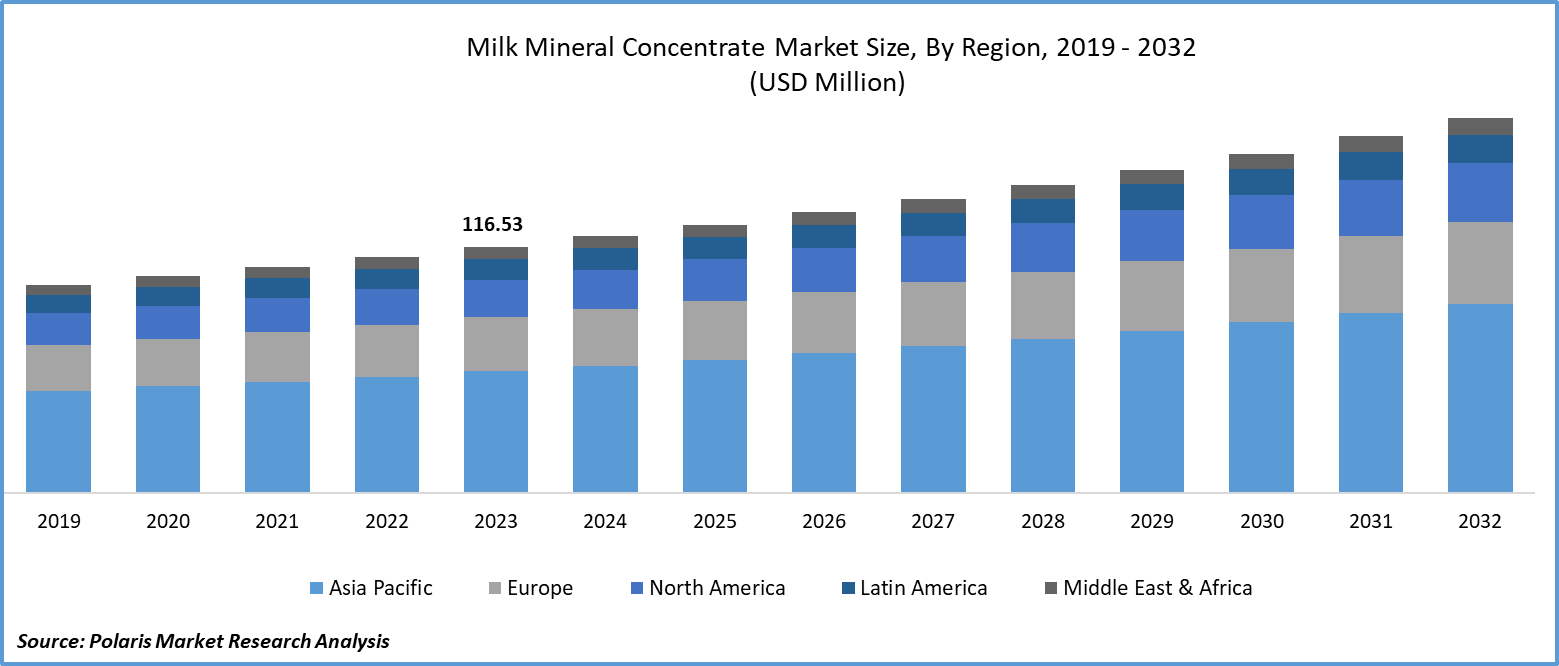
Global milk mineral concentrate market size was valued at USD 127.21 million in 2025 and is anticipated to exhibit the CAGR of 5.0% during the forecast period.
Market Statistics
- 2025 Market Size: USD 127.21 Million
- 2034 Projected Market Size: USD 197.01 Million
- CAGR (2026-2034): 5.0%
- Largest Market: Asia Pacific
Market Overview
The rising consumer awareness about the importance of personal health and the growing utilization of milk mineral concentrates in various food and refreshment items like yogurt and cheddar are driving its market growth. Also, the growing awareness among parents about the potential benefits of milk mineral concentrate for newborns for their growth is likely to bode well for the market. For instance, according to findings, around 140 million babies are born every year worldwide, that is more than 4 births every second.
Additionally, with the increasing focus of leading government authorities on the fortification of food products and infant formulas and the development of effective milk mineral concentrates by leading market companies, the market will grow drastically.
For instance, in November 2023, Arla Foods Ingredients announced the launch of its three newly formulated powder recipes specially developed for senior nutrition. The newly developed products comply with Chinese regulations and are said to be highly enriched with minerals, vitamins, and probiotics.
Source: Polaris Market Research Analysis
To Understand More About this Research: Download Sample Report
Furthermore, the rapid shift in consumer preference toward nutritional foods and supplements fostered the demand for milk mineral concentrates globally. Additionally, the constant growth in research & development activities by key players with the aim to widen the application areas of their milk concentrates and cater to emerging market needs and demands will also propel the market growth positively.
Growth Factors
Rising Population of Bone-Related Disorders and Growing Applications of Milk Minerals in Nutrition & Food Sectors Accelerating Market Growth
The prevalence of various bone-related disorders, such as osteoporosis, osteopenia, and others, especially among the geriatric population worldwide, and the growing number of children and adults suffering from calcium deficiency are fostering the market’s growth. Besides this, increasing applications of milk mineral concentrates to manufacture beverages, baked foods, and many other nutritional products to help people fulfill their calcium needs are further anticipated to boost the global market.
For instance, according to a report by PubMed Central, it is estimated that more than 200 million people worldwide are currently suffering from osteoporosis, and almost 1 in 3 women over the age of 50 years and 1 in 5 men experience some kind of osteoporotic features in their lifetime.
Source: Polaris Market Research Analysis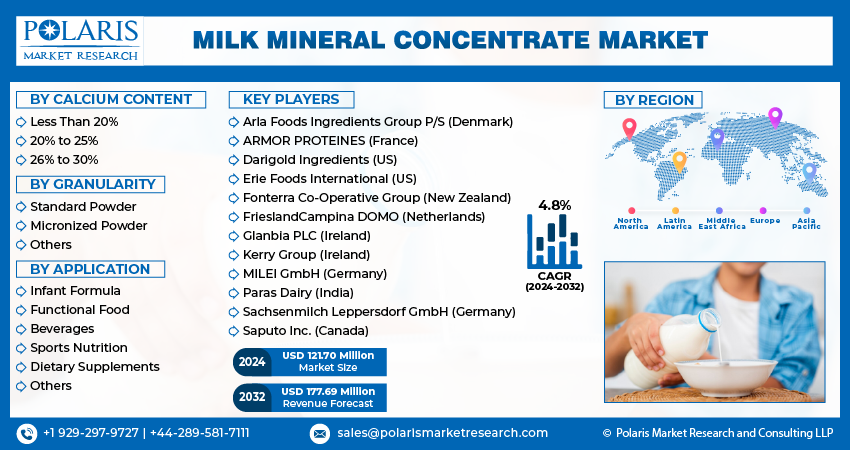
Get Full Segment-Level Forecasts & Insights: Download Sample Report
Restraining Factors
Fluctuation in Raw Material Prices and Inclination Towards Vegan Food Hampering the Market Growth
The rising consumer inclination towards vegan food and plant-based products to meet their nutritional needs and requirements and the lack of certainty in milk prices that results in unpredictability for manufacturers to rely on milk as their primary raw material for MPC products are key factors hindering the milk mineral concentrate market’s growth.
Composition of Milk Mineral Concentrate
| Component | Percentage Range | Role |
| Calcium | 23-28% | Bone formation, muscle function |
| Phosphorus | 13-14% | Energy metabolism, milk production |
| Total Minerals | 76-77.5% | Essential electrolytes (Na, K, Mg) |
| Protein | 1-8% | Minimal carrier |
| Lactose | 1-6% | Residual carbohydrate |
| Moisture | 4-7% | Product stability |
Source: Polaris Market Research Analysis
Key Application
| Use Case | Benefits | Examples |
| Human Nutrition | Natural calcium fortification, better absorption than synthetics | Beverages, supplements |
| Dairy Livestock | Boosts milk yield (0.5L/day), SNF/fat increase, fertility | Daily feed mix for cows |
| Calf Rearing | Growth enhancement, diarrhea reduction via chelated minerals | Milk fortification pre-weaning |
Source: Polaris Market Research Analysis
Report Segmentation
The market is primarily segmented based on calcium content, granularity, application, and region.
| By Calcium Content | By Granularity | By Application | By Region |
|
|
|
|
Source: Polaris Market Research Analysis
To Understand the Scope of this Report: Request Customization
By calcium content Insights
20% to 25% Segment Accounted for the Largest Market Share in 2025
The 20% to 25% segment accounted for the largest milk mineral concentrate market share. Segment’s dominance is attributable to a substantial increase in the number of people with mineral deficiencies and an increase in awareness and knowledge about various mineral deficiency conditions and treatment options. For instance, according to the World Health Organization, over 2 billion people worldwide are estimated to be deficient in key minerals and vitamins that increase the risk of infectious illness.
The 26% to 30% segment is anticipated to emerge as the fastest segment. This growth is due to a continuous increase in demand for fortified food products, nutritional drinks, and infant formulas, coupled with the greater proliferation among leading market companies towards offering milk mineral concentrate with higher calcium content.
By Granularity Insights
Micronized Powder Segment Expected to Hold Significant Market Share over the Forecast Period
The micronized powder segment is expected to hold a substantial market share. Segment’s dominance is due to widespread use in different application areas like milk juices and nutritional beverages along with the ability of micronized powder to offer enhanced biocompatibility and better solubility in liquids that makes them a highly preferred choice to be used in various applications. Additionally, micronized powders have gained huge traction in the last few years, as they provide consumers with a highly convenient and portable form of healthy and nutritional foods because people can easily carry out these solutions.
The standard powder segment led the market. This growth is due to its significant use to fortify various dairy products, biscuits, and other functional foods because of its less solubility and easy handling capabilities requirement, coupled with its longer shelf life and lower transportation costs required as compared to liquid concentrates.
By Application Insights
Dietary Supplements Segment is Expected to Witness Highest Growth in the Market
The dietary supplements segment will grow at a substantial pace. Segment’s growth is due to growing health and wellness trends among consumers and a surge in the number of consumers becoming increasingly aware of nutritional products. Additionally, the rapid increase in the global aging population, who often require a significant amount of nutrition and are more likely to get chronic health issues and various lifestyle-related diseases, further boosts the segment market growth.
For instance, according to the World Health Organization, the global aging population aged 60 years and above is projected to increase from 1 billion in 2020 to approx. 1.4 billion by 2030, when 1 in every 6 people will be aged 60 years or over. By 2050, the world’s population will reach approx. 2.1 billion, adding another 1 billion between the period.
Source: Polaris Market Research Analysis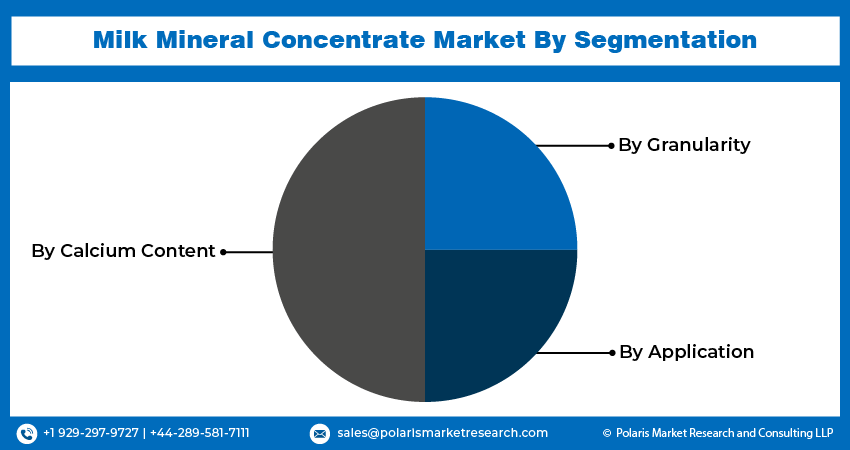
Need Granular Data Across All Market Segments? Request Customization
Regional Insights
Asia Pacific Region Dominated the Global Market in 2025
The Asia Pacific region dominated the global market. The region’s dominance is accelerated by the significant consumption of milk mineral concentrate and the rising prevalence of calcium deficiency disorders across the region, particularly in the geriatric population and infants. For instance, according to a report by UNICEF, about 25% of women in India of reproductive age are estimated to be under-nourished and suffer from low calcium and vitamin D levels that create a higher risk of osteoporosis post-menopause among the population.
The North America region is anticipated to emerge as the fastest growing region in the milk mineral concentrate market development. Region’s growth is driven by an increasing number of people becoming aware of the health benefits of milk mineral concentrates and growing concerns about health issues because of lower intake of essential nutrients and micronutrients. For instance, according to our findings, around 92 percent of the US population is suffering from at least one mineral or vitamin deficiency. More than 50 percent of the population is deficient in Vitamin D in the country.
Source: Polaris Market Research Analysis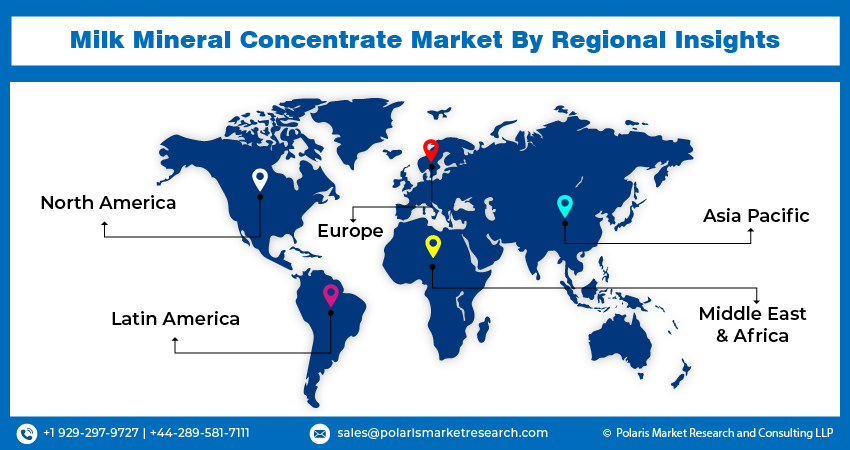
Curious About Regional Market Performance? Request Customization
Key Market Players & Competitive Insights
Development of Organic Products and Adopting Sustainable Practices to Drive Competition
The market is highly fragmented in nature with the presence of various global market players. Also, companies are competing on factors like adopting sustainable production practices, developing organic products, making their supply chain efficient, and adopting various effective marketing strategies, that led to increased product demand globally. For instance, in June 2023, dsm-firmenich, introduced its latest addition to highly-valued range of Maxilact lactase enzymes named ‘Maxilact Next’. It is said to be around 25% faster than other for milk processing.
Some of the major players operating in the global market include:
- Arla Foods Ingredients Group P/S (Denmark)
- ARMOR PROTEINES (France)
- Darigold Ingredients (US)
- Erie Foods International (US)
- Fonterra Co-Operative Group (New Zealand)
- FrieslandCampina DOMO (Netherlands)
- Glanbia PLC (Ireland)
- Kerry Group (Ireland)
- MILEI GmbH (Germany)
- Paras Dairy (India)
- Sachsenmilch Leppersdorf GmbH (Germany)
- Saputo Inc. (Canada)
Recent Developments in the Industry
- June 2022: Sachsenmilch Leppersdorf GmbH signed an agreement with FrieslandCampina DOMO to acquire five dairy brands and three production facilities, expanding its product portfolio and strengthening its manufacturing footprint in the European dairy market.
- In November 2022, Arla Foods partnered with the First Milk to produce whey protein “Nutrilac FO-7875. The newly launched product can be used in wide range of applications
- In April 2023, Valio, announced about the launch of its new infant-grade skimmed milk powder. The product offers IMF (infant milk formula) manufacturers a more effective and straightforward production process, and ensures highest microbiological quality.
Report Coverage
The milk mineral concentrate market report emphasizes on key regions across the globe to provide better understanding of the product to the users. Also, the report provides market insights into recent developments, trends and analyzes the technologies that are gaining traction around the globe. Furthermore, the report covers in-depth qualitative analysis pertaining to various paradigm shifts associated with the transformation of these solutions.
The report provides detailed analysis of the market while focusing on various key aspects such as competitive analysis, calcium content, granularity, application, and their futuristic growth opportunities.
Milk Mineral Concentrate Market Report Scope
| Report Attributes | Details |
| Market size in 2025 | USD 127.21 million |
| Market size in 2026 | USD 133.09 million |
| Revenue forecast in 2034 | USD 197.01 million |
| CAGR | 5.0% from 2026 – 2034 |
| Base year | 2025 |
| Historical data | 2021 – 2024 |
| Forecast period | 2026 – 2034 |
| Quantitative units | Revenue in USD million and CAGR from 2026 to 2034 |
| Segments covered |
|
| Regional scope |
|
| Competitive Landscape |
|
| Report Format |
|
| Customization | Report customization as per your requirements with respect to countries, region, and segmentation. |
Source: Polaris Market Research Analysis
Milk Mineral Concentrate Market FAQ's
The Milk Mineral Concentrate Market report covering key segments are calcium content, granularity, application, and region.
Milk Mineral Concentrate Market Size Worth $197.01 Million By 2034
Milk mineral concentrate market exhibiting the CAGR of 5.0% during the forecast period.
Asia Pacific is leading the global market
key driving factors in Milk Mineral Concentrate Market are Rising population of bone-related disorders
Download Sample Report of Milk Mineral Concentrate Market
Please fill out the form to request a customized copy of the research report.


