
Monitor Arm Market Size, Share Analysis Report, 2026-2034
REPORT DETAILS
Market Statistics
What is Monitor Arm Market Size?
The global monitor arm market size and share was valued at USD 1.57 billion in 2025 and is expected to grow at a CAGR of 3.2% during the forecast period. The growth is driven by rising internet penetration, rising focus on employee comfort, and technological advancement.
Market Statistics
- 2025 Market Size: USD 1.57 Billion
- 2034 Projected Market Size: USD 2.08 Billion
- CAGR (2026-2034): 3.2%
- Largest Market: North America
A monitor arm is a supportive bracket or arm designed to hold computer displays, notebooks, and other types of display screens. Rising emphasis on employee comfort & productivity is driving both organizations & individuals to adopt monitor arms. These devices offer flexible options, allowing users to adjust the viewing angle & height of their screens to their preference. This flexibility helps reduce strain on the body, promotes better posture, and enhances the overall comfort and productivity of the work environment.
The monitor arm market study is a compilation of first-hand data, quantitative and qualitative assessments by industry experts, and inputs from the most relevant stakeholders in the value chain. It uses a number of analytical tools to study and assess the data of key industry players and their monitor arm market share. Analytical tools used to prepare the report include SWOT analysis, Porter’s Five Forces analysis, feasibility study, and investment return analysis, amongst others.
Source: Polaris Market Research Analysis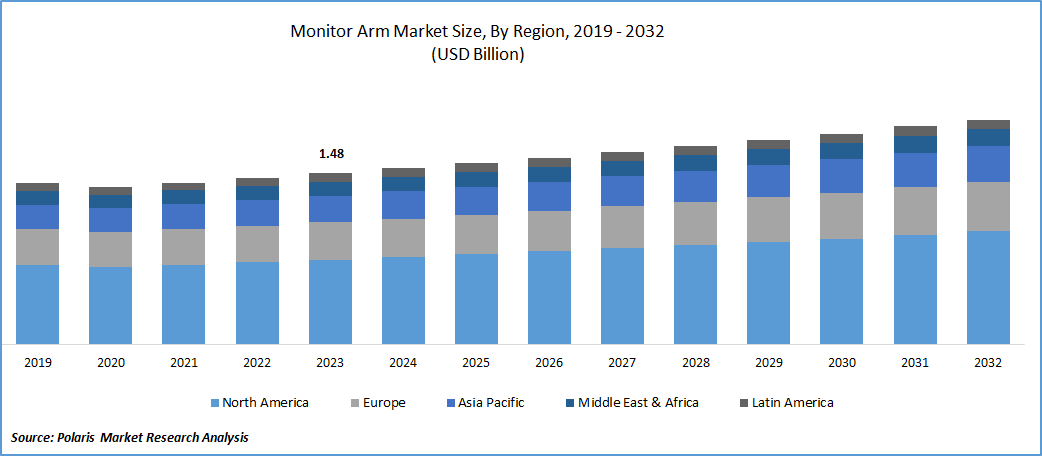
To Understand More About this Research: Download Sample Report
Growth is influenced by the increasing number of small businesses and the rising number of internet users. The proliferation of Internet services across various devices, such as desktops, laptops, and tablets, has led to a substantial increase in the global number of Internet users. According to the International Telecommunication Union (ITU), as of 2022, there were 5.3 billion internet users, accounting for approximately 66% of the global population.
Simultaneously, the business landscape has seen a surge in the number of small businesses. According to the Chamber of Commerce, it is estimated that there will be 17 million small businesses by the end of 2022. These small businesses play a crucial role in the economy and rely on technologically advanced infrastructure to manage their workload efficiently and enhance productivity. As these businesses continue to grow and adapt to the digital age, the demand for display monitors and computers, supported by monitor arms for optimal positioning, becomes essential for creating ergonomic workspaces, improving efficiency, and boosting overall productivity.
Additionally, the TV industry is witnessing a trend towards the incorporation of advanced technologies, such as 4K and 8K resolutions. These technologies enhance the visual experience by offering higher resolutions and sharper images. The increasing consumer interest in high-definition content and immersive viewing experiences is driving TV manufacturers to adopt these advanced technologies, contributing to market growth. Furthermore, the rising adoption of curved TVs is another factor fueling market growth. Curved TVs are designed to provide a more immersive and panoramic viewing experience by wrapping the screen around the viewer's field of vision. This innovation has gained popularity among consumers seeking a more engaging and cinematic experience in their home entertainment setups.
Source: Polaris Market Research Analysis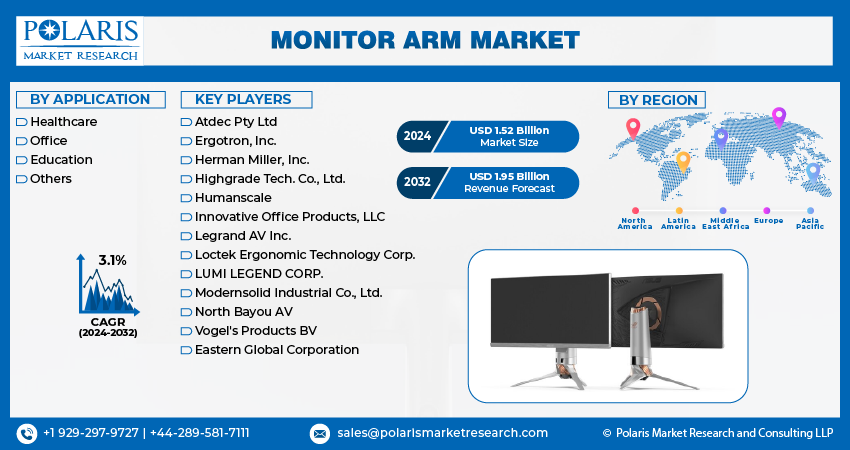
Get Full Segment-Level Forecasts & Insights: Download Sample Report
Industry Dynamics
Growth Drivers
Gaming and Entertainment Industry Growth
The increasing popularity of computer accessories for gaming is contributing to market growth by allowing manufacturers to expand their product offerings and cater to diverse consumer demands. For instance, LUMI Legend Corp designed a monitor arm to support both single-display & multiple-display monitors. In workstations across commercial and government spaces, single-screen monitor arms are preferred. These arms provide flexibility and customization for individual workstations, allowing users to optimize their setup according to their needs. On the other hand, in private and government firms, multi-display monitors are commonly used to enhance employee productivity.
Key Monitor Arm Trends
| Trend | Description | Key Drivers | Examples from Practice |
| Full ergonomic adjustability | Arms with height, tilt (up to 90°), swivel (360°), and rotation (up to 180°) enable optimal screen positioning at eye level (top line 15° below eyes, 16-29" distance). | Reduce neck/shoulder strain from static postures; comply with DSE directives for display screen work. | BenQ BSH/BDH arms: smooth adjustments for long hours, minimizing eye/neck fatigue in multitasker setups. |
| Multi-monitor configurations | Dual/triple arms supporting 20-44 lbs total, with independent articulation and cable management. | Hybrid work/multitasking demands; 40% desk clutter reduction via integrated routing. | Ergotron LX/MSI MPG MT201DR V2: stack dual monitors up to 44 lbs for gamers/professionals. |
| Counterbalanced mechanisms | Gas-spring or spring arms tested for 10,000+ cycles; 4x load capacity for stability. | Long-term durability; prevent sagging/drop risks in dynamic adjustments. | Ergotron arms: fluid motion without drifting, supporting relaxed shoulders/elbows. |
| Cable-integrated minimalism | Sleek designs with hidden channels reduce visual clutter; matte/VESA-compatible clamps. | Modern aesthetics; productivity via organized desks per OSHA workspace recs. | Minimalist arms cut clutter 40%; USB-C passthrough emerging. |
| Sit-stand compatibility | Height range 25-30" for transitions; stable 5-prong bases prevent tipping. | PDSA human factors for fatigue reduction; alternate postures every 30 min. | Haworth desk-mount arms: single/dual configs for sit-stand, fitting elbow height. |
| Sustainable/smart integration | Recycled aluminum; AI posture sensors, wireless charging in next-gen. | Wellness initiatives; EU-OSHA ergonomics for office MSD prevention. | Eco-materials prioritized; AR/HMD alignment for precise mounting. |
Source: Polaris Market Research Analysis
Report Segmentation
The market is primarily segmented based on application, and region.
| By Application | By Region |
|
|
Source: Polaris Market Research Analysis
To Understand the Scope of this Report: Request Customization
By Application Analysis
Office segment accounted for the largest market share in 2025
The office segment accounted for the largest share. The availability of features like single-screen monitor arms and multiscreen monitor arms is a key factor. Single-screen monitor arms provide flexibility and customization for individual workstations, allowing employees to position their monitors at optimal viewing angles. This adaptability reduces strain and enhances comfort, contributing to improved productivity.
Multiscreen monitor arms are particularly beneficial in office environments where employees need to multitask and work with multiple applications simultaneously. This capability allows for efficient workflow management, as users can seamlessly switch between tasks on different screens. The advanced technology incorporated into monitor arms, facilitating smooth and easy movement, eliminates the need for additional effort in adjusting monitor positions, further enhancing convenience for workers.
As start-ups emerge and expand, there is a parallel rise in the demand for computers and laptops to support their operations. This, in turn, drives the demand for ergonomic accessories like monitor arms, as companies prioritize creating comfortable and efficient workspaces for their employees. The combination of technological advancements and the surge in the number of start-ups creates a conducive environment for the growth of the monitor arm market, particularly in the office segment.
The healthcare segment will grow rapidly. In healthcare settings, quick and effortless access to computers is crucial for tasks such as recording patient information and viewing medical data from multiple angles. Monitor arms provide the flexibility to position screens at optimal angles, allowing medical professionals to access information conveniently and ensuring efficient patient care.
Moreover, monitor arms designed for healthcare applications often incorporate specific features to address the unique needs of the industry. For example, some monitor arms come with designs that offer cable management within the arm itself. This feature helps maintain an organized appearance on workstations by keeping cables neatly routed, reducing clutter, and enhancing the overall workspace environment. Importantly, it also reduces the chances of cable entanglement during critical tasks, contributing to a safer and more efficient working environment in healthcare settings.
The organized and efficient workstations facilitated by monitor arms translate into better performance for medical teams in hospitals and other healthcare setups. With easy access to computer systems, reduced cable clutter, and the flexibility to view screens from multiple angles, medical professionals can focus on delivering high-quality patient care. This underscores the role of monitor arms in enhancing the productivity and performance of Healthcare professionals, making them valuable tools in the evolving landscape of healthcare technology.
Source: Polaris Market Research Analysis
Need Granular Data Across All Market Segments? Request Customization
Regional Insights
North America dominated the global market in 2025
North America dominated the global market. Advanced infrastructure in the educational and healthcare sectors further contributes to the region’s dominance. In educational institutions and healthcare settings, where technology is integral to daily operations, monitor arms offer benefits such as easy computer access and improved workspace organization. The adaptability of monitor arms to different settings aligns with the evolving technological needs of these sectors. Moreover, the increasing adoption of technology in the hospitality sector will drive its adoption. In hospitality settings, monitor arms contribute to creating modern and efficient workstations, aligning with the industry's emphasis on technological advancements for enhanced guest experiences and operational efficiency.
The Asia Pacific will grow at a substantial pace. The rising adoption of computers, particularly in household settings, is a major contributor to the growth of the region. This trend is driven by various purposes, including education, gaming, and communication. As more households acquire computers for these diverse uses, there is a parallel increase in the demand for accessories like monitor arms that enhance the overall computing experience. In Japan, a technologically advanced country, the integration of computers into various aspects of daily life has become commonplace. The demand for monitor arms is fueled by the need for ergonomic solutions that complement the usage of computers for educational, gaming, and communication purposes.
Source: Polaris Market Research Analysis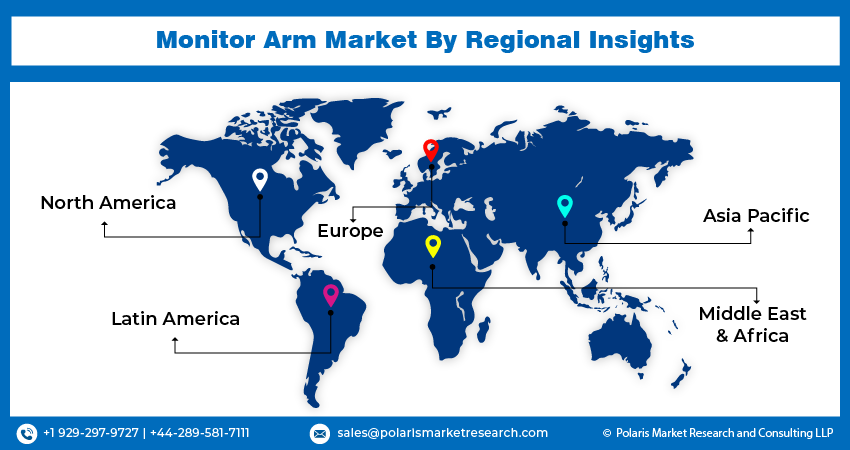
Curious About Regional Market Performance? Request Customization
Key Market Players & Competitive Insights
Companies engage in regional expansion, mergers, acquisitions, and strategic collaborations as part of their efforts to grow and strengthen their businesses both globally and within specific regions. Each of these strategic actions serves different purposes and can contribute to the overall success and competitiveness of a company.
Some of the major players operating in the global market include:
- Atdec Pty Ltd
- Ergotron, Inc.
- Herman Miller, Inc.
- Highgrade Tech. Co., Ltd.
- Humanscale
- Innovative Office Products, LLC
- Legrand AV Inc.
- Loctek Ergonomic Technology Corp.
- LUMI LEGEND CORP.
- Modernsolid Industrial Co., Ltd.
- North Bayou AV
- Vogel's Products BV
- Eastern Global Corporation
Recent Developments
- In December 2025, BenQ launched its BSH and BDH monitor arms in India, expanding its professional accessories lineup. The ergonomic arms supported long work hours with flexible adjustments, gas-spring durability, single and dual monitor options, and improved desk organization.
- In May 2023, Arm Limited unveiled its newest advancement, the Arm Total Compute Solutions 2023 (TCS23), signaling a transformative era in mobile computing. TCS23 stands as the latest premium smartphone solution from the company, featuring a comprehensive suite of state-of-the-art intellectual property (IP) meticulously designed and optimized for specific tasks. This innovation facilitates smooth integration throughout the entire system, marking a significant leap forward in mobile computing technology.
Monitor Arm Market Report Scope
| Report Attributes | Details |
| Market size in 2025 | USD 1.57 billion |
| Market size in 2026 | USD 1.61 billion |
| Revenue Forecast in 2034 | USD 2.08 billion |
| CAGR | 3.2% from 2026 – 2034 |
| Base year | 2025 |
| Historical data | 2021 – 2024 |
| Forecast period | 2026 – 2034 |
| Quantitative units | Revenue in USD million/billion and CAGR from 2026 to 2034 |
| Segments Covered | By Application, By Region |
| Regional scope | North America, Europe, Asia Pacific, Latin America; Middle East & Africa |
| Customization | Report customization as per your requirements with respect to countries, regions, and segmentation. |
Source: Polaris Market Research Analysis
Monitor Arm Market FAQ's
Application, and region are the key segments in the Monitor Arm Market.
The global monitor arm market size is expected to reach USD 2.08 billion by 2034
The global monitor arm market is expected to grow at a CAGR of 3.2% during the forecast period.
North America regions is leading the global market.
Gaming and Entertainment Industry Growth are the key driving factors in Monitor Arm Market.
Download Sample Report of Monitor Arm Market Size, Share Analysis Report, 2026-2034
Please fill out the form to request a customized copy of the research report.


