
Multi-access Edge Computing Market Size, Trends Report, 2026-2034
REPORT DETAILS
Market Statistics
What is Multi-Access Edge Computing Market Size?
Multi-Access Edge Computing Market size was valued at USD 7.63 billion in 2025 and is anticipated to exhibit the CAGR of 49.3% during the forecast period. The growth of the industry is driven by rise in usage of IoT, ability to reduce the latency, and technological advancement.
Market Statistics
- 2025 Market Size: USD 7.63 Billion
- 2034 Projected Market Size: USD 280.59 Billion
- CAGR (2026-2034): 49.30%
- Largest Market: North America
Market Introduction
In the fields of computing and telecommunication, multi-access edge computing is a novel idea. It all comes down to carefully placing computational resources such as storage and processing power, near users and devices at the network's edge. By moving computing closer to the location of data generation and utilization, the goal is to overcome the drawbacks of centralized data processing. Reducing latency, the interval of time between starting an action and getting a response is the main objective of MEC. MEC is especially well-suited for time-sensitive applications and services like virtual reality, online gaming, and driverless cars since it lowers latency, which improves responsiveness of apps and services.
The anticipated growth of the multi-access edge computing market is attributed to the escalating adoption of Over the Top (OTT) media streaming services and the increasing desire for personalized content. The expanding user base opting for the OTT video delivery model is expected to incentivize enhancements in the infrastructure of mobile networks and telecom companies. The deployment of Multi-access Edge Computing (MEC) architecture, bringing backend functions in proximity to user networks, is foreseen to assist Multichannel Video Programming Distributors (MVPDs) in meeting consumer expectations.
Source: Polaris Market Research Analysis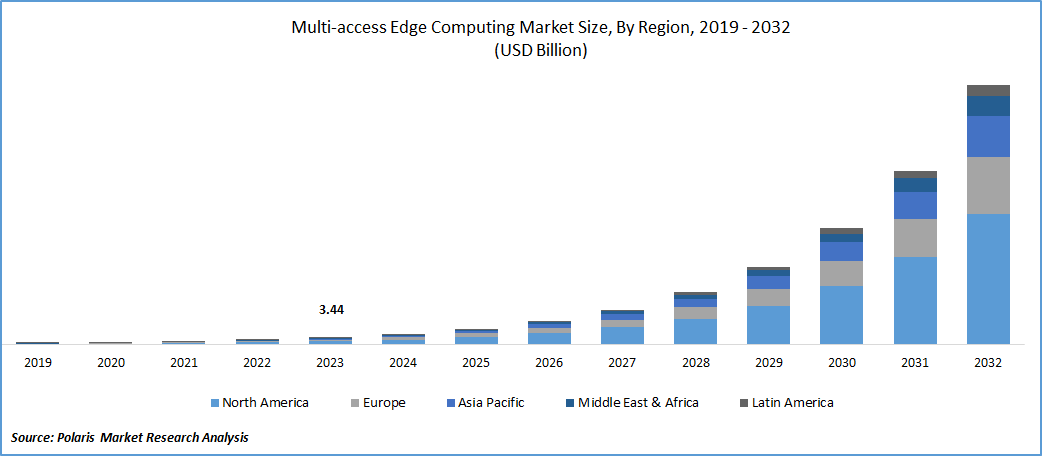
To Understand More About this Research: Download Sample Report
For instance, in November 2023, Rakuten Mobile, Inc. has revealed that its exploration and development initiative focused on cutting-edge edge cloud technologies for future-generation communications has been chosen by Japan's National Institute of Information and Communications Technology (NICT) as part of their strategic program for the implementation and overseas development of innovative information and communications technology under the Beyond 5G (6G) Fund for FY2023.
The multi-access edge computing market is undergoing dynamic changes due to changing business demands, technical improvements, and the connectivity landscape. While there are many opportunities, realizing the full potential of MEC in transforming the future of digital infrastructure requires tackling issues with resource management, security, and interoperability. The future of multi-access edge computing will be significantly shaped by continued innovation and cooperation amongst industry players as the market continues to develop.
The market research report offers an in-depth analysis of the industry to support informed decision-making. It offers a meticulous breakdown of various market niches and keeps readers updated on the latest industry developments. Along with tracking the Multi-access Edge Computing Market on the basis of SWOT and Porter’s Five Forces models, the research report includes graphs, tables, charts, and other pictorial representations to help readers understand the key insights and important data easily.
Market Trends
Industry Growth Drivers
Latency reduction is projected to spur the product demand.
The pivotal force driving the advancement and acceptance of Multi-Access Edge Computing (MEC) is the widespread deployment of 5G networks. This transformative alliance between 5G and MEC, characterized by remarkably low latency and rapid data transfer speeds, has revolutionized the functioning of industries, data processing methods, and the delivery of applications. MEC harnesses the exceptional features of 5G to enable responsiveness and real-time interactions, marking a significant shift in how various sectors operate.
The integration of 5G capabilities by MEC has profound implications, particularly in reducing data transfer delays to milliseconds. This development has brought about a revolutionary impact on applications such as augmented reality, virtual reality, and autonomous vehicles. Industries that rely on time-sensitive applications experience heightened efficiency, and end users benefit from seamless and immersive content experiences.
Increased adoption of IoT is expected to drive multi-access edge computing market growth.
The multi-access edge computing market has witnessed expansion, driven by the widespread adoption of the Internet of Things (IoT). The pervasive presence of IoT devices across diverse industries and applications has generated a substantial demand for instantaneous, low-latency data processing. MEC addresses this demand by positioning processing capacity in close proximity to the IoT devices at the network's edge.
IoT is characterized by a vast array of networked sensors and devices, generating substantial volumes of data that require immediate processing. MEC plays a pivotal role in analyzing this data at the network edge, thereby minimizing latency and facilitating real-time analytics. This infrastructure provided by MEC is crucial for meeting the requirements of numerous IoT applications, including but not limited to driverless cars, smart cities, and industrial automation, where real-time decision-making is imperative.
Industry Challenges
Security and privacy in edge computing is likely to impede the market multi-access edge computing growth opportunities.
Security and privacy in edge computing stand as a prominent factor hindering the growth of the multi-access edge computing market. The decentralized nature of edge computing poses fresh challenges regarding security and privacy. Sustaining data security at the edge and guaranteeing adherence to regulations remain persistent issues demanding holistic solutions.
However, navigating resource management in a distributed edge environment can prove demanding. Striking a balance with workloads, fine-tuning resource allocation, and ensuring the optimal use of computing resources are pivotal aspects that demand meticulous consideration. Thereby, hindering the growth of multi-access edge computing market.
Key Trends in Multi-access Edge Computing
| Trend | Description | Technical / application focus | Examples from Practice |
| Tight integration with 5G core and network slicing | MEC platforms and applications are being integrated with 5G Core and network slicing, including shared or per-slice MEC platform managers and unified NFV-MANO orchestration. | Enabling slice-specific latency, bandwidth, and isolation for URLLC, eMBB, and mMTC services, with MEC resources orchestrated per slice via a single, ETSI NFV-compliant orchestrator. | A scalable MEC-enabled slicing architecture shows MEC platform (MEP/MEPM) deployed per slice or shared across slices and managed by a unified NFV-MANO orchestrator to remove duplicated control functions. |
| MEC as foundation for XR, cloud gaming, and real-time media | MEC nodes co-located with UPF at the RAN or aggregation layer host cloud gaming, XR (AR/VR/MR), and multi-scene live streaming to meet very low latency and high bandwidth requirements. | Offloading rendering and encoding of XR and gaming workloads to edge servers to provide <20 ms motion-to-photon latency and high-resolution streams over 5G/Wi‑Fi. | ETSI MEC 047 describes XR services using MEC+UPF co-deployment to deliver high-definition interactive content with very low latency; XR surveys outline deployment scenarios with MEC near base stations or transmission nodes. |
| Federated, multi-domain and multi-tenant MEC | ETSI Phase 4 MEC work focuses on MEC federation, multi-domain, and multi-tenancy, allowing collaboration among operators and cloud providers and support for application slicing. | Creating federated edge-clouds where applications discover and consume services across multiple administrative domains while preserving tenant isolation and SLAs. | ETSI notes Phase 4 activities around MEC federation and multi-tenancy slicing; end-to-end application slicing frameworks propose multi-tenant MEC architectures spanning several providers. |
| MEC for Industry 4.0 and Industrial IoT | MEC is deployed in smart factories, campuses, and industrial sites to process sensor and control data locally, supporting high reliability and ultra-low latency Industrial IoT. | Running edge analytics, machine vision, and closed-loop control (e.g., robotics, AGVs, predictive maintenance) close to machines to meet stringent latency and reliability requirements. | Reviews on MEC advances highlight industrial automation as a primary vertical; Industrial IoT studies describe 5G+edge for real-time control and time-sensitive networking in factories. Edge computing case studies show preventive maintenance and machine-vision workloads at the industrial edge. |
| Edge support for V2X and automotive | MEC nodes in the RAN and along roadsides provide low-latency support for V2X use cases such as cooperative collision avoidance, HD mapping, and platooning. | Hosting V2X applications and local breakout at the edge so vehicles exchange information within milliseconds for safety-critical decisions. | ETSI MEC documentation lists V2X as a key MEC use case; MEC-in-5G white paper shows 5G slicing plus flexible UPF placement enabling low-latency V2X services at the edge. |
| AI/ML at the edge and edge–cloud continuum | MEC platforms increasingly host AI/ML inference close to data sources, while training and heavier analytics occur in centralized or federated clouds. | Deploying AI models for video analytics, anomaly detection, and optimization (e.g., traffic control, industrial quality inspection) as microservices on MEC nodes, coordinated with central clouds. | Surveys on edge–AI–IoT continuum report vertical use cases where AI inference runs at MEC for latency and privacy, while cloud handles training; industry analyses predict most enterprise data will be processed at the network edge by mid‑2020s. |
| Standardized MEC APIs and open ecosystems | ETSI MEC defines standardized service APIs (e.g., Radio Network Information Service, Location Service, Bandwidth Management) to let third-party apps access network context at the edge. | Enabling developers and verticals to build context-aware applications (e.g., location-based XR, QoS-aware video) that dynamically use edge resources and network information. | ETSI describes MEC as an ecosystem where operators expose RAN-edge resources and MEC service APIs to authorized third parties for rapid deployment of innovative applications. |
Source: Polaris Market Research Analysis
Source: Polaris Market Research Analysis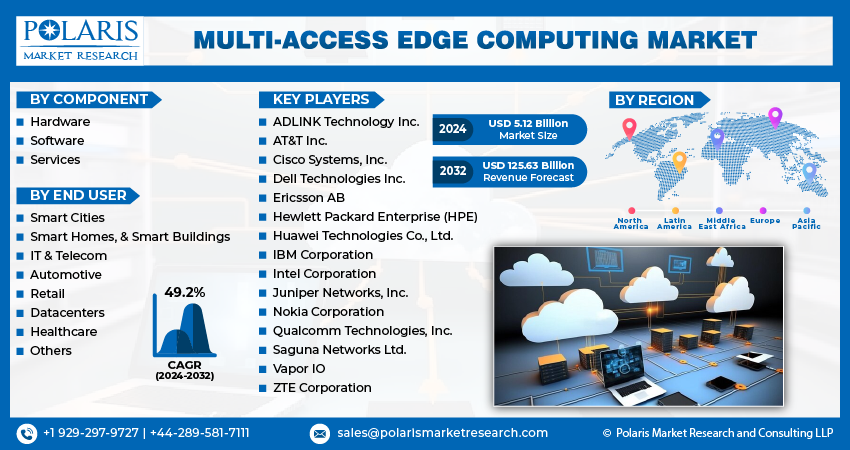
Get Full Segment-Level Forecasts & Insights: Download Sample Report
Report Segmentation
The market is primarily segmented based on component, end user and region.
| By Component | By End User | By Region |
|
|
|
Source: Polaris Market Research Analysis
To Understand the Scope of this Report: Request Customization
By Component Analysis
Services segment is expected to witness highest growth during forecast period
The services segment is projected to grow at a CAGR during the projected period in the multi-access edge computing market. The market for multi-access edge computing (MEC) has seen a notable growth in the expansion of its service segment. With the increasing demand from many industries for high-performance and low-latency applications, the service-oriented aspect of MEC has emerged as a key area for growth and innovation. This increase has been largely driven by the expansion of 5G networks, since MEC brings compute closer to the network edge, complementing 5G infrastructure. This close proximity improves service delivery and opens up new avenues for improved customer experiences and applications. Service providers are offering a variety of applications, from industrial IoT solutions to augmented reality (AR) and virtual reality (VR), by using the MEC paradigm.
By End-User Analysis
IT & Telecom segment is expected to dominate the multi-access edge computing market during forecast period
In 2025, the multi-access edge computing market share was predominantly influenced by IT & telecom sector, commanding a significant market share. The industry's transition to 5G networks makes MEC integration essential for maximizing network efficiency and providing improved services. By lowering latency and enabling real-time applications, the convergence of telecom and IT in MEC enables effective data processing at the network edge. This combination creates opportunities for creative solutions, such as low-latency communication services and analytics based on the edge.
To take advantage of the need for fast, low-latency connectivity across a range of industries, such as smart cities, driverless cars, and industrial automation, telecom operators are making calculated investments in MEC infrastructure. The expansion of the IT & Telecom sector within the multi-access edge computing market represents a significant advancement in networking capabilities, promoting a dynamic ecosystem that provides enterprises and end users with unmatched computing and connectivity capabilities.
Source: Polaris Market Research Analysis
Need Granular Data Across All Market Segments? Request Customization
Regional Insights
North America region dominated the global multi-access edge computing market in 2025
North America dominated the global multi-access edge computing market in 2025 and is expected to continue to do so. The dominance of the region stems from a rising demand for applications dependent on extremely low latency and real-time data processing, especially in sectors like autonomous vehicles, smart cities, and augmented reality (AR)/virtual reality (VR), thereby bolstering sustained market growth.
Simultaneously, the Asia Pacific region is positioned for significant expansion in the multi-access edge computing market over the forecast period. This upswing is driven by the widespread adoption of 5G technology and the swift proliferation of Internet of Things (IoT) devices and applications, serving as pivotal factors propelling market growth in the region.
Source: Polaris Market Research Analysis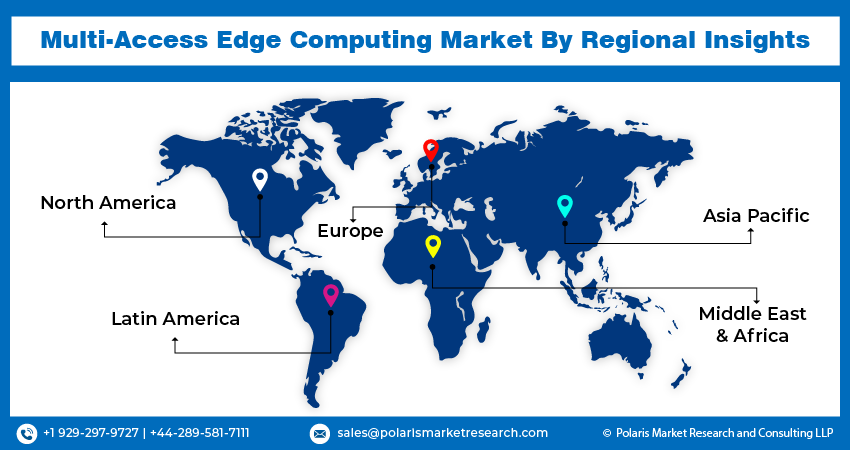
Curious About Regional Market Performance? Request Customization
Key Market Players & Competitive Insights
The multi-access edge computing market is fragmented and is anticipated to witness competition due to several players' presence. Major service providers in the market are constantly upgrading their technologies to stay ahead of the competition and to ensure efficiency, integrity, and safety. These players focus on partnership, product upgrades, and collaboration to gain a competitive edge over their peers and capture a significant market share.
Some of the major players operating in the global market include:
- ADLINK Technology Inc.
- AT&T Inc.
- Cisco Systems, Inc.
- Dell Technologies Inc.
- Ericsson AB
- Hewlett Packard Enterprise (HPE)
- Huawei Technologies Co., Ltd.
- IBM Corporation
- Intel Corporation
- Juniper Networks, Inc.
- Nokia Corporation
- Qualcomm Technologies, Inc.
- Saguna Networks Ltd.
- Vapor IO
- ZTE Corporation
Recent Developments
- June 2025, SoftBank expanded its SRv6 Mobile User Plane field trial to its commercial 4G network in Japan, demonstrating improved low-latency MEC and network slicing performance across 4G/5G with over 10 ms latency reduction during live drive tests.
- March 2025, Qualcomm acquired Edge Impulse to enhance its edge AI and IoT capabilities, integrating Edge Impulse’s no-code machine learning platform with Qualcomm hardware to accelerate deployment and boost developer productivity across multiple industries.
- January 2024, Mangata Networks, a worldwide enterprise specializing in satellite-based connectivity and smart edge computing solutions, has forged a partnership with Microsoft. The collaboration is focused on the joint development of an artificial intelligence (AI)-enabled edge cloud product seamlessly connected through satellite technology.
- February 2023, Infosys unveiled the introduction of Private 5G-as-a-Service, aiming to enhance business value for its global enterprise clients.
Report Coverage
The multi-access edge computing market report emphasizes on key regions across the globe to provide better understanding of the product to the users. Also, the report provides market insights into recent developments, trends and analyzes the technologies that are gaining traction around the globe. Furthermore, the report covers in-depth qualitative analysis pertaining to various paradigm shifts associated with the transformation of these solutions.
The report provides detailed analysis of the market while focusing on various key aspects such as competitive analysis, component, end-user, and their futuristic growth opportunities.
Market Report Scope
| Report Attributes | Details |
| Market size in 2025 | USD 7.63 billion |
| Market size in 2026 | USD 11.37 billion |
| Revenue forecast in 2034 | USD 280.59 billion |
| CAGR | 49.3% from 2026 – 2034 |
| Base year | 2025 |
| Historical data | 2021 – 2024 |
| Forecast period | 2026 – 2034 |
| Quantitative units | Revenue in USD billion and CAGR from 2026 to 2034 |
| Segments covered |
|
| Regional scope |
|
| Competitive Landscape |
|
| Report Format |
|
| Customization | Report customization as per your requirements with respect to countries, region and segmentation. |
Source: Polaris Market Research Analysis
multi access edge computing market FAQ's
The Multi-access Edge Computing Market report covering key segments are component, end user and region.
The global multi-access edge computing market size is expected to reach USD 280.59 billion by 2034
Multi-Access Edge Computing Market CAGR of 49.3% during the forecast period.
North America regions is leading the global market.
Latency reduction is projected to spur the product demand are the key driving factors in Multi-access Edge Computing Market.
Download Sample Report of multi access edge computing market
Please fill out the form to request a customized copy of the research report.


