
Multi-factor Authentication Market Size, Share Global Analysis Report, 2026-2034
REPORT DETAILS
Market Statistics
What is Multi-Factor Authentication Market Size?
The global multi-factor authentication market was valued at USD 21.46 billion in 2025 and is expected to grow at a CAGR of 14.0% during the forecast period. The growth is driven by rising sophistication of cyber threats, increase in investment in cloud technologies, and technological advancement.
Market Statistics
- 2025 Market Size: USD 21.46 Billion
- 2034 Projected Market Size: USD 69.79 Billion
- CAGR (2026-2034): 14.0%
- Largest Market: Asia Pacific
Multi-factor authentication (MFA) enhances security by adding extra layers of authentication to verify user identities and safeguard online transactions. One of the significant trends contributing to market growth is the rise in cyberattacks and data breaches experienced by organizations. This alarming trend, coupled with stricter regulations aimed at protecting sensitive data, is expected to drive the growth of the market.
Source: Polaris Market Research Analysis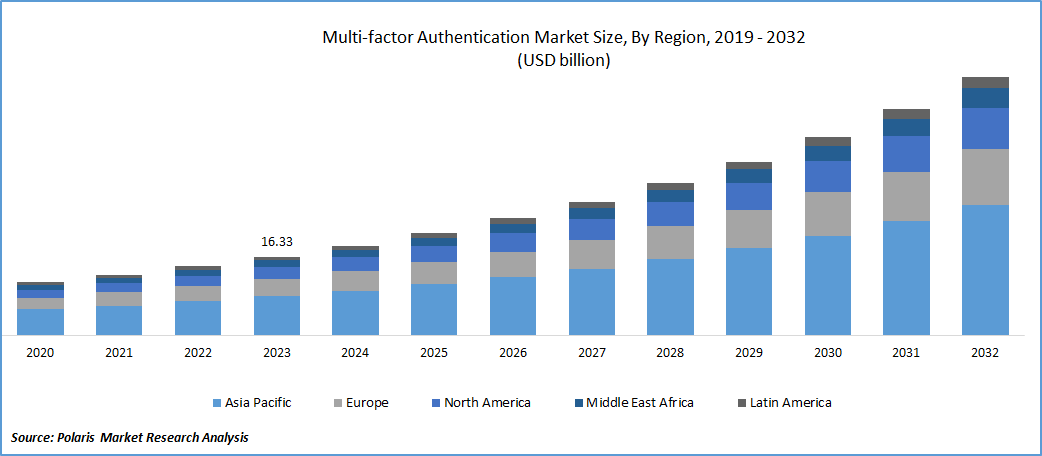
To Understand More About this Research, Download Sample Report
As cyber threats become more sophisticated, organizations are recognizing the need for robust security measures beyond traditional passwords. MFA provides an additional barrier, requiring users to provide multiple forms of verification, such as passwords, biometric data, or security tokens. This layered approach significantly reduces the risk of unauthorized access, ensuring that only authorized users can access sensitive information or conduct transactions online.
Furthermore, regulatory bodies worldwide are imposing stringent rules and standards to protect sensitive data, especially in sectors dealing with financial, healthcare, and personal information. Compliance with these regulations necessitates the implementation of advanced security solutions like MFA, leading to a higher demand for such authentication methods in the market. In summary, the increasing frequency of cyberattacks, coupled with regulatory pressure, is driving organizations to adopt multi-factor authentication, fueling the growth of the market.
There is a significant increase in investments in cloud technologies and enterprise mobility. As businesses move their operations to the cloud and employees access company resources remotely, the need for robust security measures like multi-factor authentication becomes paramount. This technology ensures that even if unauthorized users gain access to login credentials, they cannot proceed without additional verification methods, enhancing overall security in cloud-based and mobile environments.
The market faces limitations due to costs and complexities in implementation, although their impact is expected to diminish gradually. Many industries have introduced data security standards in response to the increasing incidents of data breaches and cyber-attacks. To counter these security threats, enterprises have embraced Multi-Factor Authentication (MFA) solutions. However, the implementation of these solutions is intricate and involves significant capital investments for procurement, deployment, upkeep, and administration. Additionally, the diverse IT setups across different industries add to the overall complexity of implementing MFA solutions.
Source: Polaris Market Research Analysis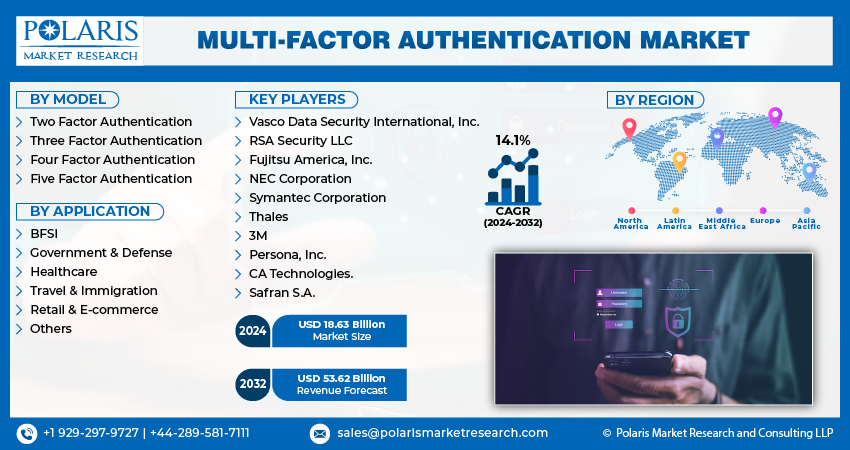
Get Full Segment-Level Forecasts & Insights: Download Sample Report
Growth Drivers
Increasing trend of BYOD in enterprises
Growing trend of Bring Your Own Device (BYOD) in enterprises contributes to the adoption of multi-factor authentication. With employees using their personal devices for work-related tasks, organizations need reliable security solutions to safeguard sensitive corporate data. Multi-factor authentication provides an extra layer of protection, ensuring that only authorized individuals can access company resources, even from personal devices.
Additionally, the emergence of authentication-as-a-service solutions further accelerates market growth. These services offer advanced security features and authentication capabilities to organizations without the need for extensive in-house infrastructure. By leveraging authentication-as-a-service, businesses can implement robust multi-factor authentication methods without significant upfront investments, making it a cost-effective and efficient solution to enhance their security posture.
Key Trends in Multi-factor Authentication
| Trend | Description | Technical / application focus | Examples from Practice |
| Passwordless authentication | FIDO2 passkeys, biometrics (face/iris), and hardware tokens eliminate passwords using public-key cryptography. | Phishing-resistant logins for enterprises; Microsoft reports 87% cost reduction and better security. | Platforms support facial recognition/NFC badges; accelerates Zero Trust adoption. |
| AI/ML adaptive authentication | Real-time analysis of device fingerprint, location, behavior to dynamically adjust auth requirements. | Risk-based access (low for trusted devices, step-up for anomalies); continuous session monitoring. | Analyzes patterns beyond static rules; PR Newswire notes growing enterprise use. |
| Biometric 2.0 multimodal | Combines facial/iris/voice with behavioral (typing/gait) for layered verification. | Frictionless enterprise auth; adapts to environments/preferences without single failure points. | Finance/government adoption; layered profiles exceed simple fingerprints. |
| Blockchain decentralized identity | Self-sovereign credentials in digital wallets verified cryptographically, no central database. | User-controlled identity sharing; eliminates breach-prone centralized auth stores. | Financial/healthcare leading; integrates with MFA while enhancing privacy. |
| MFA for shared devices/frontline | Facial recognition, NFC badges, QR+PIN for kiosks/tablets without personal phones. | Retail/warehouse/manufacturing; solves password sharing in shift work. | Purpose-built for non-desk workers; compliance without user friction. |
| IoT/edge continuous auth | Proximity/device certs for resource-constrained sensors; zero-touch verification. | Industrial networks; prevents gateway attacks on connected infrastructure. | Hardware security modules + trusted devices; scales to distributed systems. |
| Zero Trust continuous verification | Ongoing behavior/device monitoring throughout sessions, re-auth on anomalies. | Defense/government; rejects perimeter trust model entirely. | Session-long protection vs one-time login; essential for sensitive data |
Source: Polaris Market Research Analysis
Report Segmentation
The market is primarily segmented based on model, application, and region.
| By Model | By Application | By Region |
|
|
|
Source: Polaris Market Research Analysis
To Understand More About this Research, Request Customization
By Model Analysis
Two factor authentication segment garnered the largest share
Two factor authentication segment dominated the market. This authentication model allows organizations to verify the digital identities of users by utilizing multiple parameters. These parameters include knowledge-based factors (such as passwords or PINs), possession-based factors (such as smart cards or mobile devices), and inherence-based factors (such as biometric data like fingerprints or facial recognition). In essence, two-factor authentication enhances security by requiring users to provide two different types of authentications, making it significantly more difficult for unauthorized individuals to access sensitive information or systems.
Four factor authentication segment will grow at significant pace. It provides an extra layer of security when compared to conventional multi-factor authentication techniques. This comprehensive approach substantially improves the overall security framework, increasing the difficulty for attackers to bypass authentication protocols.
Additionally, the demand for stricter authentication methods, including four-factor authentication, is being propelled by regulatory compliance mandates in various sectors like finance and healthcare. These regulations necessitate the implementation of robust security standards to safeguard customer data effectively. As a result, industries are increasingly adopting stringent authentication measures to adhere to these standards and ensure the protection of sensitive information.
By Application Analysis
BFSI segment accounted for the largest market share in 2025
BFSI segment accounted for the largest market share. Given the BFSI industry's management of extensive financial data, it becomes an appealing target for cybercriminals seeking unauthorized access. To counter this threat, financial institutions are increasingly embracing multifactor authentication as a vital security measure. Moreover, customer expectations for secure and seamless online banking experiences are on the rise. This growing demand underscores the importance for BFSI organizations to implement robust authentication methods that strike a balance between ensuring security and providing user-friendly and convenient services.
Retail & e-commerce segment will exhibit robust growth rate. With the rising trend of online shopping, the retail and e-commerce industry is increasingly vulnerable to cyber threats, including payment fraud and identity theft. To counter these risks and establish trust with customers, retailers are embracing multifactor authentication as a crucial security measure. This approach helps protect sensitive customer data, including payment details and personal information, from unauthorized access. Furthermore, consumers are becoming more aware of security issues related to online transactions.
Source: Polaris Market Research Analysis
Need Granular Data Across All Market Segments? Request Customization
Regional Insights
Asia Pacific region accounted for the largest share of global market in 2025
Asia Pacific emerged as the largest region. This dominance is a result of escalating investments in connected devices, substantial funding in diverse cloud and Internet of Things (IoT) technologies, and a surging need for digital services. The growing focus on ensuring the security of personal data and validating online transactions, combined with stricter regulatory requirements, is driving the demand for Multifactor Authentication (MFA) solutions in the region.
North America will grow at the substantial pace. Technological advancements, widespread use of smartphones, improved network connectivity, and a high uptake of digital services are among the key drivers contributing to the region's expansion. Additionally, the increasing incidence of cyber-attacks is prompting a higher adoption rate of multi-factor authentication solutions in the region.
Source: Polaris Market Research Analysis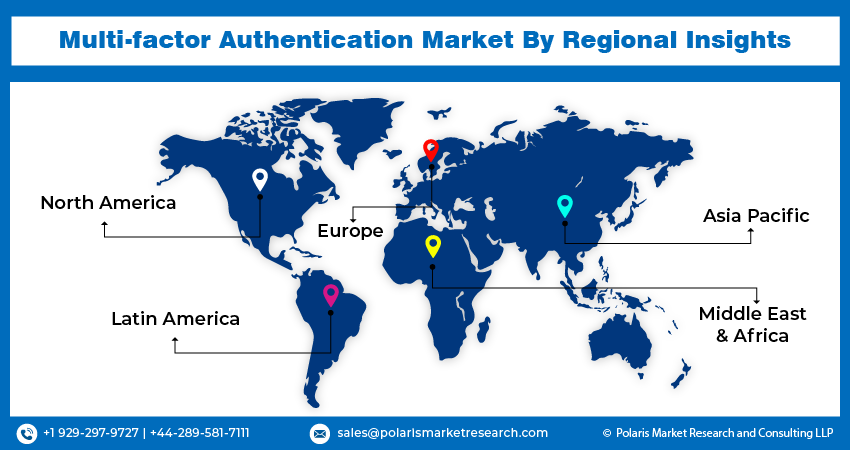
Curious About Regional Market Performance? Request Customization
Key Market Players & Competitive Insights
Major industry players are employing a combination of organic and inorganic growth strategies to uphold their market presence. These strategies involve initiatives such as introducing new products, acquiring other companies, and forming collaborations, all aimed at expanding their global footprint.
Some of the major players operating in the global market include:
- Vasco Data Security International, Inc.
- RSA Security LLC
- Fujitsu America, Inc.
- NEC Corporation
- Symantec Corporation
- Thales
- 3M
- Persona, Inc.
- CA Technologies.
- Safran S.A.
Recent Developments
- January 2025, the National Bank of Egypt adopted BIO-key’s PortalGuard IAM platform, in partnership with Raya Information Technology, to enhance secure access for its 30,000 employees.
- March 2024, Identiv, Inc. launched ScrambleFactor, a high-security addition to its physical access control portfolio, combining fingerprint biometrics with an LCD touchscreen keypad to deliver fast, flexible, and enhanced authentication for the federal market.
- February 2023, Microsoft has implemented a "Number Matching" feature in its Authenticator app to bolster security, especially in the face of MFA fatigue attacks. These attacks involve hackers utilizing social engineering techniques to illegitimately access individuals' accounts.
- April 2023, Thales, introduced the SafeNet Token Fusion series. This advanced range of USB tokens integrates Fast IDentity Online 2.0 (FIDO2) with PKI/CBA, offering a unified authenticator solution.
Multi-factor Authentication Market Report Scope
| Report Attributes | Details |
| Market size in 2025 | USD 21.46 billion |
| Market size in 2026 | USD 24.39 billion |
| Revenue forecast in 2034 | USD 69.79 billion |
| CAGR | 14.0% from 2026 – 2034 |
| Base year | 2025 |
| Historical data | 2021 – 2024 |
| Forecast period | 2026 – 2034 |
| Quantitative units | Revenue in USD million/billion and CAGR from 2026 to 2034 |
| Segments covered | By Model, By Application, By Region |
| Regional scope | North America, Europe, Asia Pacific, Latin America, Middle East & Africa |
| Customization | Report customization as per your requirements with respect to countries, region and segmentation. |
Source: Polaris Market Research Analysis
multi factor authentication market FAQ's
model, application, and region are the key segments in the Multi-factor Authentication Market.
The global multi-factor authentication market size is expected to reach USD 69.79 Billion by 2034.
expected to grow at a CAGR of 14.0% during the forecast period.
Asia Pacific regions is leading the global market.
Advancements in Technology are the key driving factors in Multi-factor Authentication Market.
The two-factor authentication segment dominated the market, as it allows organizations to verify user identities using multiple parameters such as passwords, smart cards, and biometric data, making it significantly more difficult for unauthorized users to access sensitive systems.
The high cost and complexity of implementation are the primary restraints, as deploying MFA solutions requires significant capital investment in procurement, deployment, and administration, while diverse IT setups across industries further add to the overall complexity.
Download Sample Report of multi factor authentication market
Please fill out the form to request a customized copy of the research report.


