
Music Streaming Market Size, Share & Growth Analysis Report, 2026-2034
REPORT DETAILS
Market Statistics
Music Streaming Market Overview
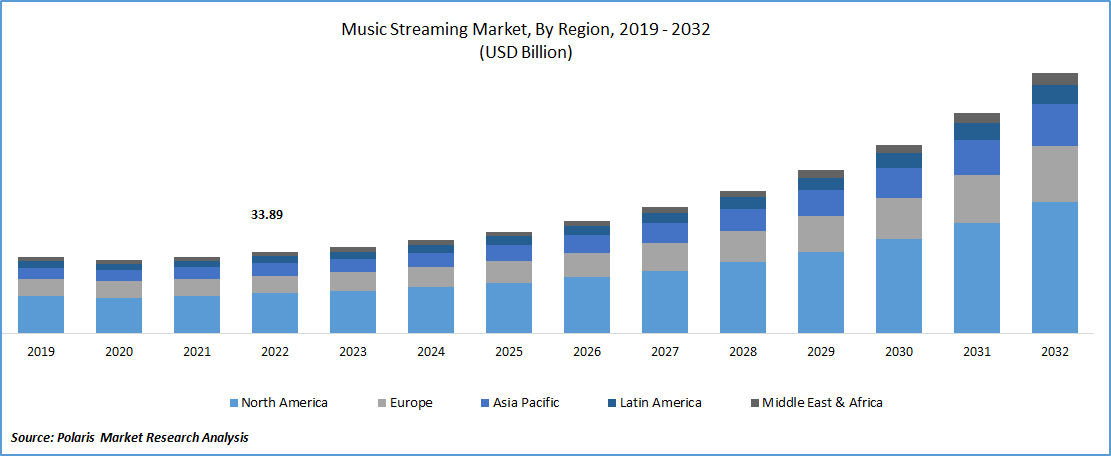
The music streaming market size was valued at USD 52.80 billion in 2025 and is expected to grow at a CAGR of 14.7% during the forecast period of 2026–2034. The market growth is backed by increasing smartphone usage, expanding internet access, and rising demand for on-demand and customized audio content.
Key Insights
- North America dominated the global music streaming market in 2025, accounting for 35.05% of the total share. This is because of strong digital infrastructure and high smartphone usage. Early adoption of subscription-based services also supports growth.
- Asia Pacific is the fastest-growing region in the music streaming market and is estimated to register a CAGR of 15.6% during 2026–2034. Growth is backed by rising internet access, increasing smartphone adoption, and expanding demand for digital entertainment content.
- By service, the on-demand streaming segment led the market in 2025, with a revenue share of 82.91%. This is due to large content libraries and easy access. It also offers a personalized listening experience.
- By platform, the apps segment led the market by 80.9% revenue share because of high mobile adoption. Features such as offline access and simple interfaces make them widely used.
- By content type, the video content segment is projected to grow fastest at CAGR of 15.2% during 2026–2034. Growth is fueled by the rising need for music videos and live content.
Note: Figures and projections outlined in this report are the result of Polaris Market Research’s proprietary analytical processes, grounded in the latest available datasets and market observations.
Market Statistics
- 2025 Market Size: USD 52.80 billion
- 2034 Projected Market Size: USD 181.14 billion
- CAGR (2026–2034): 14.7%
- North America: Largest market in 2025
Industry Dynamics
- Growing demand for on-demand and customized music creates new opportunities for the market. Users prefer easy access to music across different devices.
- High smartphone use and better internet access support market growth. People can stream music anytime and anywhere.
- Easy access to large music libraries drives user adoption. Features like offline listening and simple design make platforms easier to use.
- AI and machine learning analyze consumer listening patterns to suggest appropriate songs and playlists. This keeps users engaged and increases listening time.
- High licensing and royalty fees continue to be a major hurdle. These expenses can minimize profits and slow down market expansion.
Source: Polaris Market Research Analysis
To Understand More About this Research:Download Sample Report
Impact of AI on Music Streaming Market
- AI analyzes consumer listening behavior to recommend songs and playlists. This improves user experience and keeps users engaged.
- AI supports personalized content suggestions based on mood, activity, and preferences. This increases user retention.
- AI helps platforms organize and manage large music libraries. It makes content search and discovery easier.
- AI is used in voice assistants and smart search features. This allows users to find music quickly and easily.
- AI also supports content creation and trend analysis. However, concerns around data use and artist rights may affect adoption.
Music Streaming in Simple Terms
Music streaming means listening to songs online anytime without downloading them. It works through apps or websites where music plays instantly using the internet. It saves storage and provides access to millions of songs in one place.
The music streaming market includes online platforms that deliver music, podcasts, and other audio content in a streaming format, without the need for downloads or permanent storage. Users can access these services through subscriptions or advertisement-based models, providing a large range of content across different genres and artists. These platforms are available on smartphones, smart speakers, tablets, and computers. This easy access and wide content availability have changed how people consume music. It has shifted the industry from physical ownership to on-demand digital access.
The growing use of smartphones and the expansion of high-speed internet continue to support market growth. Users can stream content anytime and across multiple devices. This has increased the adoption of subscription-based services that offer ad-free listening, offline access, and better audio quality. These models support steady revenue generation and make user retention more important for service providers.
Artificial intelligence (AI) and machine learning (ML) are playing a key role in shaping AI-driven music streaming platforms. These technologies study user listening behavior and help deliver personalized music recommendations. AI-powered playlist creation allows platforms to offer content based on user mood, activity, and preferences. This improves user experience and keeps listeners engaged for longer periods. AI is also used in targeted marketing and video advertising, supporting platforms in reaching the right audience more effectively.
In addition, the 5G impact on streaming is expected to further improve the market. Faster network speeds and lower latency will help high-quality audio streaming and better real-time experiences. This is especially important for live music streaming, virtual concerts, and interactive sessions. As technology continues to advance, music streaming platforms are anticipated to focus more on customization, content quality, and seamless user experience to stay competitive in the market.
Market Dynamics
Widespread Device Penetration and Internet Access
The rising use of smartphones and wider internet access continue to support the music streaming market. Affordable devices and improved mobile networks have expanded the consumer base. Data from the Pew Research Center (June 2024) shows that about 91% of adults in the U.S. own a smartphone, compared to 35% in 2011. This mirrors the strong availability of streaming-enabled devices. Dependable connectivity allows users to access music anytime and from any location. It has also supported the shift from physical formats to digital platforms. This trend continues to support demand for streaming services.
Enhanced Content Accessibility and Convenience
Content availability and usage ease remain the key determinants in propelling music streaming market growth. Music streaming services allow users to access music libraries directly without having to download them. Users can access music using various gadgets like smartphones, tablets, laptops, and smart speakers. Features such as offline listening and simple interfaces improve usability. Personalized music recommendations support content discovery. At the same time, podcast streaming growth is expanding platform reach. Many platforms are adding exclusive podcasts to attract users. This is increasing listening time and platform engagement.
Advanced Personalization Through AI and Machine Learning
Artificial intelligence and machine learning play an important role in platform functionality. These technologies analyze listening patterns to suggest relevant songs and playlists. This supports AI-driven music streaming and improves user experience. AI-powered playlist creation enables content delivery based on user patterns. It is also used in targeted promotions and video advertising. Features including voice search and smart recommendations optimize navigation. These capabilities support consistent user engagement.
Rising Demand for Live and Interactive Audio Experiences
Live music streaming is becoming popular on various platforms. Virtual concerts, live sessions, and artist interactions are all experiencing growth. These formats offer real-time engagement and extended coverage. They also provide additional revenue opportunities for platforms and artists. User interest in interactive content continues to grow. This is encouraging platforms to expand live streaming capabilities.
Blockchain Integration and Royalty Transparency
The use of blockchain in music royalties is gradually increasing. It supports secure artist payment systems by improving transparency in royalty tracking. This approach minimizes disputes and strengthens trust between stakeholders. It also improves visibility across payment flows. However, high licensing costs and complicated royalty structures remain the main challenges. These factors can impact profitability and slow wider adoption.
Source: Polaris Market Research Analysis
Get Full Segment-Level Forecasts & Insights: Download Sample Report
Segmental Insights
Market Assessment By Service
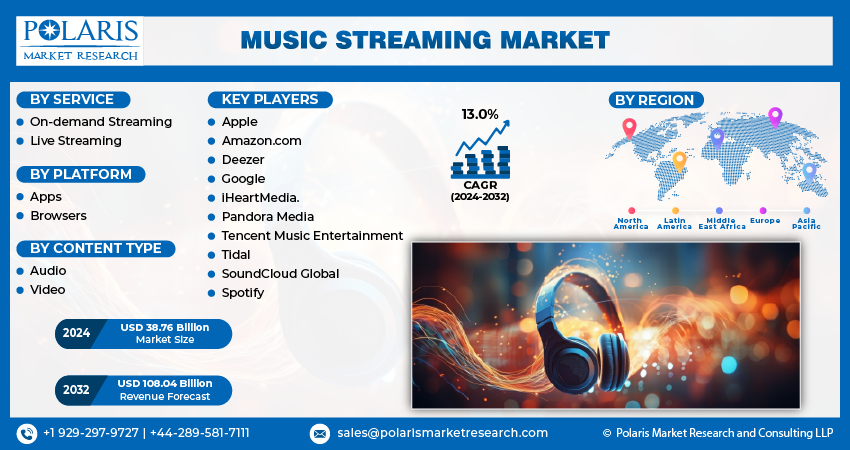
Based on service, the music streaming market is segmented into on-demand streaming and live streaming. On-demand streaming dominated the market in 2025, with a revenue share of 82.91%. This is because of large content libraries and easy access across devices. Users can listen to music and podcasts anytime without downloads. It helps a wide range of genres and offers a consistent listening experience. This segment remains the most preferred mode of digital music consumption.
Live streaming is the fastest-growing segment. Live music streaming growth is fueled by increasing interest in real-time content. Virtual concerts, streaming, and artist-led sessions are becoming more frequent. These formats allow direct interaction between artists and listeners. They also support higher engagement and new revenue opportunities for platforms.
Market Evaluation By Platform
Based on platform, the music streaming market is segmented into apps and browsers. The apps segment led the market in 2025, accounting for a revenue share of 80.92%, due to high mobile adoption. Smartphones and smart devices remain the primary access points for streaming services. Apps offer features such as offline listening and simple navigation. These features support regular usage and better user experience.
Browser-based streaming enables access through desktops and shared devices. It is useful for users who prefer not to install applications. However, it provides fewer features compared to apps.
Market Evaluation By Content Type
Based on content type, the music streaming market is segmented into audio and video. Audio content continues to dominate the market by holding 73.3% revenue share. It remains the core use case for music streaming platforms. Users depend on audio streaming for daily listening, playlists, and podcasts. It offers flexibility and can be used during multitasking.
Video content is forecast to grow at the fastest pace, with a compound annual growth rate of 12.32% during 2026–2034. Music video streaming growth is driven by rising demand for audio-visual music content. This includes music videos, live performances, and artist-led content. Audio-visual music content improves engagement and attracts new users.
Market Evaluation By End Use
Based on end use, the music streaming market is segmented into individual and commercial. The individual segment led the market in 2025, accounting for a revenue share of 61.86%. Growth is driven by personal subscriptions and ad-supported usage. Consumers use streaming services through smartphones and other personal devices.
The commercial segment is growing consistently. Businesses such as retail stores, hotels, and fitness centers are adopting streaming services. These platforms support customer engagement and improve overall experience.
Source: Polaris Market Research Analysis
Need Granular Data Across All Market Segments? Request Customization
Service-Level Business Comparison
| Parameter
| On-Demand Streaming | Live Streaming |
| Market Role | Dominant segment | Fastest-growing segment with increasing adoption |
| Revenue Model | Subscription-based, ad-supported tiers, premium plans | Ticket-based access, brand sponsorships, hybrid monetization |
| User Engagement Pattern | Continuous usage driven by playlists and personalized recommendations | Time-bound engagement linked to events and scheduled sessions |
| Content Economics | High licensing and royalty costs linked to large catalog management | Event production costs, artist partnerships, and streaming infrastructure |
| Technology Stack | AI/ML for recommendations, offline access, multi-device integration | Low-latency delivery, real-time streaming tech, 5G support |
| Scalability Factor | High scalability due to reusable and repeatable content | Limited scalability due to real-time delivery dependency |
| Customer Retention Strategy | Algorithm-driven personalization, curated playlists, long-term subscriptions | Interactive experiences, exclusivity, and real-time participation |
| Business Stability | Predictable recurring revenue streams | Variable revenue linked to event frequency and audience turnout |
| Growth Drivers | Rising smartphone usage, internet penetration, demand for personalized content | Increasing interest in virtual concerts and interactive formats |
| Strategic Importance | Core revenue foundation for platforms | Emerging growth lever and engagement differentiator |
Source: Polaris Market Research Analysis
Regional Analysis
North America held the largest share of the global music streaming market in 2025, at 36.05%. This is due to strong digital infrastructure and high smartphone usage. Early adoption of subscription-based services also contributes to market growth. Streaming platforms are well established in the region, with a large user base and strong content availability. High spending capacity and stable internet access further help demand. The shift from physical to digital music consumption is well advanced in this region.
Asia Pacific is the fastest-growing region and is projected to register a CAGR of 15.6% during 2026–2034. Growth is backed by rising internet penetration and growing smartphone adoption. Countries such as India are showing strong expansion in user base and streaming activity. Music streaming in India is expanding because of low-cost data plans and a large young population. The region is also seeing a rising need for digital entertainment across urban and semi-urban areas.
Latin America music streaming growth is driven by improving internet access and increasing smartphone penetration. Users in this region are shifting toward mobile-based streaming services. Local and international platforms are increasing their presence through affordable subscription models. Regional music preferences also play a key role in platform adoption.
The Middle East & Africa music streaming market is also expanding steadily. Growth is fueled by rising mobile connectivity and increasing access to digital services. While infrastructure issues remain, adoption is improving in main urban areas. Streaming platforms are working on mobile-first strategies to reach consumers in this region.
Content localization in streaming is becoming an important factor across emerging markets. Platforms are providing local language content and regional music genres to attract consumers. This perspective improves user engagement and backs market expansion. It also supports platforms in building a stronger connection with local audiences.

Source: Polaris Market Research Analysis
Curious About Regional Market Performance? Request Customization
Competitive Landscape and Key Players
The music streaming market is highly competitive. It continues to evolve with new updates and content planning strategies. Global players such as Spotify, Apple Music, and Amazon Music focus on increasing content libraries. They work on improving user experience. Investments in podcasts, live sessions, and exclusive releases help attract users. Flexible pricing models, including ad-supported and premium plans, support a wider reach.
Regional platforms are building strength in local markets. JioSaavn India music, Anghami music streaming, and Tencent Music China focus on regional content. They offer local language help and relevant pricing. Partnerships also help them grow their user base. This shows the rising role of localized competition.
The companies operating in the music streaming market are employing AI features for playlists. These features analyze the behavior of the users and suggest music and playlists. This retains the customers and increases the overall streaming time. Partnerships with telecom operators and electronic manufacturers help drive market growth. They are also helpful for accessibility.
Source: Polaris Market Research Analysis
Spotify Technology S.A. focuses on product updates and AI-based recommendations. It also invests in podcast content and partnerships. These efforts help user growth and market position.Apple Inc., through Apple Music, focuses on audio quality and device integration. Its ecosystem improves user experience. It also enables long-term user retention.
List of Key Companies:
- Amazon Music (Amazon.com, Inc.)
- Apple Music (Apple Inc.)
- Deezer (Deezer S.A.)
- LiveOne
- Pandora (SiriusXM)
- Qobuz
- SoundCloud
- Spotify (Spotify Technology S.A.)
- Tidal (Block, Inc.)
- YouTube Music (Alphabet Inc.)
Industry Developments
- March 2026: Feels Music Messaging: This app lets users share short music video clips to communicate messages through song lyrics. Source: universalmusic.com
- October 2025: AuroMasters launched its immersive audio streaming platform in India, offering studio-quality 3D music using AURO-3D technology and a pay-per-play “jukebox” model instead of traditional subscriptions. Source: musically.com
Future Outlook
Market growth will continue with increasing smartphone penetration and larger internet access in regions. Paid subscriptions are on the rise as people move towards ad-free and premium listening. AI and machine learning will help to curate playlists based on listening history, skip rates and session behaviour. Live and interactive streaming will grow with virtual concerts, artist-led sessions and in-app audience participation features. Platforms will invest in audio quality, exclusive content and interface optimisation to improve retention and differentiation.
Market Segmentation
By Service Outlook (Revenue – USD Billion, 2021–2034)
- On-demand Streaming
- Live Streaming
By Platform Outlook (Revenue – USD Billion, 2021–2034)
- Apps
- Browsers
By Content Type Outlook (Revenue – USD Billion, 2021–2034)
- Audio
- Video
By End Use Outlook (Revenue – USD Billion, 2021–2034)
- Individual
- Commercial
By Regional Outlook (Revenue-USD Billion, 2021–2034)
- North America
- US
- Canada
- Mexico
- Europe
- Germany
- France
- UK
- Italy
- Spain
- Netherlands
- Russia
- Rest of Europe
- Asia Pacific
- China
- Japan
- India
- Malaysia
- South Korea
- Indonesia
- Australia
- Vietnam
- Rest of Asia Pacific
- Middle East & Africa
- Saudi Arabia
- UAE
- Israel
- South Africa
- Rest of Middle East & Africa
- Latin America
- Brazil
- Argentina
- Rest of Latin America
Market Report Scope
| Report Attributes | Details |
| Market Size Value in 2025 | USD 52.80 billion |
| Market Size Value in 2026 | USD 60.44 billion |
| Revenue Forecast by 2034 | USD 181.14 billion |
| CAGR | 14.7% from 2026 to 2034 |
| Base Year | 2025 |
| Historical Data | 2021–2024 |
| Forecast Period | 2026–2034 |
| Quantitative Units | Revenue in USD billion and CAGR from 2026 to 2034 |
| Report Coverage | Revenue Forecast, Market Competitive Landscape, Growth Factors, and Industry Insights |
| Segments Covered |
|
| Regional Scope |
|
| Competitive Landscape |
|
| Report Format |
|
| Customization | Report customization as per your requirements with respect to countries, regions, and segmentation. |
Source: Polaris Market Research Analysis
Music Streaming Market FAQ's
The market was valued at USD 52.80 billion in 2025 and is expected to reach USD 181.14 billion by 2034, growing at a CAGR of 14.7%.
Key drivers include smartphone growth, better internet access, AI-based personalization, and the shift to digital music.
North America dominated the global music streaming market in 2025, accounting for 36.05% of the total share.
AI improves recommendations, playlists, and content discovery.
Trends include live streaming, podcasts, AI features, and smart device integration.
Live music streaming, including virtual concerts, is growing the fastest rate of 15.2%.
Key challenges include royalty payments, copyright issues, and data privacy.
Download Sample Report of Music Streaming Market
Please fill out the form to request a customized copy of the research report.


