

What is Nanofiltration Membrane Market Size?
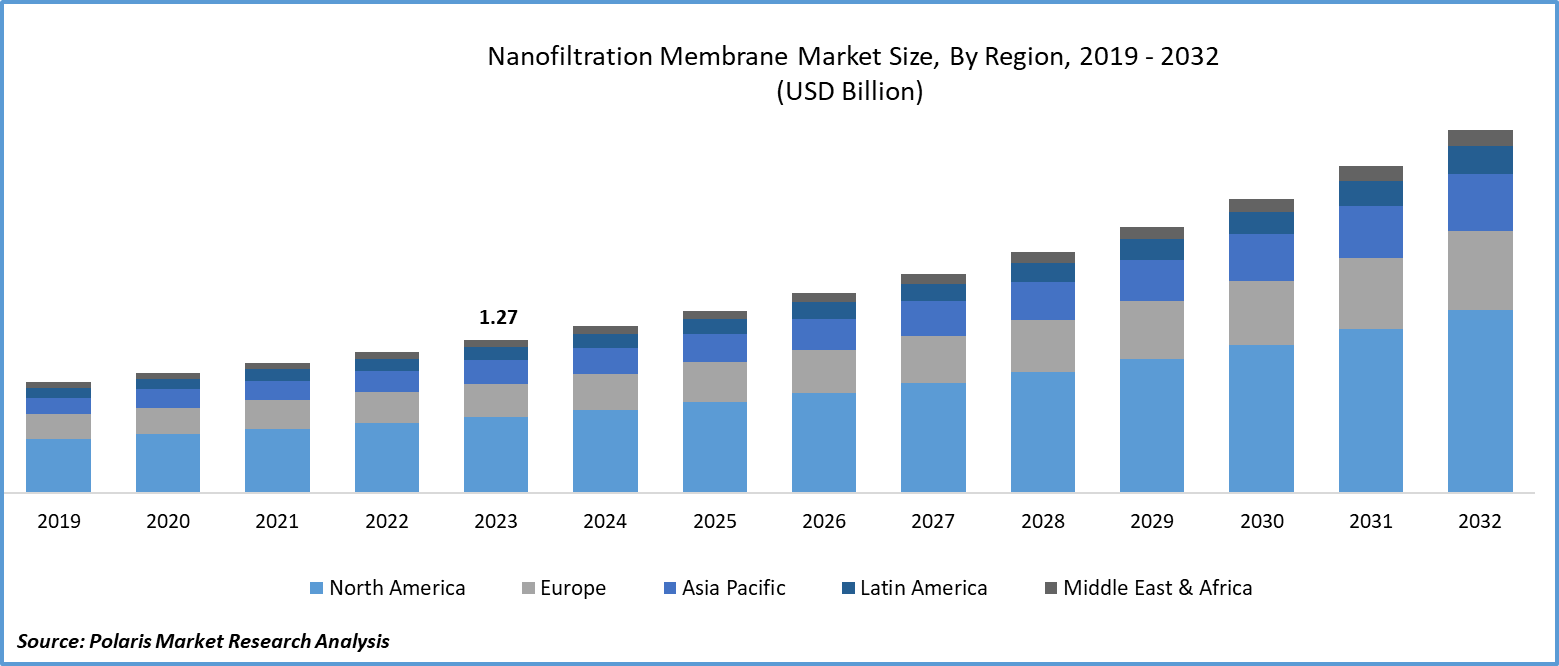
Nanofiltration Membrane Market size was valued at USD 1.52 billion in 2025 and is anticipated to exhibit the CAGR of 10.1% during the forecast period.
Market Statistics
- 2025 Market Size: USD 1.52 Billion
- 2034 Projected Market Size: USD 3.62 Billion
- CAGR (2026-2034): 10.1%
- Largest Market: North America
Market Overview
Nanofiltration membranes are highly utilized in the pharmaceutical industry, water treatment, biotechnology, and other verticals attributable to their superior filtration capacity and the potential to hinder contaminants and other particles from flowing through flexible permeable membranes. The rising demand for automobiles, primarily e-vehicles, in the marketplace is positively influencing market growth owing to their use in the automotive and semiconductor manufacturing processes for fabrication procedures.
For instance, in July 2023, DuPont introduced a new nanofiltration membrane, DuPont FilmTec LiNE-XD, for lithium brine purification. This initiative supports the ongoing demand for direct lithium extraction.
To Understand More About this Research: Request a Free Sample Report
Moreover, nanofiltration is gaining importance in the food and beverage industry, driven by their prevalent use of filtration in the processing of juices, dairy products, wine, and beer. This is anticipated to boost the demand for nanofiltration membranes in the coming years. The rising researchers’ efforts to separate chemicals from water are significantly gaining the use of nanofiltration. For instance, a 2023 study published in Desalination Journal developed the positively charged nanofiltration membrane to separate magnesium from the seawater.
Growth Drivers
The rising extraction process of oil and gas
The rising oil and gas extraction process in the world market is significantly benefiting the growth of the nanofiltration membrane market as it can be utilized in the separation of resources from impurities, facilitating the higher quality of oil and gas for end users. In addition, it is widely incorporated in brine solution processing as it involves the separation of water generated from salts and impurities derived in the extraction activity.
Furthermore, growing companies' initiatives exploring the application of nanofiltration in the food industry is expected to fuel the nanofiltration membrane market growth during the forecast period. For instance, in February 2024, DuPont introduced nanofiltration elements product line, FilmTec Hypershell NF245XD for dairy operations.
The increasing number of research studies focusing on nanofiltration
The global dye industry is looking for nanofiltration membranes due to the presence of stringent regulations on the textile emissions, primarily among the nations like India, China, and Bangladesh. Additionally, the higher use of water in manufacturing and dye coloring, are playing a significant role in driving the demand for nanofiltration membranes in the world.
The growing studies unraveling the effectiveness of nanofiltration membranes is anticipated to boost market growth. For instance, a 2023 study focused on reviewing the recent developments in nanofiltration membranes, specifically those that are used to extract heavy metals from wastewater. The polyvinyl amine and glutaraldehyde membranes showed 99.90% treatment efficiency in extracting Cr3+ from wastewater.
Restraining Factors
Higher initial costs will impede market growth
The higher deployment and maintenance costs of the nanofiltration membrane and limited awareness about them among the end-users are likely to hinder the expansion of the global market in the long run.
Key Trends in Nanofiltration Membrane
|
Trend |
Description |
Examples/Drivers |
|
Sustainable Fabrication |
Low-hazard monomers/solvents (PLA, DMSO, T80) for green NF membranes. |
Reduced pollution, biodegradability, ultrafast flux |
|
Antifouling Nanostructures |
Nanomaterial coatings (GO, CNTs, Ag NPs) for biofouling resistance. |
Extended lifespan, lower maintenance costs |
|
Hybrid Ceramic/Polymer |
Tighter pores, solvent-resistant designs for harsh conditions. |
Higher selectivity, durability in pharma/chemicals |
|
Micropollutant Removal |
PFAS/pharma residue targeting with advanced selectivity. |
Regulatory compliance (REACH), potable reuse |
|
Digital/AI Optimization |
Predictive monitoring for fouling, hybrid UF-NF systems. |
Energy efficiency, 7.8-10% market CAGR to 2035 |
Report Segmentation
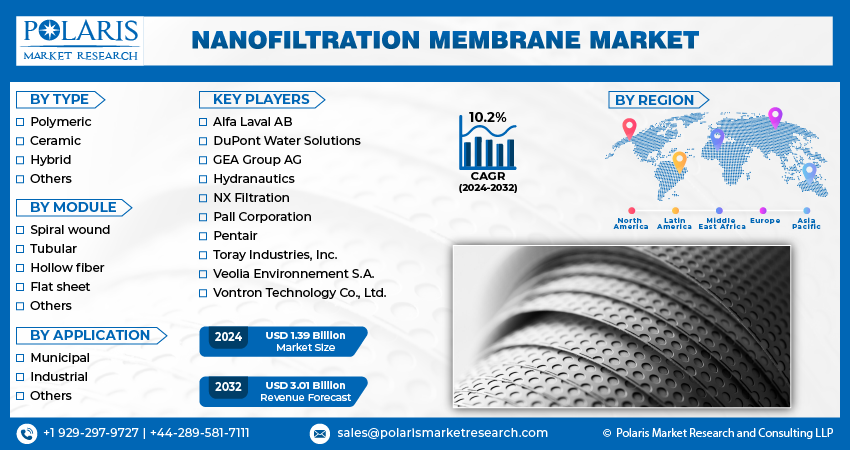
The market is primarily segmented based on type, module, application, and region.
|
By Type |
By Module |
By Application |
By Region |
|
|
|
|
By Type Analysis
Polymeric segment is likely to register the highest growth during the forecast period
The polymeric segment will grow with substantial pace, due to its ease of production and filtration of wastewater. Polymeric nanofiltration membranes are widely employed in separation processes, from water filtration to industrial manufacturing purification, due to their effectiveness and adaptability
For instance, in 2023, a study published in PubMed Central focused on reviewing the biomedical applications of polymeric nanofiltration membranes. It shows development of artificial organs, like the liver, lungs, and pancreas, thereby inducing the adoption of the polymeric membranes.
The ceramic segment led with a substantial revenue share in 2023, largely attributable to its ability to offer higher hydrophilicity and thermal & chemical resistance. This is driving its use in dairy production, oil and water separation, filtering wastewater, and dye filtration. A 2022 study explored the utilization of periodic electrolysis to limit fouling and promote the filtration efficiency of ceramic membranes.
By Module Analysis
Hollow fiber segment accounted for the largest market share in 2025
The hollow segment accounted for the largest market share in 2025 and is likely to retain its market position throughout the forecast period. It plays a significant role in removing large particles based on their size in the liquid with the selective filters. The higher rate of scalability of hollow fiber is anticipated to witness significant growth potential in the coming years.
Research studies are revealing potential opportunities for hollow fiber. For instance, a 2023 study focused on reviewing the production process of hollow fiber nanofiltration in labs for long-term applications. The increased geometral and chemical stability of hollow fiber with the polyelectrolyte multilayer production process is gaining adoption in multiple applications, making it a sustainable alternative to spiral fiber nanofiltration.
The spiral wound segment is expected to grow at the fastest rate over the next few years on account of the rapid increase in demand for whey protein and lactose concentration. The availability of several configurations of spiral wound nanofiltration with multiple membrane lengths and types is stimulating its use in the global space. The lower chance of membrane breakability compared to the hollow, ease of cleaning process, and strong design are likely to create new growth potential during the study period.
By Application Analysis
Industrial segment held a prominent share in terms of revenue in 2025
The industrial filtration segment held an iconic growth share in revenue in 2025, which is highly accelerated due to the continuous rise in its adoption in brine recovery. The enormous strength of avoiding larger quantities of sulfate and permitting sodium chloride ions through the nanofiltration membrane makes it a suitable solution for brine recovery in the industrial process.
The growing progress in nanofiltration membrane application in water treatment, pharmaceuticals, and chemical and petrochemical processing are the crucial factors leading to higher revenue in the marketplace. However, according to the nanofiltration membrane market analysis, rising municipal water treatment activities in the world are projected to showcase new demand for nanofiltration membranes in the coming years.
Regional Insights
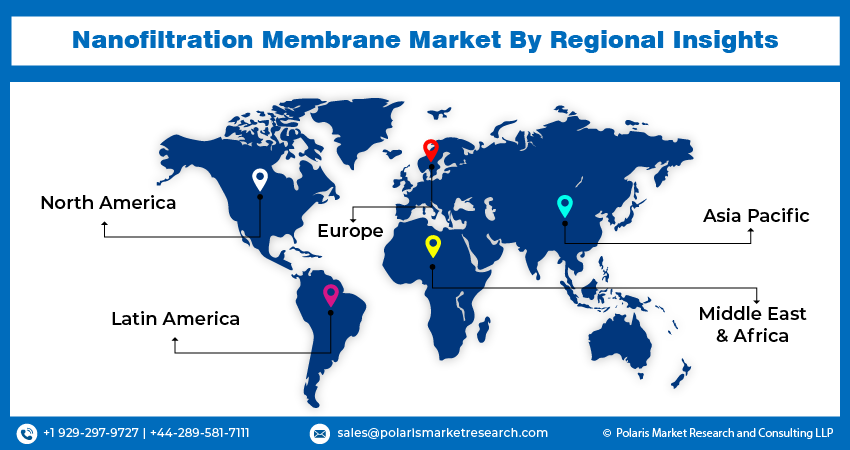
North America region registered the largest share of the global market in 2025
The North America region dominated the global market. This is due to rising sustainable practices in water recovery and reutilization in municipal and industrial applications. The progress in investment activities in water treatment plants is positively influencing the demand for nanofiltration membranes. For instance, in October 2023, the US Agriculture Department unveiled an allotment of USD 800 million for rural infrastructure projects. For instance, Stanly County, a county in North Carolina announced that it has USD 32 million to promote wastewater treatment in West Stanly, which is expected to start construction in January 2025.
The Asia Pacific region is expected to be the fastest-growing region with a healthy CAGR during the projected period, owing to the growing need for water and the rising population growth in the region. Climate change is causing water scarcity in the world, driving the need for wastewater treatment by countries. The presence of industrial and manufacturing hubs in the region, such as India and China, is contributing to the higher demand for nanofiltration membranes in the coming years due to their effective filtration potential.
Key Market Players & Competitive Insights
Strategic partnerships to drive the competition
The nanofiltration membrane market is moderately fragmented and consolidated, driven by the presence of several players with ongoing expansion activities, specifically partnerships and acquisitions. Key players are focusing on research and development activities focusing on high-productive & bio-separation solutions in the bio-pharmaceutical space. For instance, in November 2023, Nijhuis Saur Industries and NX Filtration entered into a collaboration agreement to develop MONF, an advanced mobile, hollow fiber nanofiltration unit.
Some of the major players operating in the global market include:
- Alfa Laval AB (Sweden)
- DuPont Water Solutions (US)
- GEA Group AG (Germany)
- Hydranautics (US)
- NX Filtration (Netherlands)
- Pall Corporation (US)
- Pentair (US)
- Toray Industries, Inc. (Japan)
- Veolia Environnement S.A. (France)
- Vontron Technology Co., Ltd. (China)
Recent Developments in the Industry
-
In March 2025, Toray Industries introduced a fouling-resistant polymeric nanofiltration membrane designed for industrial wastewater recycling.
-
In January 2025, scientists at the Chinese Academy of Sciences developed an advanced nanofiltration membrane—a new smart material that enables selective ion transport with high salt permeability and strong organic matter rejection, designed for treating and recovering resources from high-salinity wastewater.
-
In March 2024, a study published in Desalination Journal focused on development of composite nanofiltration membrane with the integration of electrostatic air spray disposition and found the improved separation capability, hydrophilicity, and longer stability.
- In November 2022, NX Filtration and Transcend entered a partnership with the aim of showcasing the advantages of direct nanofiltration membranes through generative design software.
Report Coverage
The nanofiltration membrane market report emphasizes on key regions across the globe to provide better understanding of the product to the users. Also, the report provides market insights into recent developments, trends and analyzes the technologies that are gaining traction around the globe. Furthermore, the report covers in-depth qualitative analysis pertaining to various paradigm shifts associated with the transformation of these solutions.
The report provides detailed analysis of the market while focusing on various key aspects such as competitive analysis, type, module, application, and their futuristic growth opportunities.
Nanofiltration Membrane Market Report Scope
|
Report Attributes |
Details |
|
Market size in 2025 |
USD 1.52 billion |
| Market size in 2026 | USD 1.67 billion |
|
Revenue forecast in 2034 |
USD 3.62 billion |
|
CAGR |
10.1% from 2026 – 2034 |
|
Base year |
2025 |
|
Historical data |
2021 – 2024 |
|
Forecast period |
2026 – 2034 |
|
Quantitative units |
Revenue in USD billion and CAGR from 2026 to 2034 |
|
Segments covered |
|
|
Regional scope |
|
|
Competitive Landscape |
|
|
Report Format |
|
|
Customization |
Report customization as per your requirements with respect to countries, region and segmentation. |
FAQ's
The Nanofiltration Membrane Market report covering key segments are type, module, application and region
The global nanofiltration membrane market size is expected to reach USD 3.62 billion by 2034
Nanofiltration Membrane Market exhibiting the CAGR of 10.1% during the forecast period.
North America is leading the global market
key driving factors in Nanofiltration Membrane Market are rising extraction process of oil and gas
Page last updated on:
Feb-2024
Research Methodology
A robust system of research, verification, and forecasting designed to ensure reliable and actionable market insights.
Polaris Market Research uses a clear and structured approach to deliver insights that clients can rely on. The process combines detailed primary and secondary research, including direct communication with industry experts. The detailed information helps build a complete picture of market trends and developments. Secondary data is gathered from credible sources such as industry reports, company filings, government source links, and trusted organization databases. It is then cross-checked through discussions with key stakeholders across the value chain. Market size and forecasts are developed using both bottom-up and top-down methods to ensure accuracy and consistency in the final results.
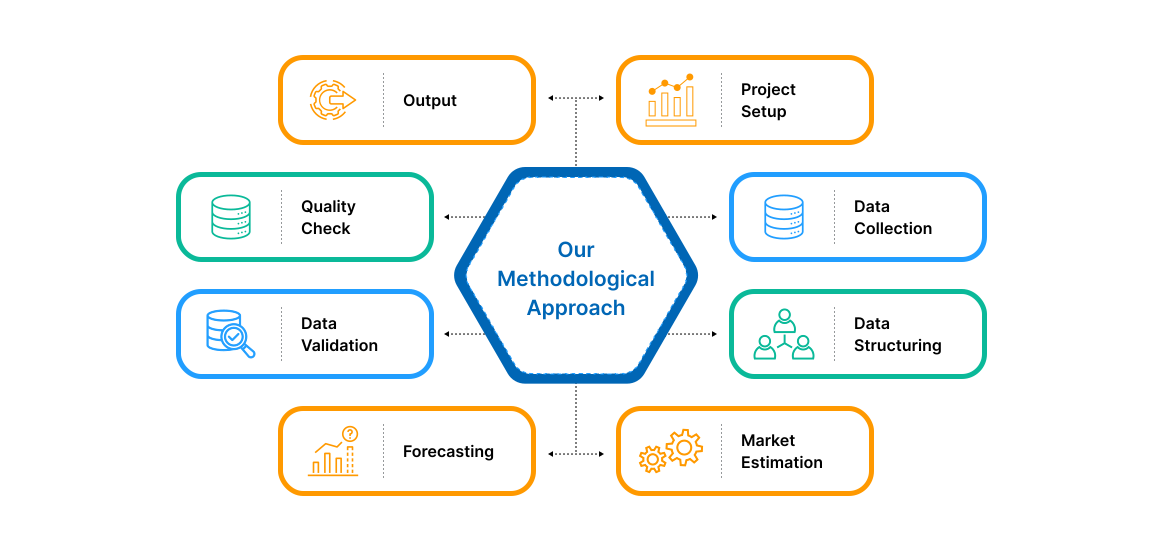
Project Setup
Step 1 & 2:
- We start every project by clearly understanding the client’s objective or goal, then defining the market scope, and aligning regions, segments, and timelines.
- Once the foundation is set, we collect data from all-around of sources, including company reports, government databases, and paid industry platforms.
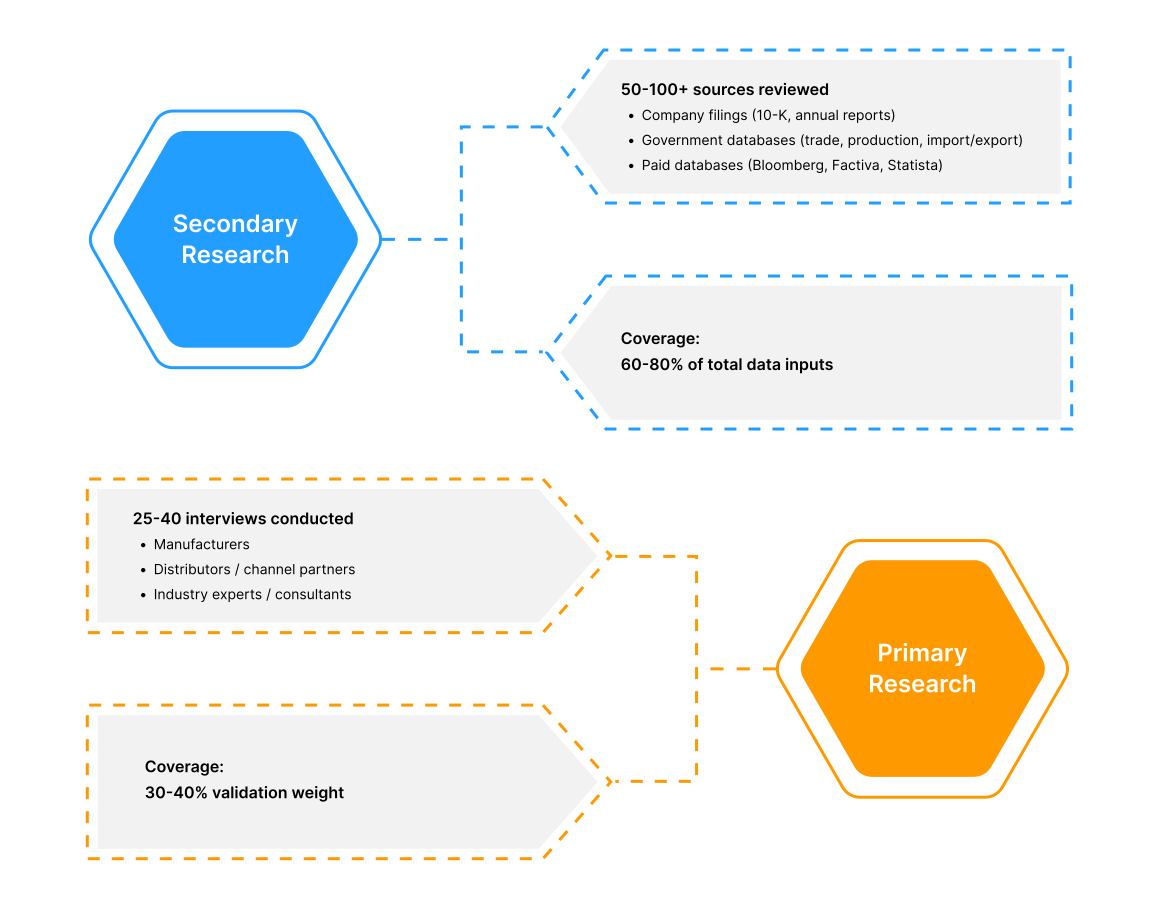
- Our research is based on secondary data, which helps us build a strong understanding of the market across regions and industries. Then we validate this information through primary research by speaking directly with industry experts, companies, and stakeholders.
- By combining secondary and primary research, we ensure that our market insights are accurate, practical, and closely aligned with real market conditions.
Data Collection
We gather information from both public and verified sources:
Data Structuring
Step 3:
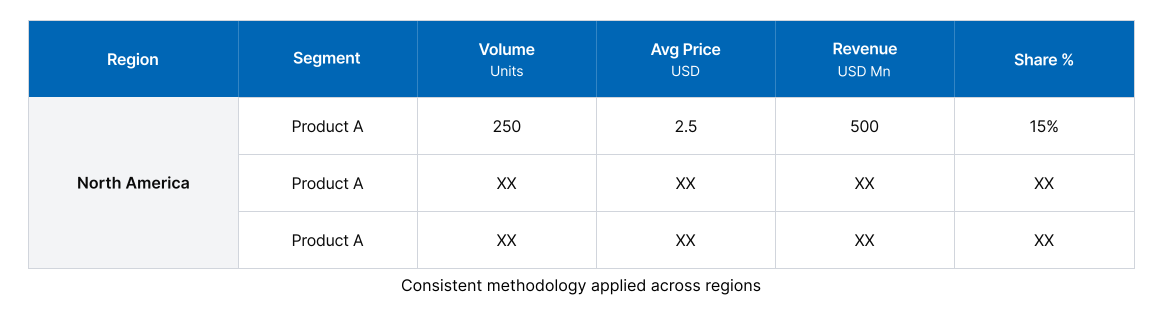
- All collected data is organized into a consistent format to ensure accurate analysis. Since inputs come from multiple sources, they are standardized and aligned before use.
- The data is segmented by product, application, and region, and mapped across a defined historical period (2020–2024). All values are converted into common units (USD Mn/Bn), and volume and pricing are aligned where required to estimate revenue.
- Any overlaps or inconsistencies are reviewed and adjusted to maintain accuracy (<5% variance threshold).
- The result is a structured dataset that allows for clear comparison across regions and supports reliable analysis and forecasting.
Structured Market Dataset, USD Mn/Bn
4. Data Structuring
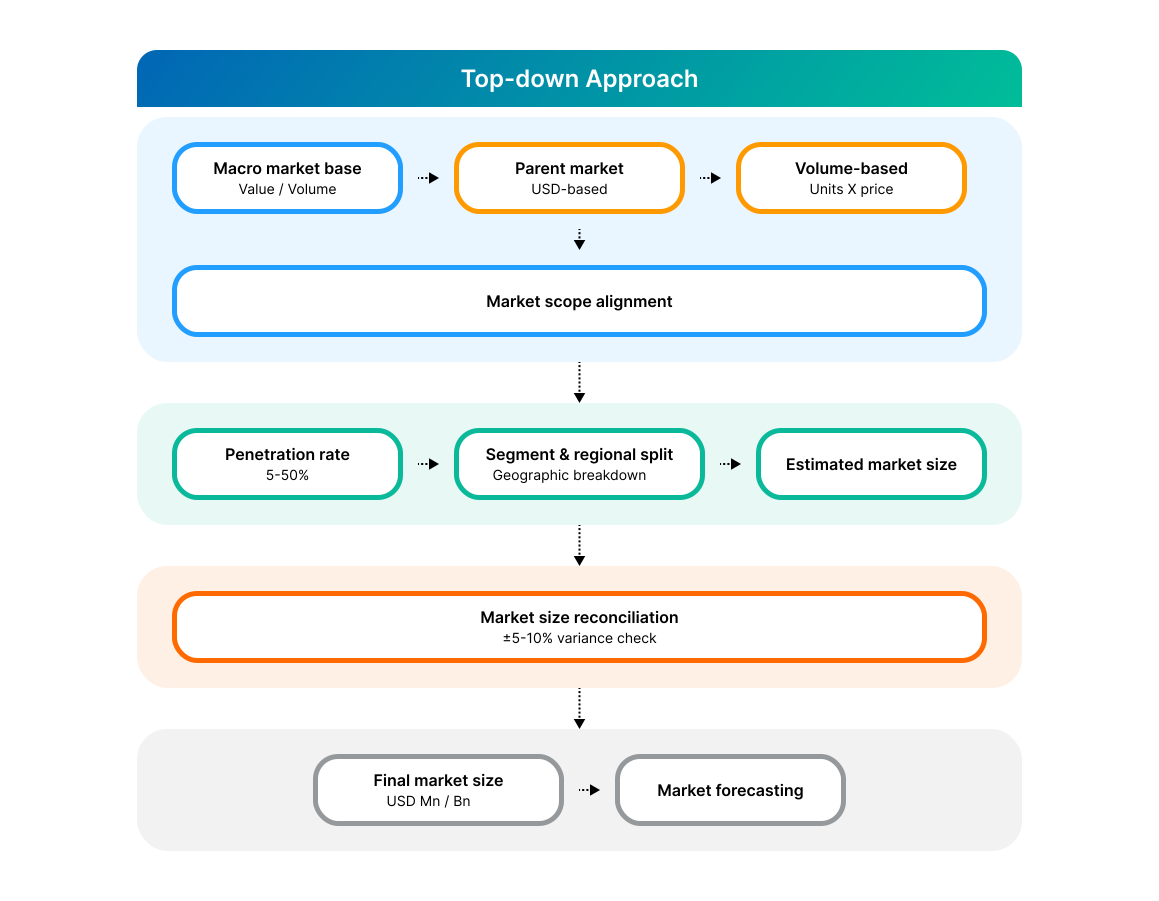
Step 4: TOP-DOWN APPROACH
- We start with the overall market size at a global or macro level.
- The market is then narrowed down based on scope and industry relevance.
- We apply penetration rates and split the data by region and segment.
- This helps us estimate the market size for specific segments.
- The numbers are validated through cross-checks to ensure accuracy.
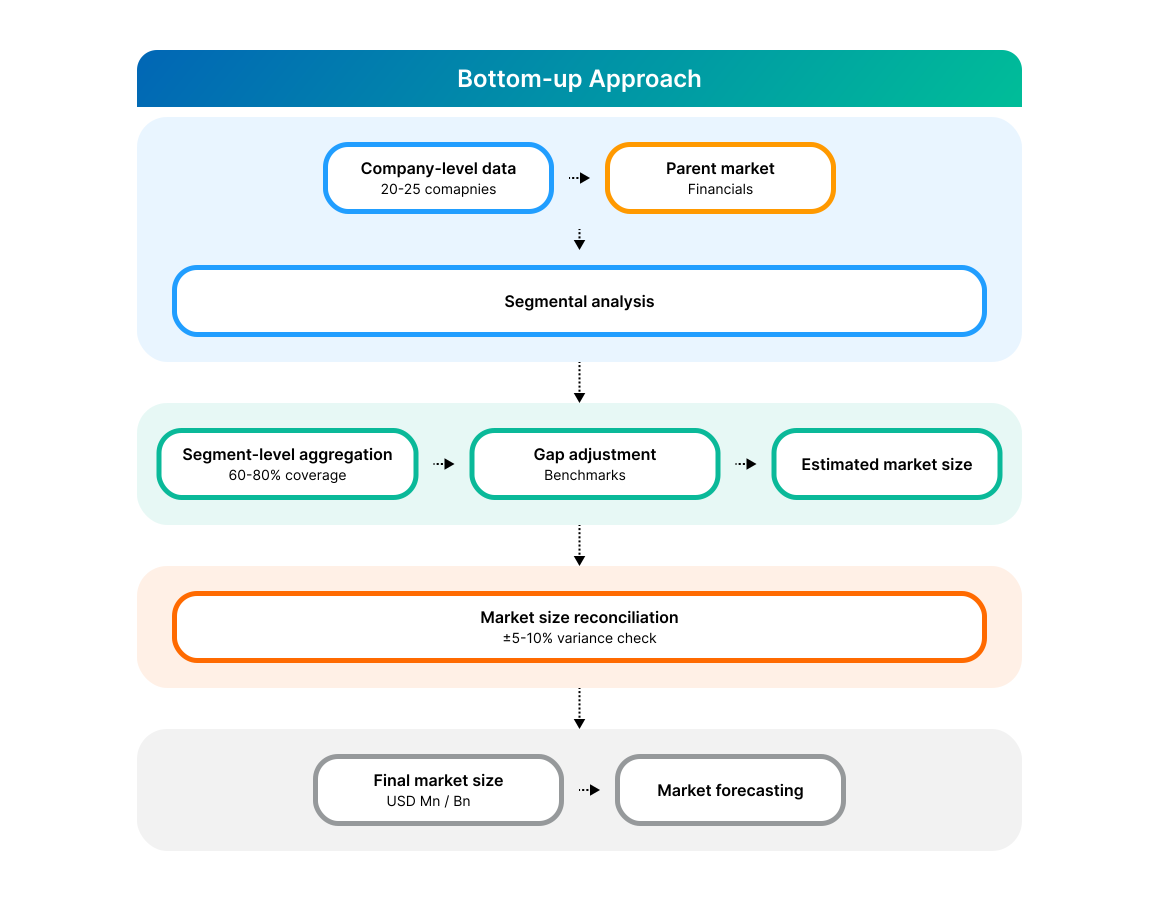
Step 5: BOTTOM-UP APPROACH
- We begin by analyzing data from leading companies in the market.
- Revenue data is collected and mapped across different segments.
- The data is then aggregated to estimate the total market size.
- To fill in any gaps, adjustments are made based on industry standards.
- Validation checks make sure that the results are correct.
5. Data Structuring
Step 6:
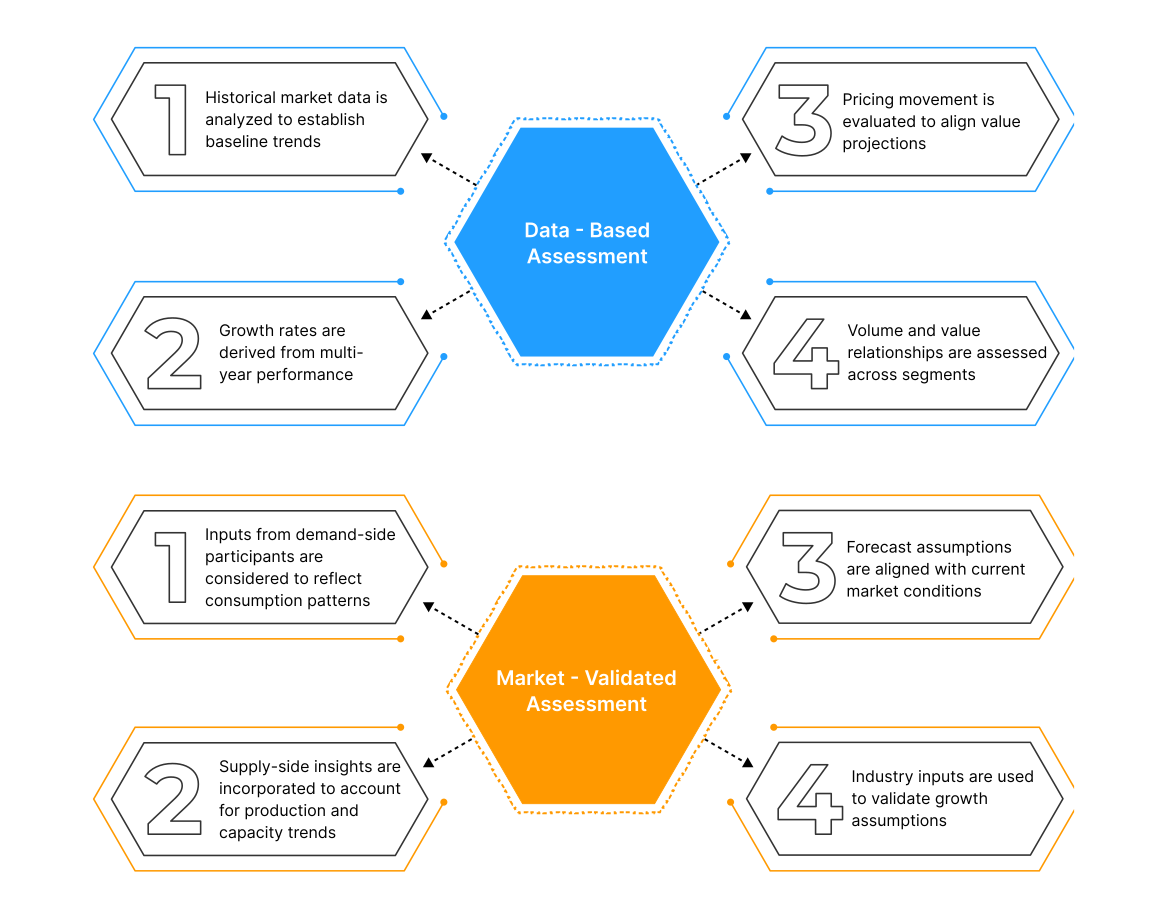
At Polaris Market Research, we employ a methodical forecasting strategy. This approach blends the analysis of historical data with real-time market validation. To forecast future trends with precision, we examine past patterns, pricing fluctuations, and the interplay of supply and demand. To ensure our conclusions reflect the present market landscape, we actively seek input from industry experts and key stakeholders.
To refine our predictions, we carefully consider critical elements such as market drivers and restraints, fluctuations in raw material costs, emerging technologies, and the production capabilities of various regions. Furthermore, we assess regulatory frameworks and potential policy shifts to gauge their potential impact on market expansion.
All this information is synthesized to generate precise forecasts for each segment and region. These forecasts illuminate the current state of the market and highlight forthcoming opportunities.
6. Data Structuring
Step 7:
In the final stage, we validate all our estimates using a triangulation method, where data is cross-checked from multiple reliable sources, like company data, primary interviews, and secondary research. This helps us make sure that our numbers are correct and fit with the rest of the market.
This process involves verifying data consistency across various segments and geographic areas. It also requires comparing historical trends with the assumptions support the forecast. Any discrepancies involve adjustments to ensure everything remains aligned and dependable.
Once the data is finalized, we prepare the final outputs, including market size estimates, segment-wise breakdowns, and growth metrics. These are delivered in structured formats such as tables, charts, and data files for easy analysis and use.
We collaborate closely with clients, ensuring the final products align with their requirements. This includes offering tailored adjustments, supplementary data analyses, and continuous assistance. Furthermore, we monitor market trends post-delivery, providing updates and refinements to maintain the insights' relevance as time passes.
Post-delivery, we continue to monitor market shifts, offering updates and adjustments to ensure the insights remain relevant over time.
Validation
Triangulation Framework
- Company-level data
- Primary inputs from industry participants
- Secondary benchmarks and published data
- Variance maintained within ±5-10%
- Adjustments applied to align estimates
- Segment values validated against overall market structure
Quality Check
Data Consistency & Integrity
- Segment totals validated to 100%
- Regional estimates aligned with global market size
- Historical trends compared against forecast outputs
- Assumptions reviewed for cross-segment and regional alignment
Output & Delivery
Final Outputs
- Market size estimates (USD Mn/Bn)
- Segment-wise distribution (%)
- Growth metrics (CAGR %)
- Structured tables and charts
- Segment-level datasets
- Excel-based data files for further analysis
Client Alignment & Support
- Deliverables are aligned with defined client requirements and scope
- Custom data cuts and segment splits are incorporated as required
- Post-delivery queries are addressed through analyst interactions
- Additional clarifications and data support are provided upon request
Client Continuity & Updates
- Market developments are tracked post-delivery to capture changes in key trends
- Updated data and revisions are provided based on new market inputs
- Additional refinements and data cuts are shared as required
- Continued analyst engagement supports evolving client requirements


