Nicotinamide Adenine Dinucleotide Market Size, Share Global Analysis Report, 2023-2032
REPORT DETAILS
The global nicotinamide adenine dinucleotide (NAD) market was valued at USD 535.53 million in 2022 and is expected to grow at a CAGR of 12.41% during the forecast period. Growing usage of NAD to catalyze the chemical reactions, which are highly required to build and repair the molecules that make our body as well as to generate energy along with the numerous benefits associated with NAD, including help in maintaining cell health, are among the major factors influencing the growth of the global market. Moreover, the increased awareness regarding the several advantages of the product among end-users, including anti-inflammatory efficacy and osteoblast differentiation in inflammatory experimental situations, have encouraged manufacturers to innovate and introduce new developments in the market with advanced features, which in turn, propelling the global market growth.
Source: Polaris Market Research Analysis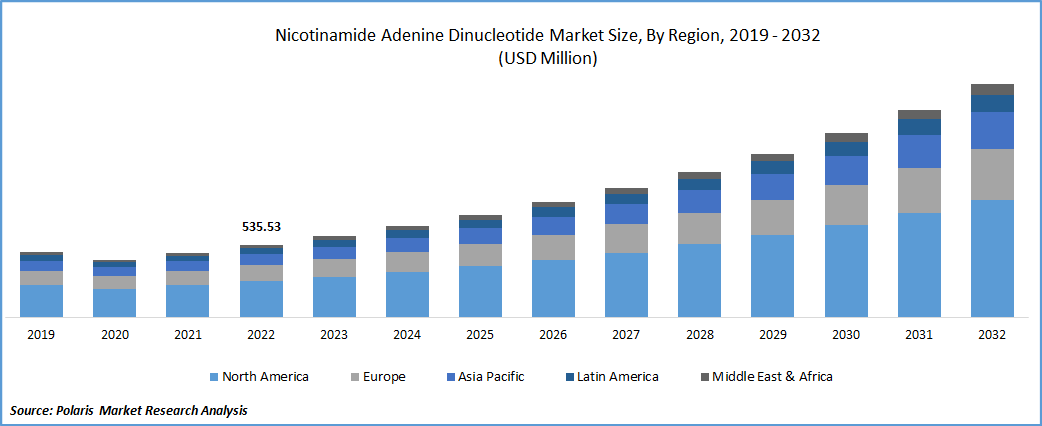
Know more about this report: Download Sample Report
For instance, in January 2022, Elysium Health introduced “SIGNAL,” a novel combination of the most direct NAD+ precursor for promoting a healthy metabolism through replenishing critical metabolic factors lost with age.
Being a co-enzyme, it has an important role in the effective regulation of metabolism & gained significant traction and importance as a co-substrate for the enzymes which regulate fundamental biological processes like transcriptional regulation and signaling. Apart from this, owing to its high therapeutic potential, the molecule was widely renewed & the regulation of the NAD metabolism became a major target for the drug discovery process. These factors will likely create lucrative growth opportunities for the market over the coming years.
The outbreak of the COVID-19 pandemic has positively impacted the growth of the nicotinamide adenine dinucleotide market. The rapid emergence of novel coronavirus across the globe has resulted in dysregulation of various genes related to the NAD+ metabolism since NAD+ and NMN supplements was being highly used in phenotypes, embolization, cell infiltration, and consisting of hemolysis, which has spurred the demand during the pandemic.
Source: Polaris Market Research Analysis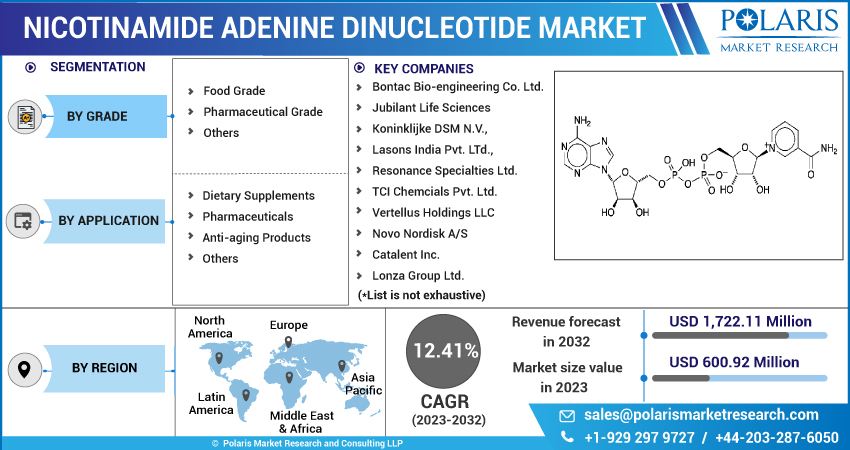
Know more about this report: Download Sample Report
Industry Dynamics
Growth Drivers
The growing number of product applications in biochemistry, including the synthesis of proteins, production of energy-rich ATP, and the chemical construction of RNA and DNA, along with the rising adoption as a supplement, are the primary factors driving the global market growth. Moreover, it further helps boost energy levels and allows athletes to overcome jet lag easily. It delays fatigue and exhaustion and minimizes reaction time, enhancing endurance and mental alertness.
In addition, NAD+ emerged as a crucial molecule in both bio-energetic ad signaling pathways and regulated cellular & organism homeostasis, which has further augmented the global market growth. Moreover, the growing requirement for crucial pyridine nucleotide nicotinamide adenine dinucleotide for various cellular processes like DNA repair, regulated gene expression, and immunological functions also results in high product demand across the globe.
Report Segmentation
The market is primarily segmented based on grade, application, and region.
| By Grade | By Application | By Region |
|
|
|
Source: Polaris Market Research Analysis
Know more about this report: Download Sample Report
Food grade segment accounted for the largest market share in 2022
The food-grade segment accounted for a significant global market share in 2022. It is likely to retain its position throughout the forecast period due to the multiple benefits of NAD supplementation, such as higher immunity & energy, enhanced memory, and low blood pressure & cholesterol. In addition, the rapid increase in the use of NAD as a substrate and cofactor for a wide range of essentially biological processes, including epigenetically controlled gene expression and DNA repair, is further projected to boost the demand and growth of the segment market over the coming years.
The pharmaceutical grade segment is expected to expand at the highest growth rate over the anticipated period because of its wide range of beneficial features and characteristics, including anti-depressant, an anti-aging solution, improving cell restoration, and bolstering the including of NDADH in a variety of diseases curing-drugs. In addition, several supplements are being made with a high standard of purity & maximum absorption.
Dietary supplements segment dominated the global market in 2022
The dietary supplements segment dominated the global market in 2022 and is expected to dominate over the study period. The growth of the segment market can be mainly attributed to the increased adoption of the product as an effective alternative form of B3 vitamin, and is being highly acquired through the synthesis in the human body as a dietary source and supplement. It allows humans to live healthier and longer lives and is crucial in all biological processes. Additionally, the extensive rise in the need and demand for dietary vitamin supplements due to the growing fitness awareness and change in consumer living patterns across the globe has also fueled the demand and growth of the segment market.
Moreover, the anti-aging products segment is likely to grow at a significant growth rate during the projected period, which is highly attributable to the increased use of a variety of anti-aging products to treat pigmentation, fine lines, wrinkles, acne, and rosacea among others along with the growing popularity of cosmetic and skin care products and high awareness regarding the benefits of NAD supplements among consumers. In addition, to cater to this rising demand for anti-aging products, major market manufacturers are increasingly focusing on developing more advanced and improved products and are introducing them to the market, which in turn, propelling the segment market at a significant pace.
Asia Pacific region is expected to witness significant growth during forecast period
The Asia Pacific region is expected to grow at a significant CAGR during the anticipated period, mainly driven by the wide applicability of NAD in manufacturing supplementation and nutrition and the growing adoption of the product in the pharma sector. The increasing penetration for enhancing immunization for chronic diseases and continuous rise in consumer spending capacity, especially in emerging economies including India, China, South Korea, and Malaysia, coupled with the surge in the number of health-conscious people who are looking for advanced skincare and pharmaceutical solutions that is further likely to fuel the regional market growth.
North American region led the industry market in 2022 with a substantial market share. It will continue its dominance over the coming years due to the robust presence of NAD-based product manufacturing facilities and the increasing prevalence of cardiovascular diseases in countries like the US and Canada. Additionally, the growing consumer knowledge regarding the benefits of NADs on their health and well-being is another factor supporting the market expansion.
For instance, according to the Centers for Disease Control and Prevention, heart diseases it the major cause of death in the United States, with 697,000 people dying from heart disease in the US. And, every 34 seconds, one person dies from cardiovascular disease in the country.
Competitive Insight
Some of the major players operating in the global market:
- Bontac Bio-engineering
- Jubilant Life Sciences
- Koninklijke DSM.
- Lasons India
- Resonance Specialties
- TCI Chemcials
- Vertellus Holdings
- Novo Nordisk
- Catalent
- Lonza Group
- Zhejiang Lanbo Biotechnology
- Otto Chemie
- Himedia Laboratories
- NutriScience Innovations.
Recent Developments
- In February 2022, ChromaDex, announced a new US continuation patent, adding to their global patent portfolio for NAD and NR. The new patent will allow the company to protect the process of developing NR and its several forms that can be leveraged through future innovations and significantly reinforce ChromaDex’s intellectual property position.
- In June 2022, NADMED introduced its two new CE-marked NAD+ analysis kits named Q-NADMED & Q-NAD in the market. This technology is mainly based on the proprietary extraction & measurement of the NAD metabolites, which allows excellent accuracy compared to mass spectrometry. The new kits bring the analysis easily accessible to a wide range of laboratories at very competitive costs.
Nicotinamide Adenine Dinucleotide Market Report Scope
| Report Attributes | Details |
| Market size value in 2023 | USD 600.92 million |
| Revenue forecast in 2032 | USD 1,722.11 million |
| CAGR | 12.41% from 2023– 2032 |
| Base year | 2022 |
| Historical data | 2019– 2021 |
| Forecast period | 2023– 2032 |
| Quantitative units | Revenue in USD million and CAGR from 2023 to 2032 |
| Segments covered | By Grade, By Application, By Region |
| Regional scope | North America, Europe, Asia Pacific, Latin America; Middle East & Africa |
| Key companies | Bontac Bio-engineering Co. Ltd., Jubilant Life Sciences, Koninklijke DSM N.V., Lasons India Pvt. LTd., Resonance Specialties Limited, TCI Chemcials Pvt. Ltd., Vertellus Holdings LLC, Novo Nordisk A/S, Catalent Inc., Lonza Group Ltd., Zhejiang Lanbo Biotechnology Co. Ltd., Otto Chemie Pvt. Ltd., Himedia Laboratories, and NutriScience Innovations. |
Source: Polaris Market Research Analysis
Nicotinamide Adenine Dinucleotide Market FAQ's
The global nicotinamide adenine dinucleotide market size is expected to reach USD 1,722.11 million by 2032.
Key players in the Bontac Bio-engineering, Jubilant Life Sciences, Koninklijke DSM., Lasons India, Resonance Specialties, TCI Chemcials, Vertellus Holdings, Novo Nordisk.
Asia Pacific contribute notably towards the global nicotinamide adenine dinucleotide (NAD) market.
The global nicotinamide adenine dinucleotide (NAD) market expected to grow at a CAGR of 12.41% during the forecast period.
The nicotinamide adenine dinucleotide (NAD) market report covering key segments are grade, application, and region.
Download Sample Report of Nicotinamide Adenine Dinucleotide Market
Please fill out the form to request a customized copy of the research report.


