
Nootropics Market Share, Size, Trends, Industry Analysis Report, 2022 - 2030
REPORT DETAILS
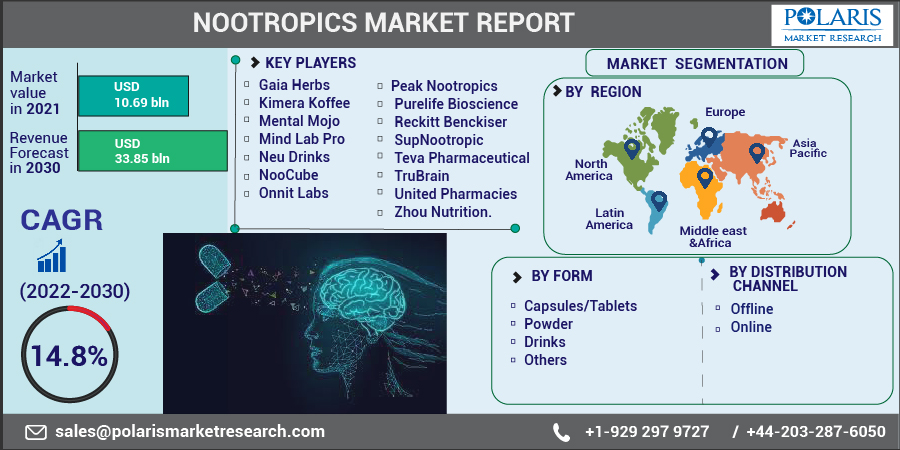
The global nootropics market was valued at USD 10.69 billion in 2021 and is expected to grow at a CAGR of 14.8% during the forecast period. Significant market factors such as increasing consumer spending on supplements, increasing incidence of stress and anxiety issues, rising popularity of brain health improvement drugs, the inclination of parents towards making nootropics their kids smart with the help of drugs, and a rise in research & development activities in the field of smart drugs are anticipated to drive the nootropics market during the forecast period.
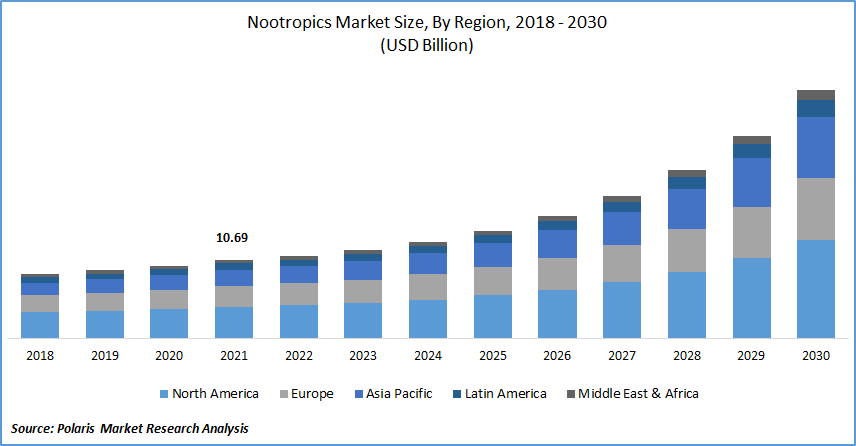
Source: Polaris Market Research Analysis
Know more about this report: Download Sample ReportAs per the article published by the ADF (Alcohol and Drug Association) in 2021, the most popular nootropics pill among young people are Alpha Brain and CILTEP. After the outbreak of COVID-19, most people started consuming supplements and drugs to boost their overall health. Small and large manufacturers witnessed growth in the sales of several supplements and drugs.
Nootropics are also called ‘Smart Drugs.’ It can be produced in a lab or else found in some herbal plants like American Ginseng. Improvements in memory or attention are examples of special effects of nootropics. These medications can help improve, maintain, and protect your cognitive abilities. As cognition is the brain's important activity in humans, the nootropic concept appealed to many people who wished to have better and longer-lasting mental activity, as well as drug companies eager to create such enticing goods.
Several medications can be used as nootropic agents that help to improve memory. Nootropics provide numerous advantages in terms of cognitive ability and brain health. Alzheimer's disease, Parkinson's disease, Huntington's disease, and cognitive symptoms of schizophrenia are treated with nootropics. Hence the market demand for nootropics is increasing.
During the peak of COVID-19, many drug manufacturers faced many challenges owing to the disrupted supply chain of the pharmaceutical sector. Even after the lockdown is lifted in many countries, the market production rate of drugs is lower owing to the shortage of a skilled workforce. The sales of supplements and drugs through online stores have increased drastically due to the COVID lockdown, which is anticipated to rise during the forecast period, boosting market growth.
Industry Dynamics
Growth Drivers
Due to the adoption of an unhealthy lifestyle, the incidence of several mental disorders, such as stress, depression, anxiety, Alzheimer's, etc., is increasing rapidly. According to the WHO, more than 300 Mn people across the globe are living with depression. And this number is anticipated to grow in the upcoming decade.
Also, as per the data published by the Anxiety and Depression Association of America (ADAA), more than 18% of the United States population is affected by anxiety, which is the most common mental disorder in the US. Medical professionals prescribe most the nootropics to cure these mental disorders. These factors are anticipated to augment the market growth of the global nootropics market.
The market trend of smart drug consumption to improve brain function and power is rising rapidly. Most people associated with various sports were consuming nootropics to make their brains calm and sharper. Hence, companies are trying to target this type of consumer. For example, Koios, a nootropic beverage company based in Colorado, promotes its goods through commercials featuring professional athletes. And this trend is expected to have a positive impact on the revenue growth of this market segment.
Companies are trying to develop nootropics that act on specific problems in the brain. Neuratech, a Brisbane-based business, launched three novel nootropics in May 2021. These products, available in both beverage and power forms, aim to tackle and assist specific concerns connected to brain wellbeing. So, the rise in research and development activities is expected to boost the market growth of the nootropics market.
Source: Polaris Market Research Analysis
Source: Polaris Market Research Analysis
Know more about this report: Download Sample ReportReport Segmentation
The market is primarily segmented based on form, distribution channel and region.
| By Form | By Distribution Channel | By Region |
|
|
|
Source: Polaris Market Research Analysis
Know more about this report: Download Sample Report
The capsules/tablets segment is estimated to garner the largest revenue share
The capsules/tablets market segment is anticipated to grow considerably during the forecast period. Most of the nootropics are available in tablet form. Tablets are more accessible to carry and consume than any other form of media. Also, it becomes easy for healthcare practitioners to prescribe the drug in capsule/tablet form.
Also, the drinks market segment is anticipated to grow at a high CAGR during the forecast period. Nootropics are being incorporated with RTD (ready-to-drink) beverages. Most companies are launching this drink to increase their business in the target market. Soylent Nutrition, a meal-replacement company, based in the United States, released an RTD energy drink brand in January 2021, boosting the company's foothold in the nootropics sector. Also, nootropics present in the drinks are easy to digest; hence, they improve brain function instantly.
The distribution channel is estimated to account most significant market share over the forecast period
Among all the distribution channels, the offline market segment is estimated to account for the largest revenue share in the years to come. Large retail companies like Costco, Walmart, Target, 7-Eleven, etc., are expanding their chains in developing regions like India, Indonesia, Thailand, Malaysia, South Africa, etc. This channel improves the visibility of the target product and attracts a large consumer base. Also, these offline channels promote the purchase of OTC (over-the-counter) drugs and supplements by giving buyers attractive rewards and high discounts.
The online market segment is anticipated to grow at a high CAGR in the forecast period. Online shopping for drugs and supplements is increasing at a rapid rate due to rapid digitization all across the globe. Hence, manufacturers of drugs and supplements are launching their e-commerce/online stores. Most small and medium-scale manufacturers make their products available on famous e-commerce platforms such as Amazon, Alibaba, Flipkart, etc. An online presence helps to attract consumers from different regions.
North America is estimated to capture the highest revenue share among all regions.
North America market is anticipated to grow at the fastest pace owing to high awareness about the benefits associated with the use of nootropics among consumers. Also, major market players such as Onnit Labs LLC, Mental Mojo, LLC, etc., are present in this region. Moreover, Americans spend more money on drugs and supplements. According to the article published in The Washington Post, Americans spend more than 30 billion dollars on vitamins, minerals, and botanical supplements. These factors are having a positive impact on the growth of nootropics market in this region.
Over the forecast period, the Asia Pacific regional market is expected to grow at a high CAGR. The number of people suffering from depression, stress, and anxiety is increasing rapidly in this region. Hence, there is a surge in demand for nootropics market to cure this mental problem. According to the World Health Organization, more than 7% of Indians suffer from mental disorders, which is anticipated to rise.
Competitive Insight
Some of the major market players:
- Gaia Herbs
- Kimera Koffee
- Mental Mojo
- Mind Lab Pro
- Neu Drinks
- NooCube
- Onnit Labs
- Peak Nootropics
- Purelife Bioscience
- Reckitt Benckiser
- SupNootropic
- Teva Pharmaceutical
- TruBrain
- United Pharmacies
- Zhou Nutrition.
Recent Developments
- In February 2025, Nootropics Depot introduced the Scientific Advisory Board and Research Snapshot sections to enhance transparency and trust within the supplements industry. The newly formed advisory board will oversee product formulations and research reviews to ensure top standards of safety and effectiveness. It will feature experts in integrative medicine, fitness, plant biology, and ethnobotany globally today.
- In March 2022, NO. 8 INC., new mental health and wellness brand, launched nootropic gummies. These gummies have four variants: energy, sleep, focus, and calm. Gummies are vegan and gluten-free.
- In February 2022, Australian company AusVitality launched a new supplement that combines nootropics and adaptogens. This supplement is specially designed to address the human body's burnout and fatigue. The company claims this product improves mental energy, focus, and clarity.
- Gaia Herbs launched a novel line of vegan’s nootropics supplement in 2019 named BACOP that helps improve mental performance.
- Liveli announced the debut of a comprehensive nootropic supplement solution in June 2018 that includes 70 vitamins, botanicals, and dietary precursors and targets sleep, attention, and cognition.
Nootropics Market Report Scope
| Report Attributes | Details |
| Market size value in 2021 | USD 10.69 billion |
| Revenue forecast in 2030 | USD 33.85 billion |
| CAGR | 14.8% from 2022 - 2030 |
| Base year | 2021 |
| Historical data | 2018 - 2020 |
| Forecast period | 2022 - 2030 |
| Quantitative units | Revenue in USD billion and CAGR from 2022 to 2030 |
| Segments covered | By Form, By Distribution Channel, By Region |
| Regional scope | North America, Europe, Asia Pacific, Latin America; Middle East & Africa |
| Key companies | Gaia Herbs, Kimera Koffee, Mental Mojo, Mind Lab Pro, Neu Drinks, NooCube, Onnit Labs, Peak Nootropics, Purelife Bioscience, Reckitt Benckiser, SupNootropic, Teva Pharmaceutical, TruBrain, United Pharmacies, and Zhou Nutrition. |
Source: Polaris Market Research Analysis
Nootropics Market FAQ's
The global Nootropics Market size was valued at USD 10.69 billion in 2021 and is projected to grow to USD 33.85 billion by 2030.
CAGR of 14.8% during 2022-2030
North America accounted for the largest revenue share in 2021
Gaia Herbs, Kimera Koffee, Mental Mojo, Mind Lab Pro, Neu Drinks, NooCube, Onnit Labs, Peak Nootropics, Purelife Bioscience, Reckitt Benckiser, SupNootropic, Teva Pharmaceutical, TruBrain, United Pharmacies, Zhou Nutrition
Drinks segment is anticipated to grow at a high CAGR during the forecast period
Download Sample Report of Nootropics Market
Please fill out the form to request a customized copy of the research report.


