North America Rainscreen Cladding Market Size, Report, 2026-2034
REPORT DETAILS
Market Statistics
What is the Current Market Size?
North America Rainscreen Cladding Market size was valued at USD 46.64 billion in 2025. The market is anticipated to grow from USD 49.95 billion in 2026 to USD 87.23 billion by 2034, exhibiting the CAGR of 7.20% during the forecast period.
Market Statistics
- 2025 Market Size: USD 46.64 billion
- 2034 Projected Market Size: USD 87.23 billion
- CAGR (2026-2034): 7.20%
Market Overview
Increasing growth of the North America rainscreen cladding market share can be attributed to growth in residential & non-residential construction industry across the region. Rainscreen cladding systems demand is increasing due to its durability. A type of building material called rainscreen cladding is used to shield a building's outer walls from the weather and precipitation. It consists of several panels that are affixed to the building's outer wall. The panels are typically composed of wood, metal, plastic, or a mix of materials. Because of its appealing aesthetic appeal, energy efficiency, and durability, this form of cladding has grown in popularity among architects and builders in North America. Therefore, the growth of the market is rising over the forecast period.
The increased need for moisture management technologies, government regulations, and the need for environmentally friendly infrastructure are the some of the factors that are creating growth opportunities for the North America rainscreen cladding market.
- For instance, in May 2023, Kebony announced the introduction of a new 1" x 8" profile for Click-In Cladding solution (CCS), a rainscreen solution designed specifically for interior accent walls and the region's building sector. This is the only 1 "x8" wood cladding product in North America to offer real hidden fastening due to Grad's Mini Rail system that precisely secures Kebony cladding into place swiftly and efficiently.
Source: Polaris Market Research Analysis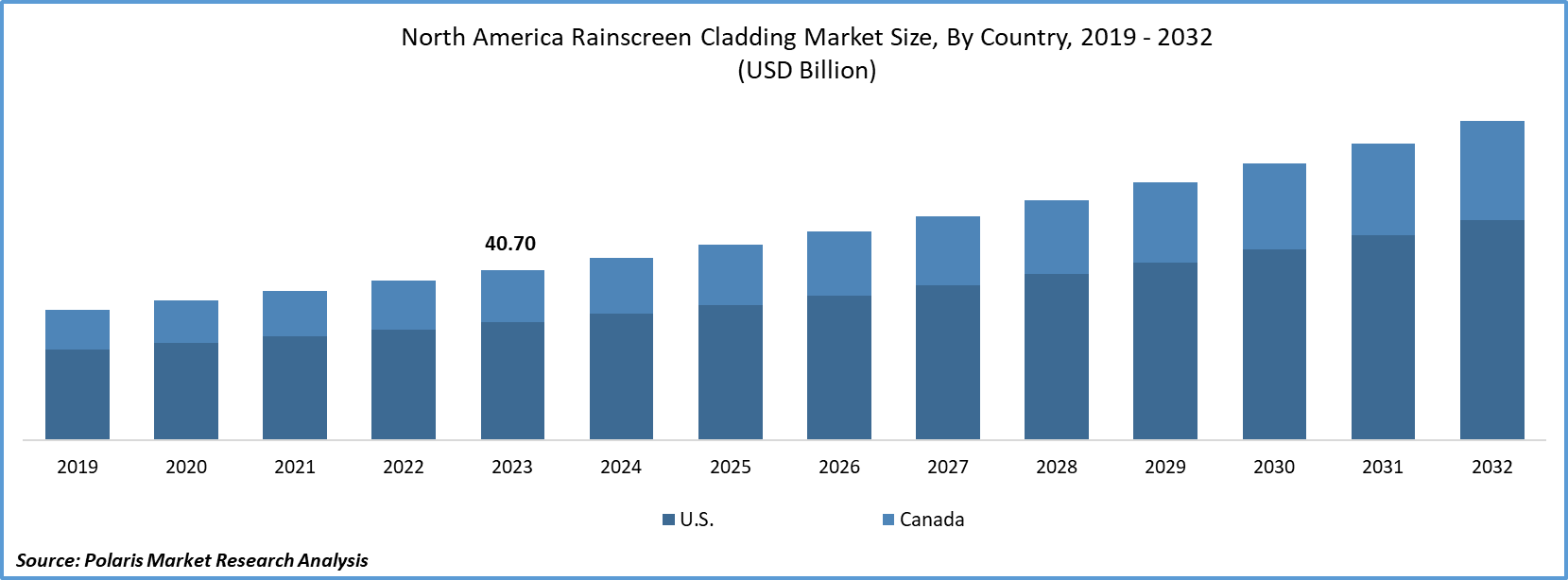
To Understand More About this Research: Download Sample Report
Demand for rainscreen cladding systems is increasing because of its capacity to control airflow, lessen thermal movement through walls, minimize overheating in the summer, and maintain stable internal temperatures in the winter. Climate control and energy efficiency are rising to the top of the priority list, propelling the industry.
Furthermore, another factor that is boosting the North America rainscreen cladding market size is the adoption of advanced technology and innovation in cladding materials. The most popular cladding techniques for modern construction projects are face-sealed and screen-drained systems because they completely enclose the building structure and prevent rainwater from penetrating these shields' innards. Rainscreen cladding constructions are generally more technologically advanced than formal techniques. They present a promising avenue for the sustainable construction initiatives that different governments are pursuing to achieve success.
However, the increasingly high cost of cladding materials at the initial stage of construction is the key factor hampering the market growth. Rainscreen cladding systems can be rather expensive to install initially, which could be a problem for building projects with limited funding.
Source: Polaris Market Research Analysis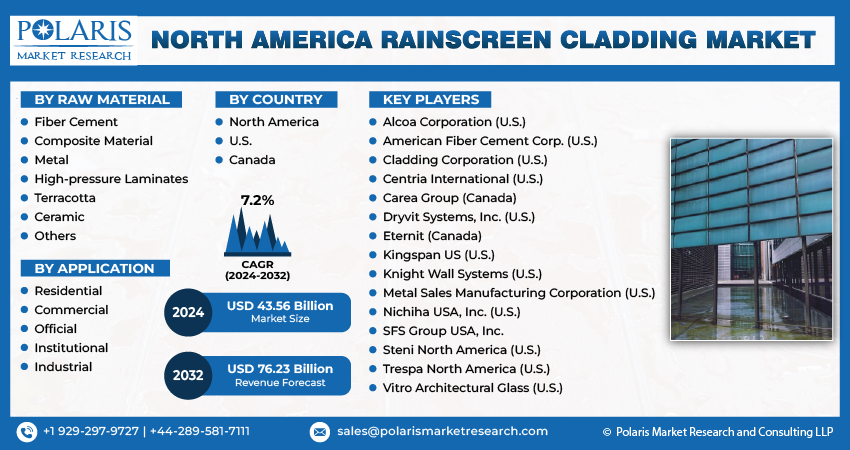
Get Full Segment-Level Forecasts & Insights: Download Sample Report
Growth Factors
Rising use of green building materials in the construction industry.
The rising awareness of using green building materials in construction has fueled the adoption of rainscreen cladding and that has driven the global market growth at a rapid pace. An environmentally friendly building structure is built using green building components. They are employed in the construction of environmentally friendly buildings that support the preservation of the natural order. The usage of such materials can alleviate several environmental concerns, such as atmospheric pollution, loss of biodiversity, abnormal climate change, ingestion of water supplies, and land natural resource depletion. Green building materials are superior to traditional construction materials because of these advantages.
Furthermore, the requirement for green building materials is anticipated to rise throughout the forecast period as a result of developed country governments implementing incentives and policies to promote green construction. The North America rainscreen cladding market size will expand as more people choose green building materials over conventional ones for construction projects. By decreasing carbon footprints, the materials help to mitigate global warming. These materials are inexpensive, simple to maintain, and environmentally and energy-friendly. When compared to more conventional building materials, these advantages make them the perfect option. Therefore, the rising use of green building materials has increased the market demand for rainscreen claddings, which has driven the North America rainscreen cladding market share over the forecast period.
Increase in governments guidelines for energy efficiency
The American Architectural Manufacturers Association (AAMA), the National Building Code of Canada, the U.S. Environmental Protection Agency, and a few other organizations have established guidelines, standards, and policies that control the North America rainscreen cladding market size. Since a building's protective systems can affect its total energy performance, the industry must adhere to strict regulations. Structural engineers are also needed to handle cladding loads and vibrations of the building and façade. Standards and regulations also assist engineers in analyzing the technical requirements for rainscreen cladding's build-up, service, and maintenance. This is an important concern since it tells architects and their clients about the ongoing operational costs of the structure. Therefore, the favorable regulations of the government that support construction are driving the North America rainscreen cladding market growth opportunities over the forecast period.
Restraining Factors
Increase strict regulatory compliance which increase the installation cost likely to impede the market growth.
The rising regulatory compliance for using materials in the construction of buildings that are increasing construction costs is the factor that is impeding the growth of the market over the forecast period. Adherence to varied local building norms and laws can be a limitation since different requirements may need personalized solutions, thus raising the expense and difficulty of the rainscreen cladding installation procedure.
U.S. Government Initiatives
| Initiative | Description | Impact on Rainscreen |
| 2018/2021 IRC R703 (PNNL BASC Guide) | Requires water-resistant barrier behind cladding with drainage to exterior; applies to retrofits and new construction. | Promotes rainscreen gaps (e.g., 3/16" min.) to prevent water accumulation in walls |
| EISA Section 433 (DOE/FEMP Rules) | Energy efficiency standards for federal buildings, emphasizing envelope performance. | Supports rainscreen for thermal efficiency and reduced infiltration. |
Source: Polaris Market Research Analysis
Canada Government Initiatives
| Initiative | Description | Impact on Rainscreen |
| National Building Code (NBC) 2020/2025 (NRC) | Part 5 covers wind, water, vapor protection; updates for climate resilience. | Requires rain penetration control, favoring ventilated cladding systems. |
| NBC Proposed Changes (NRC Codes Canada) | Ongoing revisions for egress, fire safety, and envelope durability. | Enhances moisture management in Part 3 residential buildings. |
Source: Polaris Market Research Analysis
Manufacturer Compliance
| Company | Key Compliance Notes |
| Cladding Corp | Drained/back-ventilated (DBV) rainscreen systems using sustainable materials for North American codes. |
| SFS NVELOPE (Canada/US) | Rainscreen support with drainage/ventilation; adapts to facades per building codes. |
| CERACLAD | Certified rainscreen for US/Canada; freeze-thaw, fire, wind resistance integrated. |
Source: Polaris Market Research Analysis
Report Segmentation
The market is primarily segmented based on raw material, application, and region.
| By Raw Material | By Application | By Country |
|
|
|
Source: Polaris Market Research Analysis
To Understand the Scope of this Report: Request Customization
By Raw Material Insights
Terracotta segment is expected to witness highest growth during forecast period
The terracotta segment will grow at a rapid pace due to its various beneficial qualities and features, such as weatherproof qualities, resilience to fire, low maintenance requirements, and durability. When combined terracotta with other materials like paint, stone surfaces, and glass, terracotta cladding is utilized to create panel designs. Smooth-finished exposed bricks can have a similar appearance as a result of terracotta preservation. These panels come in a variety of colors, shapes, and sizes and can be purchased glazed or unglazed. The building industry is anticipated to experience a significant rise in demand for terracotta rainscreen cladding systems due to its durability, resistance to harmful ultraviolet rays, and ease of the recycling process.
The high-pressure laminates segment led the market with a substantial revenue share in 2025. Decorative resin paper and several core layers make up high-pressure laminate. Because of their strength, resilience to impact, ease of maintenance, capacity to be customized, and availability in attractive colors and textures, high pressure laminate claddings are predicted to become more and more popular for use as rainscreen cladding.
By Application Insights
Commercial segment accounted for the largest market share in 2025
The commercial segment accounted for the largest market share in 2025 and is likely to retain its market position throughout the forecast period. This is because office complexes, retail centers, and other commercial structures are increasingly in need of energy-efficient and aesthetically pleasing building facades.
The residential segment is expected to grow at the fastest CAGR in the North America rainscreen cladding market expansion. These cladding materials are being used by the residential owners owing to various benefits provided by them. Rainscreen claddings shield these buildings from rainfall and wind. Because of their affordable price, low maintenance requirements, and attractive appearance, fiber cement, and terracotta cladding panels are the primary options for this product.
Source: Polaris Market Research Analysis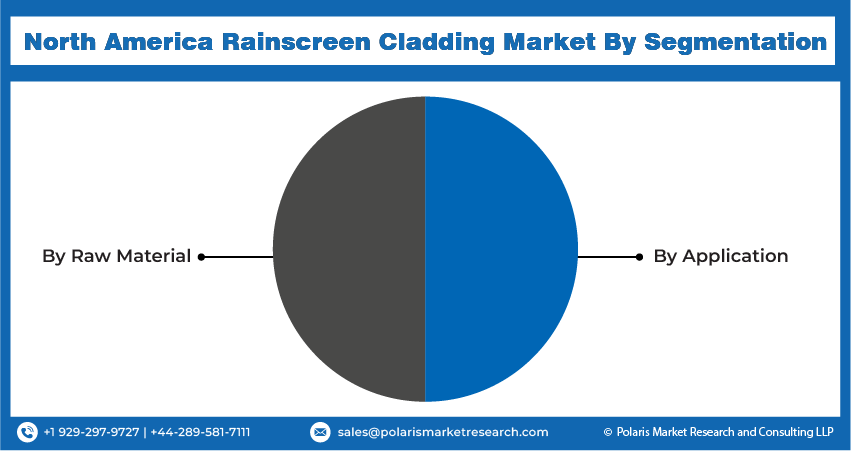
Need Granular Data Across All Market Segments? Request Customization
Regional Insights
United States dominated the regional market in 2025
The United States dominated the regional market with the largest market share in 2025 and is expected to maintain its dominance over the anticipated period. The growing number of green building projects in the area and the growing need for energy-efficient building materials are the main drivers of the market expansion. Furthermore, it is projected that an increase in the frequency of natural disasters, such as hurricanes and wildfires, striking various parts of the United States will benefit the nation's building industry, increasing demand for rainscreen cladding over the projection period.
Source: Polaris Market Research Analysis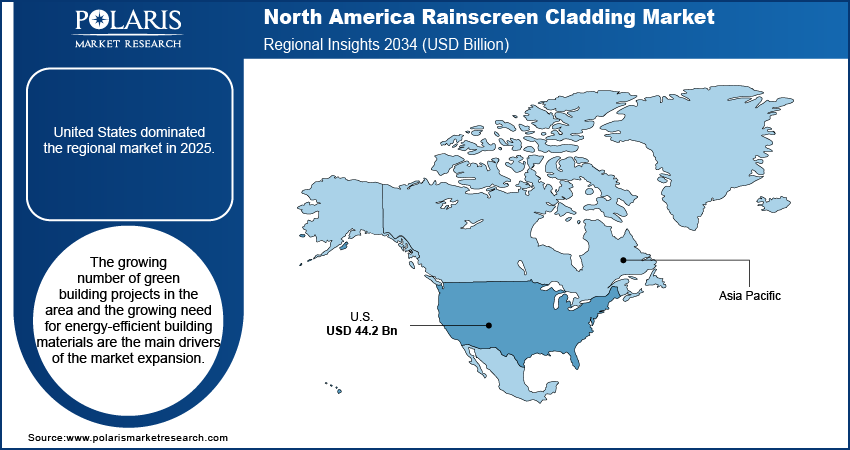
Curious About Regional Market Performance? Request Customization
Key Market Players & Competitive Insights
Mergers and Acquisitions to drive the competition
The North America Rainscreen Cladding market is fragmented. Major providers are constantly upgrading to stay ahead, ensuring efficiency, & safety. Also, the focus of the players behind the mergers is to expand the market, increase market share, cutting costs, growth opportunities, diversification, eliminating competition among them.
Some of the major players operating in the global market include:
- Alcoa Corporation (U.S.)
- American Fiber Cement Corp. (U.S.)
- Cladding Corporation (U.S.)
- Centria International (U.S.)
- Carea Group (Canada)
- Dryvit Systems, Inc. (U.S.)
- Eternit (Canada)
- Kingspan US (U.S.)
- Knight Wall Systems (U.S.)
- Metal Sales Manufacturing Corporation (U.S.)
- Nichiha USA, Inc. (U.S.)
- SFS Group USA, Inc.
- Steni North America (U.S.)
- Trespa North America (U.S.)
- Vitro Architectural Glass (U.S.)
Recent Developments in the Industry
- In September 2021, Sotech introduced the Optima XTR Contour series, an inventive substitute for terracotta cladding. An amazing array of forms and sizes may be manufactured for the Optima XTR Contour series. Rainscreen cladding made of XTR Contour Extrusion is a visually striking and highly durable material that is lighter than typical terracotta. It may be customized to an architect's exact specifications.
- April 2024: Laminators Incorporated introduced AdaptaClad RS, a shop fabricated rainscreen wall system with an open dry joint rainscreen design. It employs a two-side mechanical attachment and continuous extrusions that allow for installation over a wide range of substrates and/or over continuous insulation. The system offers a drained and ventilated assembly without the use of caulks or adhesives.
Report Coverage
The North America Rainscreen Cladding market report emphasizes on key regions across the globe to provide better understanding of the product to the users. Also, the report provides market insights into recent developments, market trends and analyzes the technologies that are gaining traction around the globe. Furthermore, the report covers in-depth qualitative analysis pertaining to various paradigm shifts associated with the transformation of these solutions.
The report provides detailed analysis of the North America rainscreen cladding market demand while focusing on various key aspects such as competitive analysis, raw material, applications, and their futuristic growth opportunities.
North America Rainscreen Cladding Market Report Scope
| Report Attributes | Details |
| Market size value in 2025 | USD 46.64 billion |
| Market size value in 2026 | USD 49.95 billion |
| Revenue forecast in 2034 | USD 87.23 billion |
| CAGR | 7.20% from 2026 – 2034 |
| Base year | 2025 |
| Historical data | 2021 – 2024 |
| Forecast period | 2026 – 2034 |
| Quantitative units | Revenue in USD billion and CAGR from 2026 to 2034 |
| Segments covered |
|
| Regional scope |
|
| Competitive Landscape |
|
| Report Format |
|
| Customization | Report customization as per your requirements with respect to countries, region and segmentation. |
Source: Polaris Market Research Analysis
Navigate through the intricacies of the 2025 North America RainScreen Cladding Market with precision, thanks to the comprehensive statistics on market share, size, and revenue growth rate assembled by Polaris Market Research Industry Reports. This thorough analysis not only provides a glimpse into the historical context but also extends its reach with a market forecast outlook until 2032. Immerse yourself in the richness of this industry analysis by securing a complimentary Download Sample Report.
North America Rainscreen Cladding Market FAQ's
key companies in North America Rainscreen Cladding Market Cladding Corporation, Kingspan US, SFS Group USA, Inc., and Nichiha USA, Inc.
North America Rainscreen Cladding Market exhibiting the CAGR of 7.20% during the forecast period.
The North America Rainscreen Cladding Market report covering key segments are raw material, application, and region.
key driving factors in North America Rainscreen Cladding Market Rising use of green building materials in the construction industry
The global North America Rainscreen Cladding Market size is expected to reach USD 87.23 billion by 2034.
Download Sample Report of North America Rainscreen Cladding Market Size, Report, 2026-2034
Please fill out the form to request a customized copy of the research report.


