
Paprika Oleoresin Market Size, Global Scope Report, 2026-2034
REPORT DETAILS
Market Statistics
What is the Current Market Size?
The global paprika oleoresin market size and share was valued at USD 191.36 million in 2025 and is expected to grow at a CAGR of 8.90% during the forecast period.
Market Statistics
- 2025 Market Size: USD 191.36 million
- 2034 Projected Market Size: USD 410.82 million
- CAGR (2026-2034): 8.90%
- Asia Pacific Largest market in 2025
Paprika oleoresin, derived from Capsicum fruits and soluble in oil, serves as a coloring and flavoring agent in various food items. Anticipated to experience significant growth, the paprika oleoresin market is propelled by the increasing consumer preference for natural colorants and flavor enhancers in the food sector. With a rising inclination toward clean-label products and natural components, paprika oleoresin has gained favor as a safer substitute for synthetic colorants, aligning with consumer demands for transparency and natural ingredients in food.
The expanding utilization of Paprika oleoresin, particularly due to its health benefits and antioxidant properties, is driving the growth of the market. The Paprika Oleoresin Market offers a variety of oleoresin types, including oil-soluble and water-soluble variants, meeting diverse needs in the cosmetics, food and beverage, pharmaceutical, and animal feed industries. To meet the increasing demand, industry players are actively investing in research and development, refining production processes, and enhancing the overall texture and quality of paprika oleoresin products. For instance, Universal Oleoresins has established a dedicated laboratory and research facility.
The paprika oleoresin market report details key market dynamics to help industry players align their business strategies with current and future trends. It examines technological advances and breakthroughs in the industry and their impact on the market presence. Furthermore, a detailed regional analysis of the industry at the local, national, and global levels has been provided.
Source: Polaris Market Research Analysis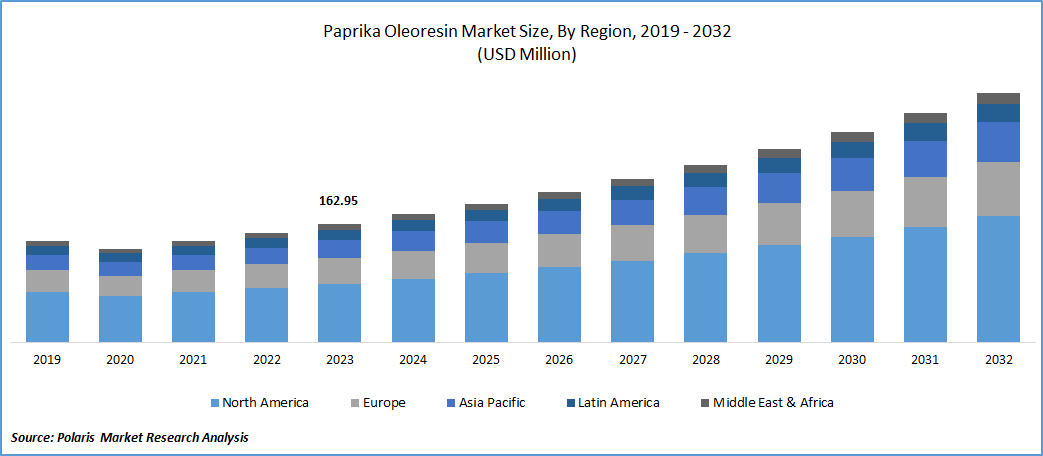
To Understand More About this Research: Download Sample Report
The global market for paprika oleoresin encounters significant obstacles that impede its expansion. A major challenge is the substantial production costs, influencing the pricing of paprika oleoresin and diminishing its competitiveness within the market. The task of ensuring a sustainable supply of raw materials is complicated by the limited availability of paprika. With the escalating demand for paprika oleoresin, the likelihood of price fluctuations and disruptions in the supply chain increases due to the scarcity of paprika resources. The constrained availability of raw paprika materials is anticipated to result in price hikes, leading to increased costs for finished goods. Businesses operating in this market must explore alternative sources of suppliers and ecosystem partners to maintain reasonable pricing and profitability.
Additionally, the growth of the market contends with potential health risks linked to the excessive consumption of paprika-infused food. While paprika is generally considered safe for cooking in moderate amounts, the ingestion of large quantities of spicy food can trigger allergic or non-allergic reactions in certain individuals. These reactions can be severe and life-threatening, posing a significant concern for the market as consumer safety becomes a paramount consideration. The paprika oleoresin market faces robust competition from major substitutes like red chili powder, ground cayenne, dried chili, and crushed red pepper flakes. These alternatives offer similar flavor profiles and coloring properties, presenting consumers with a range of choices and diminishing the exclusive appeal of paprika oleoresin.
Source: Polaris Market Research Analysis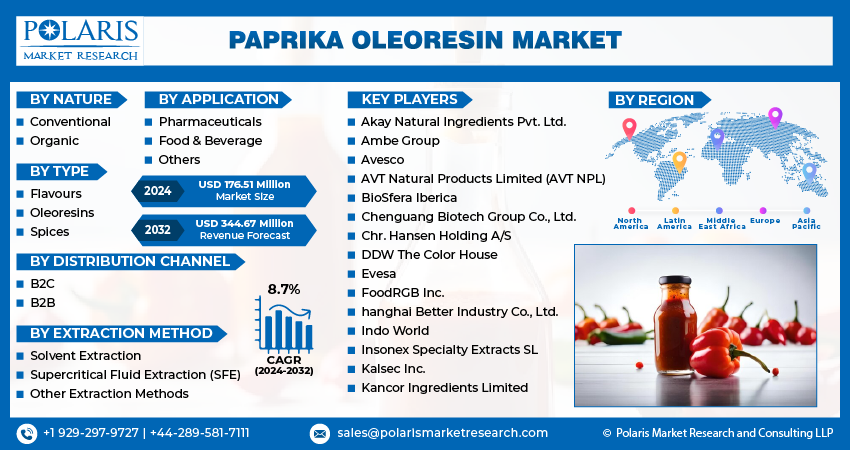
Get Full Segment-Level Forecasts & Insights: Download Sample Report
Industry Dynamics
Growth Drivers
Increasing Demand for Natural and Clean-Label Merchandise, contributing to market growth.
The increasing desire for natural and clean-label products in the food and beverage industry is driving the expansion of the Paprika Oleoresin Market. Health-conscious consumers, who acknowledge the antioxidant properties of paprika oleoresin, are pushing for its incorporation into functional foods and nutraceuticals. The paprika oleoresin market is leveraging regulatory support that promotes the use of natural colorants across various sectors. For instance, The European Union has established an approved daily intake (ADI) of 24 mg/kg body weight per day for paprika extract. This defined application within specific food and beverage categories under Regulation No 1333/2008 on food additives is fostering the expansion of the paprika oleoresin market. Moreover, there is a heightened demand in the market for products enriched with complexion nutrients, utilizing Paprika Oleoresin to mask salt reduction, and a noticeable uptick in the popularity of organic variants.
The utilization of paprika oleoresin spans across a variety of food products, encompassing sauces, cheese, spice mixtures, orange juice, and meat-based foods. This diverse application contributes to the richness of the food and beverage industry, propelling the growth of the paprika oleoresin market. Particularly in the manufacturing of meat products like sausages, there is a growing trend of replacing traditional marinades with oleoresins due to their efficiency – a small quantity of oleoresins can substitute a large volume of 100 kilograms of raw spice. The confectionery and baked food sector is also displaying an increasing inclination towards natural and organic ingredients, surpassing the preference for artificial flavors or colors, thereby augmenting the demand for oleoresins. The widespread popularity of oleoresins in the global food and beverage industry can be attributed to their heat stability, ease of storage, and prolonged shelf life in comparison to fresh or dried spices, contributing to heightened growth in the market.
3-MCPD & Glycidyl Ester (GE) Contaminant Compliance
| Region/Source | 3-MCPD Esters (µg/kg) | GE (µg/kg) | Applies To |
| EU Regulation (EC) No 2020/1322 | 1250 (vegetable oils/fats) | 1000 (vegetable oils/fats); 500 (oils for infant food) | Refined oils, fats, infant formula ingredients |
| JECFA PMTDI | 4000 (daily intake, µg/kg body weight) | No TDI (genotoxic concern) | Global guideline for 3-MCPDE/3-MCPD |
| FDA (US surveys) | Mitigation encouraged; levels reduced in infant formulas | Mitigation encouraged; levels reduced in infant formulas | Refined vegetable oils, infant formulas |
Source: Polaris Market Research Analysis
Color Value Stability & Shelf-Life Technical Specification Matrix
| Parameter | Typical Range | Stability Factors | Shelf-Life Insight |
| Color Value (ASTA CU) | 40–200,000 | Heat-stable up to 140°C; light-sensitive, add antioxidants like rosemary extract | 24 months in sealed, cool (<25°C), dark conditions; half-life 50–115 days at 25–35°C for protected forms |
| Appearance | Deep red viscous oil | Oxidative stability via low peroxide values | Maintains homogeneity with gentle warming; degradation accelerates >35°C or light exposure |
| Capsaicinoids/Heat | Low (mild flavor grades) | Formulation-specific; deodorized options | Consistent across batches if standardized |
Source: Polaris Market Research Analysis
Report Segmentation
The market is primarily segmented based on nature, type, distribution channel, extraction method, application, and region.
| By Nature | By Type | By Distribution Channel | By Extraction Method | By Application | By Region |
|
|
|
|
|
|
Source: Polaris Market Research Analysis
To Understand the Scope of this Report: Request Customization
By Type Analysis
The Flavours segment held the largest revenue share in 2025
Owing to providing a range of modified flavors, spanning from mild and sweet to highly spicy, paprika oleoresins are contributing to an expanding market. Various paprika flavors, including sweet, hot, and smoked, meet diverse consumer preferences, finding applications in salad dressings, seasonings, and condiments, imparting distinctive taste and aroma to food products.
Spices serve as prevalent natural food colorants in dishes such as sauces, soups, and snacks, imparting a robust flavor and vivid red hue, and are anticipated to dominate the market share in the forecast period. Oleoresins represent a rapidly growing segment in the Paprika Oleoresin Market, serving as concentrated extracts widely embraced in the food processing industry. They ensure uniform color and taste in convenience foods, meat products, and snacks. Oleoresins are preferred for their convenience in storage and handling, while the spices and flavors segment aligns with consumer preferences for natural and traditional ingredients.
By Application Analysis
The Food & Beverage segment accounted for the highest market share during the forecast period
Paprika Oleoresin enhances the visual appeal and consumer acceptance of diverse food products, including soups, sauces, snacks, and processed meats, by imparting a vibrant red color. It contributes a characteristic taste and aroma to seasonings, salad dressings, condiments, and ready-to-eat meals, elevating the overall sensory experience. The stability, cost-effectiveness, and ease of incorporation into various food formulations make paprika oleoresin a favored choice among food manufacturers in this sector.
Paprika oleoresin is employed across diverse medicines and healthcare items, featuring prominently in the production of herbal remedies, dietary supplements, and topical creams due to its inherent antioxidant and anti-inflammatory properties. The bioactive compounds present in paprika oleoresin exhibit the potential to enhance overall health and well-being. Furthermore, its application as a coloring agent in pharmaceutical coatings and capsules positions it as a natural alternative to synthetic dyes, appealing particularly to health-conscious consumers.
Source: Polaris Market Research Analysis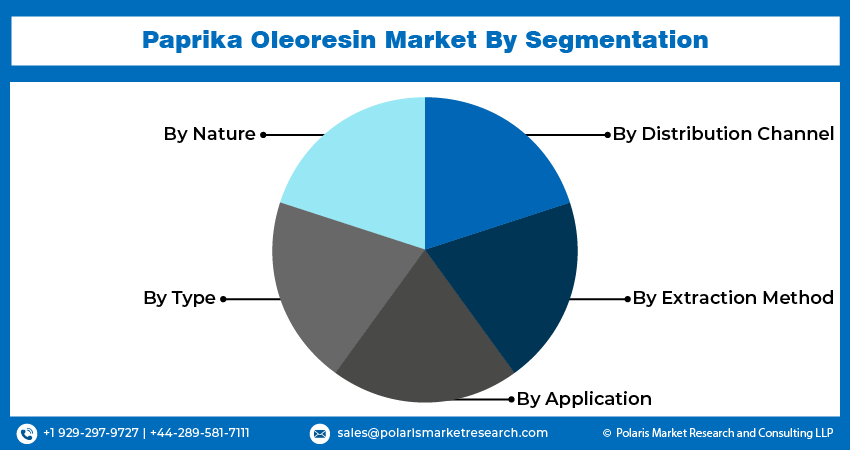
Need Granular Data Across All Market Segments? Request Customization
Regional Insights
Asia Pacific dominated the largest market in 2025
Owing, to 33.9 thousand export shipments globally, India and China emerge as key contributors in the region, jointly representing 31,646 shipments. Additionally, the market's growth is propelled by the involvement of Japan, South Korea, and other Asian nations. China plays a pivotal role, contributing around 9 thousand tonnes and notably serving the European region.
North America stands out as a significant consumer, with the United States alone importing 5,493 shipments of Paprika Oleoresin, trailed by Thailand (2,567 shipments) and Indonesia (1,696 shipments). Simultaneously, Europe exhibits a robust market presence, with Spain and Hungary serving as major producers and key exporters of Paprika Oleoresin.
Source: Polaris Market Research Analysis
Curious About Regional Market Performance? Request Customization
Key Market Players & Competitive Insights
The market is characterized by intense competition, with established players relying on advanced technology, high-quality products, and a strong brand image to drive revenue growth. These companies employ various strategies such as research and development, mergers and acquisitions, and technological innovations to expand their product portfolios and maintain a competitive edge in the market.
Some of the major players operating in the global market include:
- Akay Natural Ingredients Pvt. Ltd.
- Ambe Group
- Avesco
- AVT Natural Products Limited (AVT NPL)
- BioSfera Iberica
- Chenguang Biotech Group Co., Ltd.
- Chr. Hansen Holding A/S
- DDW The Color House
- Evesa
- FoodRGB Inc.
- hanghai Better Industry Co., Ltd.
- Indo World
- Insonex Specialty Extracts SL
- Kalsec Inc.
- Kancor Ingredients Limited
- Marfran S.L.
- Master Botanicals S.A.C.
- Naturite Agro Products Ltd.
- Paprika Oleo’s
- Plant Lipids
- Plant Lipids
- Qingdao BZ Oils
- Sinopaprika Co., Ltd
- Synthite Industries Ltd.
- Universal Oleoresins
Recent Developments
- In August 2023, Developed by GNT, OS is a component of its Exberry portfolio. The product boasts a vivid orange hue and has the potential to serve as a substitute for paprika oleoresin and artificial colors, according to the company.
- In May 2023, GNT's EXBERRY innovated the initial entirely oil-based coloring food, offering manufacturers the capability to attain vibrant orange tones in applications with minimal water content. Crafted from paprika seed oil and paprika pulp, EXBERRY Shade Vivid Orange – OS addresses the worldwide need for low-dosage, clean-label coloring ingredients that impart vivid orange hues.
Paprika Oleoresin Market Report Scope
| Report Attributes | Details |
| Market size value in 2025 | USD 191.36 million |
| Market size value in 2026 | USD 207.62 million |
| Revenue Forecast in 2034 | USD 410.82 million |
| CAGR | 8.90% from 2026 – 2034 |
| Base year | 2025 |
| Historical data | 2021 – 2024 |
| Forecast period | 2026 – 2034 |
| Quantitative units | Revenue in USD million/billion and CAGR from 2026 to 2034 |
| Segments Covered | By Nature, By Type, By Distribution Channel, By Extraction Method, By Application, By Region |
| Regional scope | North America, Europe, Asia Pacific, Latin America; Middle East & Africa |
| Customization | Report customization as per your requirements with respect to countries, regions, and segmentation. |
Source: Polaris Market Research Analysis
Uncover the dynamics of paprika oleoresin in 2025 with detailed statistics on market share, size, and revenue growth rate meticulously curated by Polaris Market Research Industry Reports. This all-encompassing analysis extends to a forward-looking market forecast until 2034, complemented by a perceptive historical overview. Immerse yourself in the profound insights offered by this industry analysis through a Download Sample Report.
Paprika Oleoresin Market FAQ's
Akay Natural Ingredients Pvt. Ltd., Ambe Group, Avesco, AVT Natural Products Limited (AVT NPL), BioSfera Iberica, Chenguang Biotech Group Co., Ltd., Chr. Hansen Holding A/S, DDW The Color House are the key companies in Paprika Oleoresin Market.
The global Paprika Oleoresin market is expected to grow at a CAGR of 8.90% during the forecast period.
The Paprika Oleoresin Market report covering key segments are nature, type, distribution channel, extraction method, application, and region.
Increasing Demand for Natural and Clean-Label Merchandise, contributing to market growth.
The global Paprika Oleoresin market size is expected to reach USD 410.82 million by 2034
Download Sample Report of Paprika Oleoresin Market
Please fill out the form to request a customized copy of the research report.


