Peelable Seal Market Trends, Forecasts, and Key Players, 2025-2034
REPORT DETAILS
Market Statistics
What is the peelable seal market size?
The global peelable seal market size was valued at USD 5.68 billion in 2024, growing at a CAGR of 5.5% from 2025 to 2034. Expanding E-commerce sector along with shift toward sustainable and recyclable packaging materials is boosting the market growth.
Key Insights
- Peelable lidding films dominated the share in 2024 owing to their extensive usage in packaging dairy, ready-to-eat items, and pharmaceuticals that need tamper-evident and easy-opening type sealing.
- Easy-peel flexible films are projected to grow rapidly owing to their lightweight structure and wide-range sealing substrates' compatibility.
- Asia Pacific led the global market in 2024, driven by the rapid urbanization, higher disposable incomes, and growing demand for packaged and convenience foods.
- India emerged as a fast-growing market due to the increase in pharmaceutical and medical device manufacturing, leading to the increasing demand for sterile and tamper-evident peelable seals.
- North America anticipated to growth at a rapid pace, due to the rise in demand for convenient, portion-controlled, and single-serve packaging across ready meals, dairy, and snack categories.
- The U.S. dominated the regional market, driven by increasing usage of advanced lidding films in high-value medical, pharmaceutical, and food applications for ensuring product integrity and sterility.
Industry Dynamics
- The ever-growing e-commerce sector are increasing the demand for durable, lightweight, protective packaging formats.
- Strong shift towards sustainable and recyclable packaging materials is driving product innovation across manufacturers.
- High development costs for advanced multilayer and resealable films are restraining the market.
- Introduction of mono-material and recyclable peelable films are creating opportunities for the future of circular and sustainable packaging solutions.
Market Statistics
- 2024 Market Size: USD 5.68 Billion
- 2034 Projected Market Size: USD 9.68 Billion
- CAGR (2025–2034): 5.5%
- Asia Pacific: Largest Market Share
What is peelable seal market?
The peelable seal market involves flexible sealing materials that allow for secure closure yet easy opening in packaging for food, pharmaceuticals, and consumer goods. These seals maintain product freshness and prevent contamination, improving user convenience. Growth is driven by increasing focus on hygiene, tamper evidence, and eco-friendly packaging formats. Developments in polymer films, coating chemistry, and sustainable packaging materials further support market growth.
Increasing demand for easy-to-open and resealable packaging formats from consumers are driving the demand for peelable seals across food, beverage, and pharmaceutical industries. These solutions make products more accessible while maintaining freshness, hygiene, and shelf life. The shift toward convenience-oriented lifestyles and on-the-go consumption patterns keeps extending the scope, thereby driving market growth.
Source: Polaris Market Research Analysis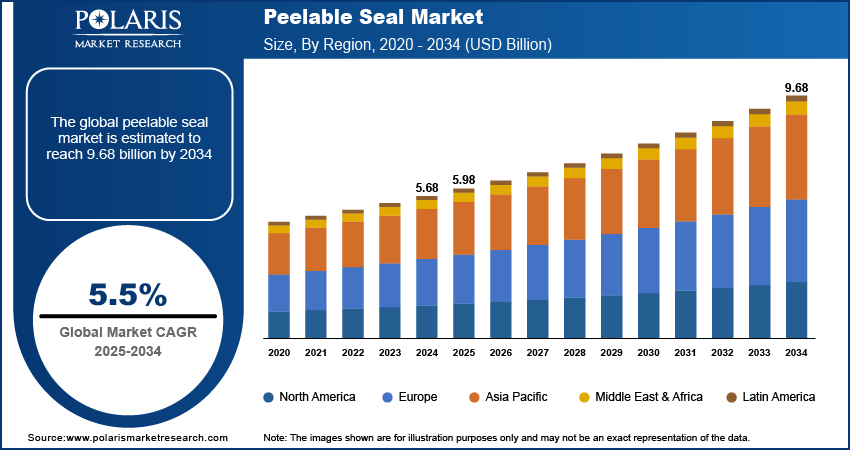
Want a Deeper Look at Key Market Players? Download Sample Report
The rising consumption of ready meals, frozen, and pre-packaged meals is driving the demand for lidding films and trays that are reliable, tamper-evident, and more convenient for users. Manufacturers are focusing on packaging designs that offer ease of use while maintaining safety, ensuring product integrity through storage and transportation. This growing reliance on convenient food packaging formats is driving the market growth.
Drivers & Opportunities
Which are the factors driving peelable seal market growth?
Expanding E-commerce Sector Boosting Durable Packaging Demand: The rapid growth in the global e-commerce industry is driving the demand for sturdy, spill-proof, and lightweight packaging solutions apt for long-distance shipment and a wide range of product types. Global B2C e-commerce revenue is expected to reach USD 5.5 trillion by 2027, with a steady compound annual rate of 14.4%, states the International Trade Administration. This growth in online retailing is accelerating market growth.
Shift Toward Sustainable and Recyclable Packaging Materials: The rising focus on sustainability bolsters the demand for mono-PET and PE-based peelable films that comply with the concept of the circular economy. In May 2025, Lacerta Group, LLC, introduced a bottom-lidding film configuration for its packaging format "Seal N' Flip," reducing plastic usage by as much as 50% while ensuring that this is tamper-resistant, leak-proof, and ideal for ready-to-eat food.
Source: Polaris Market Research Analysis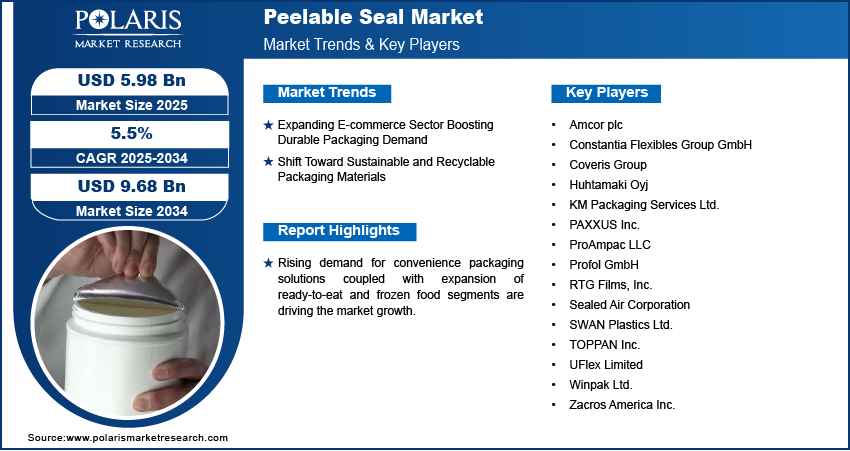
Get Full Segment-Level Forecasts & Insights: Download Sample Report
Segmental Insights
By Product
Based on product type, the market is segmented into peelable lidding films, easy-peel flexible films, peel & reseal films, and rigid peelable packaging. The segment of peelable lidding films dominated the market owing to its high usage in dairy, ready-to-eat, and pharmaceutical applications that require tamper-evident seals, yet consumer-friendly sealing solutions.
The easy-peel flexible films are projected to grow rapidly owing to their lightweight structure and compatibility with diverse sealing substrates.
By End Use
Based on the end use, the market is segmented into dairy packaging, meat, poultry & seafood, ready meals & frozen foods, snacks, bakery & confectionary, pharmaceutical & medical packaging, and other consumer & industrial end-uses. Dairy packaging dominated the market, owing to the broad applications of peelable lidding films in yogurt cups, cream tubs, and cheese trays for improved hygiene and convenience.
Ready meals and frozen foods segment is projected to grow rapidly with food manufacturers giving high importance to easy-open solutions that keep product integrity intact through variable storage conditions.
Source: Polaris Market Research Analysis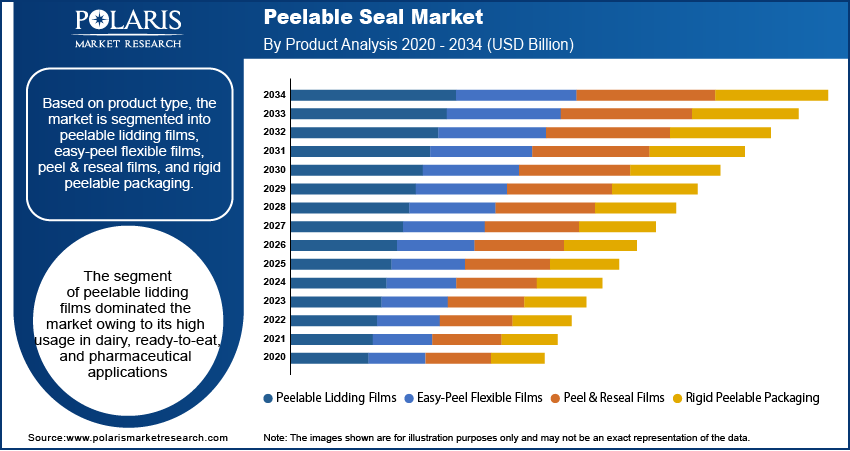
Need Granular Data Across All Market Segments? Request Customization
Regional Analysis
Asia Pacific dominated the market in 2024, owing to rapid urbanization, increasing disposable incomes, and the rise in demand for packaged and convenience foods. The region is witnessing a strong shift toward flexible and lightweight packaging formats driven by cost efficiency, ease of transport, and expanding e-commerce activity.
India Peelable Seal Market Overview
India dominated the market in Asia Pacific due to fast-growing manufacturing of pharmaceuticals and medical devices, which, in turn, fuels the demand for sterile and tamper-evident peelable seals. According to the India Brand Equity Foundation, the pharmaceutical industry's total turnover stood at USD 26.26 billion in FY25 led by strong growth across cardiac, gastrointestinal, and anti-diabetic segments.
North America Peelable Seal Market Insights
North America continues to witness stable growth driven by the rise in demand for convenience, portion-controlled, and single-serve packaging solutions for ready meals, dairy, and snacks. The increasing focus on recyclable and mono-material packaging formats is driving changes in material innovation throughout the region.
The U.S. Peelable Seal Market Analysis
The U.S. led the market share driven by high adoption of advanced lidding films in medical, pharmaceutical, and food applications to ensure product integrity and sterility. In September 2025, AWT Labels & Packaging introduced its PerfectPeel lidding films, offering secure sealing and effortless clean peeling for food, beverage, and healthcare products.
Europe Peelable Seal Market Assessment
Europe represents a significant share in the global peelable seal market, driven by stringent EU directives related to packaging waste and recycling to move toward recyclable and low-impact materials. There is also a robust presence of dairy foods, meat, and bakery industries that together continue to provide steady demand for strong, easy-to-peel lidding formats meeting high safety and sustainability standards.
Source: Polaris Market Research Analysis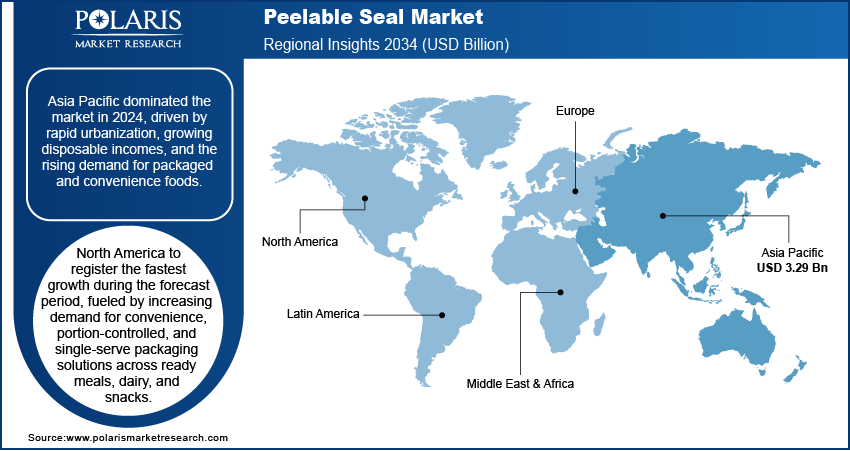
Curious About Regional Market Performance? Request Customization
Key Players & Competitive Analysis
The global peelable seal market is relatively competitive, with a mix of established packaging material producers and specialized sealant film manufacturers operating in the market. Companies are focusing on developing innovative multi-layer films, heat-seal coatings, and recyclable polymer-based solutions to enhance seal integrity and consumer convenience. Indeed, there is a strong industry movement toward sustainable and easy-open packaging formats, especially for food, healthcare, and personal care applications.
Who are the major players in peelable seal market?
Key companies operating in the global peelable seal market include Amcor plc, Constantia Flexibles Group GmbH, Coveris Group, Huhtamaki Oyj, KM Packaging Services Ltd., PAXXUS Inc., ProAmpac LLC, Profol GmbH, RTG Films, Inc., Sealed Air Corporation, SWAN Plastics Ltd., TOPPAN Inc., UFlex Limited, Winpak Ltd., and Zacros America Inc.
Key Players
- Amcor plc
- Constantia Flexibles Group GmbH
- Coveris Group
- Huhtamaki Oyj
- KM Packaging Services Ltd.
- PAXXUS Inc.
- ProAmpac LLC
- Profol GmbH
- RTG Films, Inc.
- Sealed Air Corporation
- SWAN Plastics Ltd.
- TOPPAN Inc.
- UFlex Limited
- Winpak Ltd.
- Zacros America Inc.
Peelable Seal Industry Developments
In June 2025, KM Packaging introduced K-Peel 4G, a mono PET lidding film for APET and rPET trays, capable of providing strong and clean peels even under contamination. With a low seal initiation temperature of 110°C, fast 0.3-second dwell time, anti-fog properties, ovenability, and OM7 compliance, it is suitable for ambient, chilled, and frozen foods.
In April 2025, TOPPAN Inc. completed the acquisition of Sonoco Products Company’s Thermoformed & Flexibles Packaging business for USD 1.8 billion. This acquisition significantly expands TOPPAN’s global packaging footprint and underlines its continued focus on sustainable and innovative packaging solutions.
Peelable Seal Market Segmentation
By Product Outlook (Revenue, USD Billion, 2020–2034)
- Peelable Lidding Films
- Easy-Peel Flexible Films
- Peel & Reseal Films
- Rigid Peelable Packaging
By End Use Outlook (Revenue, USD Billion, 2020–2034)
- Dairy Packaging
- Meat, Poultry & Seafood
- Ready Meals & Frozen Foods
- Snacks, Bakery & Confectionery
- Pharmaceutical & Medical Packaging
- Other Consumer & Industrial end-uses
By Regional Outlook (Revenue, USD Billion, 2020–2034)
- North America
- U.S.
- Canada
- Europe
- Germany
- France
- UK
- Italy
- Spain
- Netherlands
- Russia
- Rest of Europe
- Asia Pacific
- China
- Japan
- India
- Malaysia
- South Korea
- Indonesia
- Australia
- Vietnam
- Rest of Asia Pacific
- Middle East & Africa
- Saudi Arabia
- UAE
- Israel
- South Africa
- Rest of Middle East & Africa
- Latin America
- Mexico
- Brazil
- Argentina
- Rest of Latin America
Peelable Seal Market Report Scope
| Report Attributes | Details |
| Market Size in 2024 | USD 5.68 Billion |
| Market Size in 2025 | USD 5.98 Billion |
| Revenue Forecast by 2034 | USD 9.68 Billion |
| CAGR | 5.5% from 2025 to 2034 |
| Base Year | 2024 |
| Historical Data | 2020–2023 |
| Forecast Period | 2025–2034 |
| Quantitative Units | Revenue in USD Billion and CAGR from 2025 to 2034 |
| Report Coverage | Revenue Forecast, Competitive Landscape, Growth Factors, and Industry Trends |
| Segments Covered |
|
| Regional Scope |
|
| Competitive Landscape |
|
| Report Format |
|
| Customization | Report customization as per your requirements with respect to countries, regions, and segmentation. |
Source: Polaris Market Research Analysis
Peelable Seal Market FAQ's
The global market size was valued at USD 5.68 billion in 2024 and is projected to grow to USD 9.68 billion by 2034.
The global market is projected to register a CAGR of 5.5% during the forecast period.
Asia Pacific dominated the market in 2024.
A few of the key players in the market are Amcor plc, Constantia Flexibles Group GmbH, Coveris Group, Huhtamaki Oyj, KM Packaging Services Ltd., PAXXUS Inc., ProAmpac LLC, Profol GmbH, RTG Films, Inc., Sealed Air Corporation, SWAN Plastics Ltd., TOPPAN Inc., UFlex Limited, Winpak Ltd., and Zacros America Inc.
The peelable lidding films segment dominated the market revenue share in 2024.
The ready meals & frozen foods segment is projected to witness the fastest growth during the forecast period.
Download Sample Report of Peelable Seal Market
Please fill out the form to request a customized copy of the research report.


