
Plastic-coated Wire Ropes Market Size, Industry Share, Insights, 2025-2034
REPORT DETAILS
Market Statistics
What is the plastic-coated wire ropes market size?
The global plastic-coated wire ropes market size was valued at USD 1.40 billion in 2024, and is anticipated to register a CAGR of 6.5% from 2025 to 2034. The rising demand for construction and infrastructure projects is a major growth factor for the plastic-coated wire ropes. The increasing need for durable and corrosion-resistant materials in the marine industry also helps drive this growth. In addition, the growing use of these ropes in the automotive sector further boosts the growth.
Key Insights
- By material type, galvanized steel held the largest share in 2024 as it is a very cost-effective material that offers good corrosion resistance.
- Based on diameter, less than 1/4 inch dominated in 2024. The dominance is driven by its versatility, lightweight, and suitability for a wide range of applications.
- In terms of coating type, PVC held the largest share in 2024. Its low cost; flexibility; and good protection against moisture, abrasion, and UV rays propel its demand.
- By application, the construction industry held the largest share in 2024. Their rising requirement in building projects, from cranes to scaffolding, contributed to the leading position of the segment.
- By region, Asia Pacific led the global share in 2024. Rapid urbanization and large-scale infrastructure projects, along with significant growth in the manufacturing and marine industries across the region, drive the dominance.
Industry Dynamics
- The increasing use of these ropes in the construction industry is a major growth factor. They are widely used in building bridges, cranes, and other infrastructure projects due to their high durability and resistance to wear and tear. This demand is boosted by growing urbanization and government investments in infrastructure worldwide.
- Another key driver is the rising demand from the marine industry. These ropes are ideal for marine applications such as fishing nets and boat rigging due to their resistance to saltwater corrosion. The protective coating greatly extends their lifespan in harsh, wet environments.
- In the automotive sector, these ropes are used in various vehicle parts, including control cables, brake systems, and other components that require strong yet flexible materials. Thus, the overall growth of the automotive industry drives the market expansion.
Market Statistics
- 2024 Market Size: USD 1.40 billion
- 2034 Projected Market Size: USD 2.61 billion
- CAGR (2025-2034): 6.5%
- Asia Pacific: Largest market in 2024
AI Impact on Plastic-Coated Wire Ropes Market
- AI helps to precise manufacturing, reducing defects and improving consistent quality in plastic-coated wire ropes production.
- AI helps in real-time monitoring detects wire fractures early, minimizing downtime and enhancing safety.
- AI helps to optimize maintenance schedules, extending service life and lowering operational costs.
- AI with imaging identifies corrosion, abrasion, and coating damage faster than manual inspection
What are plastic-coated wire ropes market?
Plastic-coated wire ropes are produced out of wire strands made of galvanized or grade stainless steel. The strands are twisted to form a steel wire rope, and the end wire is coated with plastic. The rope, which is extended in strands of abrasion and protection coating, is made of materials, such as PVC protective layer, and polyethylene and propylene of the abrasion coating, resistant to corrosion or damage.
Source: Polaris Market Research Analysis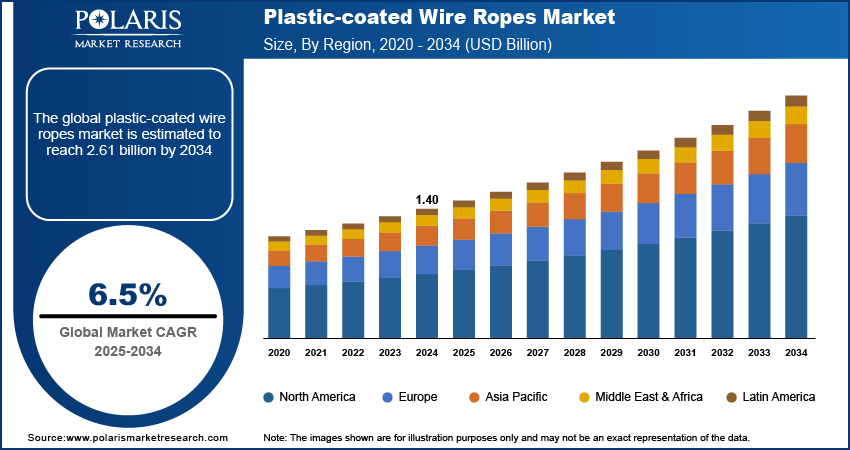
Want a Deeper Look at Key Market Players? Download Sample Report
The increasing use of these ropes in the construction industry is a major growth factor. They are widely used in the construction of bridges, cranes, and other infrastructure projects due to their high durability and resistance to wear and tear. This demand is boosted by growing urbanization and government investments in infrastructure worldwide.
Another key driver is the rising demand from the marine industry. These ropes are ideal for marine applications such as fishing nets and boat rigging due to their resistance to saltwater corrosion. The protective coating greatly extends their lifespan in harsh, wet environments. The growing use of these ropes in the automotive sector also contributes to growth. They are used in various vehicle parts, including control cables, brake systems, and other components that require strong yet flexible materials. Thus, the overall growth of the automotive industry propels the demand for plastic-coated wire ropes.
Drivers and Trends
Which are the factors driving plastic-coated wire ropes market?
Growth in Construction and Infrastructure Sector: Urbanization propels the demand for construction activities. Construction works such as suspension bridges, cranes, and construction site scaffolds all require reliable and strong plastic-coated wire ropes due to their corrosion resistance. Considering the extensive protective coating, the wire ropes are very cost-effective for long-term projects, thereby increasing their longevity.
According to a press release from the Press Information Bureau, a government of India website, published in February 2025, the country's capital investment in infrastructure reached about USD 128.64 billion in the 2025–2026 Union Budget. This significant investment highlights a strong government push for new infrastructure projects. Thus, increasing investments in infrastructure projects across the world drive the demand for materials, such as plastic-coated wire ropes.
Expansion of Marine and Offshore Industry: The deployment and use of plastic-coated wire ropes are essential to the marine and offshore industry. The rigging of boats, nets for fishing and mooring lines all require ropes that can withstand the harsh saltwater marine environment. Without the protective plastic coating, the standard metal ropes become obsolete for ship and mechanical marine use.
A report titled "Review of Maritime Transport 2024" from UN Trade and Development found that global maritime trade grew by 2.4% in 2023. Additionally, a November 2024 press note from the Press Information Bureau highlighted India's maritime sector as a key focus. It noted that major ports increased their annual cargo-handling capacity by over 87% between 2014-15 and 2023-24. These statistics show the consistent growth in marine activities and port operations, which propels the need for durable equipment such as plastic-coated wire ropes.
Source: Polaris Market Research Analysis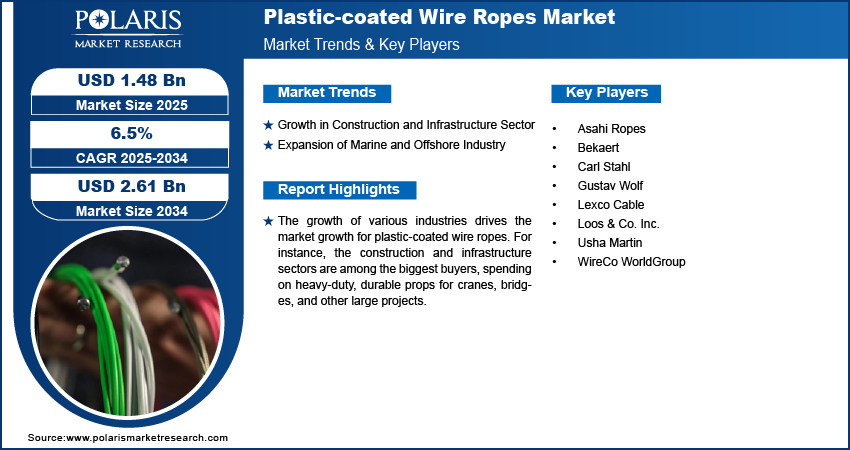
Get Full Segment-Level Forecasts & Insights: Download Sample Report
Segmental Insights
Material Type Analysis
Based on material type, the segmentation includes galvanized steel and stainless steel. The galvanized steel segment held a larger share in 2024. Copper-coated ropes provide efficient, economical solutions, due to the strong corrosion resistance gained from coating steel strands with a layer of zinc. It is widely accepted that ropes are used in construction, transportation, and agriculture due to their balance of strength, durability, and cost. Practical options for outdoor projects are ropes with the requirement to sustain harsh elements without the desired investment in materials.
The stainless steel segment is anticipated to register a higher growth rate during the forecast period. Known for its resistance to rust, chemicals, and extreme temperatures, stainless steel wire ropes are particularly useful in harsh conditions where the use of galvanized ropes is not efficient. For instance, ropes are widely used in the marine and offshore industries and in chemical plants, where they are exposed to corrosive materials.
Diameter Analysis
Based on diameter, the segmentation includes <1/4 inch and >1/4 inch. The <1/4 inch segment held a larger share in 2024. This arises because they are used in a multitude of applications that are not tailored for high strength. These lightweight, flexible, small-diameter ropes do not require specialized equipment for application. It makes them a popular choice in residential and commercial sectors for items such as garage doors, exercise equipment, and clotheslines. The low-cost production in conjunction with high demand for light industrial usages further supports the popularity of these ropes.
The >1/4 inch segment is anticipated to register a higher growth rate during the forecast period. Their fast-paced growth is fueled by an increase in funding for large-scale industries and projects that require their materials to be high-strength. The ropes are utilized in the construction, mining, and oil and gas industries for their ability to lift heavy loads, support large structures, and provide safety in hazardous environments. They are called heavy-duty ropes.
Coating Type Analysis
Based on coating type, the segmentation includes PVC, PE, PP, and others. The PVC segment held the largest share in 2024. PVC is the cheapest, most readily available, and the most diverse in use. It performs satisfactorily across a wide variety of scenarios. PVC has strong protective properties and is resistant to abrasion, corrosion, and UV light, making it suitable for indoor and outdoor use. It is also resistant to rubbing. This flexibility enables PVC to be used in wire ropes of different diameters. Due to these factors, it is used in bulk in most industries, including construction, transportation, and consumer products. The balance of performance and low cost makes PVC the go-to option for manufacturers and end-users, solidifying its leading position.
The polypropylene (PP) segment is anticipated to register the highest growth rate during the forecast period. Although it has a smaller share compared to PVC, demand for PP-coated wire ropes is growing due to enhanced benefits. PP has a lower density, which is advantageous in applications where the rope will come in contact with different chemicals or will be used under marine or fishing applications. PP has other advantageous characteristics as well, such as good resistance to abrasion. As the marine, as well as chemical processing industries expand, the demand for specialized materials is also increasing. As a result, demand for polypropylene is growing at a rapid pace, especially for coatings.
Application Analysis
Based on application, the segmentation includes construction, mining, marine, and others. The construction segment held the largest share in 2024. The ropes are used for multiple functions in the construction industry, including the lifting of heavy materials using cranes, supporting of suspension bridges, and the securing of scaffolds. The ropes are exceptionally protective, and a protective coat in construction is an add-on, as it protects from construction dust, weather, corrosion, and wear and tear. This makes it an optimal and long-lasting choice for protective and safety purposes due to its reliability for the application.
The marine segment is anticipated to register the highest growth rate during the forecast period. It is experiencing rapid growth due to the increased demand for ropes used in harsh environments of humid temperatures and saltwater. The rope used in this segment is for fishing gear, boat rigging, and the mooring of ships. The lifespan of the ropes increases alongside the protective coat, due to the coat pushing back the formation of rust and corrosion. This decreases the rate of replacement needed for the ropes, which is very cost-effective and efficient, as the global maritime trade and industry of offshore wind energy, along with aquaculture, is booming.
Source: Polaris Market Research Analysis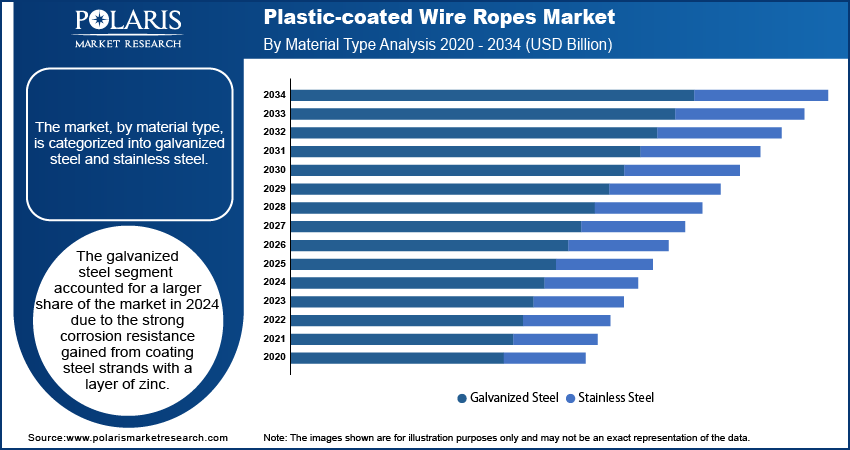
Need Granular Data Across All Market Segments? Request Customization
Regional Analysis
The Asia Pacific plastic-coated wire ropes market accounted for the largest share in 2024. The market is driven by accelerated urbanization, large-scale infrastructure development, and rapidly growing industrialization within the region. Countries such as China and India are undertaking large-scale projects that consist of constructing fully fledged new cities along with other supporting spatial infrastructure, such as highways and seaports. These are critical consumers of plastic-coated wire ropes. Also, the roaming and mining industries are growing fairly rapidly, which adds to the demand.
China Plastic-coated Wire Ropes Market Insights
In Asia Pacific, China is the most active market. China remains one of the key industrial economies across the globe, which creates demand for plastic wire-coated ropes in construction and marine operations. While the country possesses numerous extensive infrastructure projects, its industrial activities also remain very active, making it a principal customer for wire rope. In addition, China’s major industrialized marine and export-focused economies solidify its stance as a significant producer and supplier to other regions.
North America Plastic-coated Wire Ropes Market Insights
The demand for plastic-coated wire ropes in the wire coating construction and industrial sectors in North America is steadily growing. The enduring and corrosion-resistant ropes are in need of modernization of infrastructure, such as roads, bridges, and commercial buildings, as well as from specialized ropes associated with the demands of marine and offshore as coastal areas. Due to the value placed on safety and high-performance materials, various other segments are also gaining traction in the region.
U.S. Plastic-coated Wire Ropes Market Insights
In North America, the US dominated the market in 2024. This is evident in U.S. investment in both the residential and commercial construction industries. There is a continuous need for ropes used in cranes, elevators, and other construction riggings. Further, control cables and various other components of the domestic automotive industry also utilize these ropes. Drilling and rigging are also other segments of the oil and gas domain that are exploring to harness ropes.
Europe Plastic-coated Wire Ropes Market Insights
Europe retains mature industries and an emphasis on quality and safety standards for plastic-coated wire ropes. Activity in construction and the modernization of urban and industrial infrastructure drives the demand. The marine and offshore industries, including shipbuilding and fishing, also sustain demand. There is also increasing demand for recreational and sporting applications of these ropes.
Germany leads in the plastic-coated wire ropes industry in Europe. The robust industrial and advanced manufacturing in Germany drives strong demand for the products. The construction of high-rise buildings in the country’s construction industry is a major consumer of these ropes. High engineering and product innovation in Germany is also resulting in the use of specialized high-performance industrial-coated ropes for different industries.
Source: Polaris Market Research Analysis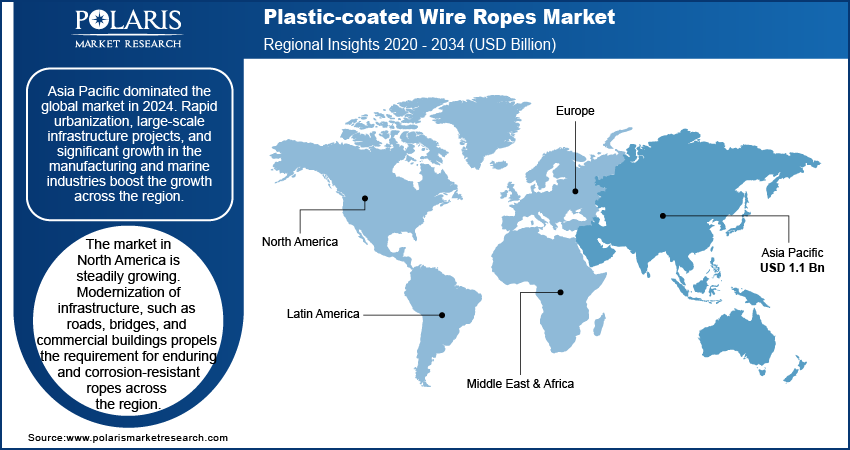
Curious About Regional Market Performance? Request Customization
Key Players and Competitive Insights
The market for plastic-coated wire ropes remains competitive with large-scale manufacturers as well as smaller companies specializing in the same product line. Along with product development, the major players in the manufacturing sector have also focused on expanding their distribution systems and forming partnerships with varied players. Enhanced development in the field pertaining to advanced materials has been noted recently in companies targeting the marine and offshore industries, and advanced materials and coatings in demand are highly durable. Competition remains high with respect to the commodities, with the market positioned on the low-cost and high-profit margin. The necessary result is a product that meets high reliability and safety standards, ensuring product performance and safety.
A few prominent companies in the industry include Usha Martin, WireCo WorldGroup, Carl Stahl, Lexco Cable, Asahi Ropes, Gustav Wolf, Bekaert, and Loos & Co.
Key Players
- Asahi Ropes
- Bekaert
- Carl Stahl
- Gustav Wolf
- Lexco Cable
- Loos & Co. Inc.
- Usha Martin
- WireCo WorldGroup
Industry Developments
In July 2025, Axcel Johnson International expanded globally by acquiring Canada-based Lam-é St-Pierre Group through its lifting solutions business, opening access to a new geographic market.
In May 2025, WireCo launched Boomfit, a plastic-coated steel wire rope using CASAR’s Plast rope technology to enhance durability and performance.
In April 2025, WireCo unveiled a new generation of rotation-resistant hoist ropes called Lazerlift. This product was showcased at a trade show in Munich, Germany, and is designed for use in large cranes, showing the company's focus on innovation in high-capacity lifting solutions.
In February 2025, Bekaert agreed to sell its Steel Wire Solutions businesses in Costa Rica, Ecuador, and Venezuela to Grupo AG for an enterprise value of about USD 73 million.
In July 2024, Carl Stahl GmbH, a company in the lifting and safety technology sector, took over the exoskeleton manufacturer noonee. This acquisition expands Carl Stahl's product offerings and shows a move into new areas, bringing new technologies into its portfolio.
Plastic-coated Wire Ropes Market Segmentation
By Material Type Outlook (Revenue – USD Billion, 2020–2034)
- Galvanized Steel
- Stainless Steel
By Diameter Outlook (Revenue – USD Billion, 2020–2034)
- <1/4 inch
- >1/4 inch
By Coating Type Outlook (Revenue – USD Billion, 2020–2034)
- PVC
- PE
- PP
- Others
By Application Outlook (Revenue – USD Billion, 2020–2034)
- Construction
- Mining
- Marine
- Others
By Regional Outlook (Revenue-USD Billion, 2020–2034)
- North America
- U.S.
- Canada
- Europe
- Germany
- France
- UK
- Italy
- Spain
- Netherlands
- Russia
- Rest of Europe
- Asia Pacific
- China
- Japan
- India
- Malaysia
- Suth Korea
- Indnesia
- Australia
- Vietnam
- Rest of Asia Pacific
- Middle East & Africa
- Saudi Arabia
- UAE
- Israel
- Suth Africa
- Rest of Middle East & Africa
- Latin America
- Mexico
- Brazil
- Argentina
- Rest of Latin America
Plastic-coated Wire Ropes Market Report Scope
| Report Attributes | Details |
| Market Size in 2024 | USD 1.40 billion |
| Market Size in 2025 | USD 1.48 billion |
| Revenue Forecast by 2034 | USD 2.61 billion |
| CAGR | 6.5% from 2025 to 2034 |
| Base Year | 2024 |
| Historical Data | 2020–2023 |
| Forecast Period | 2025–2034 |
| Quantitative Units | Revenue in USD billion and CAGR from 2025 to 2034 |
| Report Coverage | Revenue Forecast, Competitive Landscape, Growth Factors, and Industry Insights |
| Segments Covered |
|
| Regional Scope |
|
| Competitive Landscape |
|
| Report Format |
|
| Customization | Report customization as per your requirements with respect to countries, regions, and segmentation. |
Source: Polaris Market Research Analysis
Plastic-coated Wire Ropes Market FAQ's
The global market size was valued at USD 1.40 billion in 2024 and is projected to grow to USD 2.61 billion by 2034.
The global market is projected to register a CAGR of 6.5% during the forecast period.
Asia Pacific dominated the market share in 2024.
A few key players in the market include Usha Martin, WireCo WorldGroup, Carl Stahl, Lexco Cable, Asahi Ropes, Gustav Wolf, Bekaert, and Loos & Co.
The galvanized steel segment accounted for a larger share of the market in 2024.
The PP segment is expected to witness the fastest growth during the forecast period.
Download Sample Report of Plastic-coated Wire Ropes Market
Please fill out the form to request a customized copy of the research report.


