
Printed Circuit Board Assembly Market Size, Share, Global Analysis Report, 2026-2034
REPORT DETAILS
Market Statistics
PCBA Market Size & Growth Outlook (2025–2034)
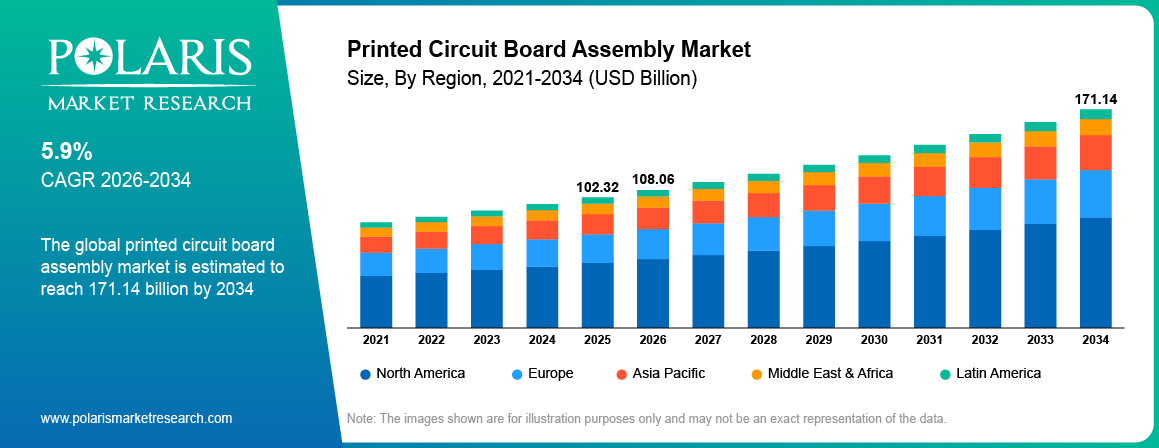
The global printed circuit board assembly market is estimated around USD 102.32 billion in 2025, with consistent growth anticipated during 2026–2034. Expansion is supported by increasing electronics integration across the automotive, telecommunications, aerospace, medical devices, and consumer electronics industries. The market is projected to grow at a CAGR of 5.9% during the forecast period.
Key Takeaways:
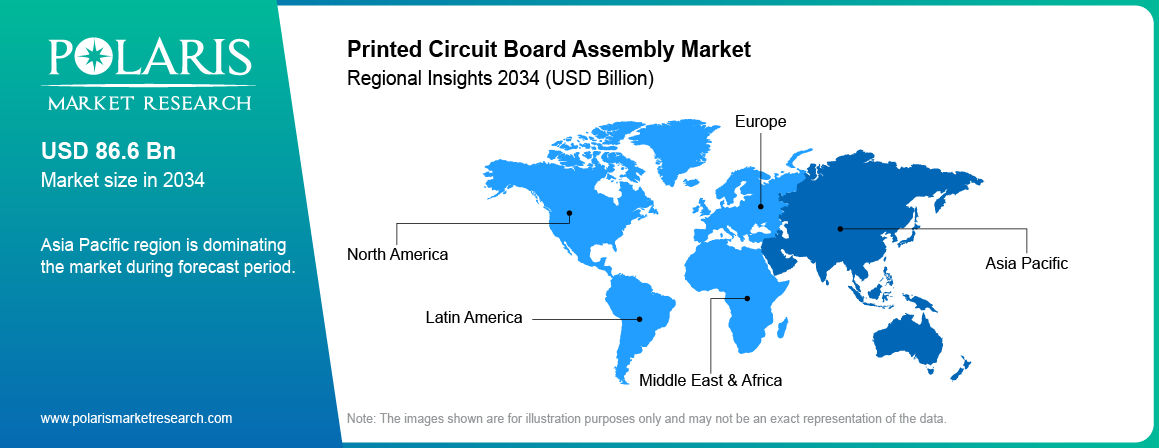
- By Region, Asia Pacific accounted for the largest market share of around 52% in 2025, driven by strong electronics manufacturing hubs and increasing production of semiconductors and consumer electronics across China, Taiwan, South Korea, Japan, and India.
- By Assembly Type, Surface Mount Technology segment accounted for the largest market share of around 63% in 2025, driven by high component density and compatibility with automated PCB assembly processes.
- By Application, Smartphones segment accounted for the largest market share of around 58% in 2025, driven by increasing demand for high-density PCBs used in advanced mobile devices.
- By End-Use Industry, Consumer Electronics segment accounted for the largest market share of around 60% in 2025, driven by rising production of smartphones, laptops, and wearable devices requiring compact and high-performance PCB assemblies.
Market Statistics
- 2025 Market Size: USD 102.32 Billion
- 2034 Projected Market Size: USD 171.14 Billion
- CAGR (2026-2034): 5.9%
- Asia Pacific: Largest market in 2025
Industry Dynamics
- The increasing rate of electric vehicle production is fueling demand for PCB assemblies used for battery management systems and electronic control units.
- Expansion of 5G infrastructure is further boosting demand for high-performance PCB assemblies for 5G equipment.
- High manufacturing cost and electronics supply chain risk are the key challenges for PCB production.
- Growing artificial intelligence hardware and electronics manufacturing is creating market opportunity for high-density PCB assembly technologies.
What is included in the Printed Circuit Board Assembly market?
The printed circuit board assembly market is defined as the process of integrating electronic components into a printed circuit board for the development of functional electronic modules. In this case, a bare board is referred to as a PCB, while a fully assembled board is known as a PCBA. In the PCB assembly industry, this market represents a key stage in the development of electronics manufacturing services that aim to transform boards assembled during the PCB manufacturing stage into fully functional electronic systems for usage in different industries.
The global PCB assembly market is growing steadily as electronics production increases globally. Current size of the PCBA market is based on the increasing demand for PCBAs due to the miniaturization of electronics components, increased density of components on the board, and the rate of technological advancements in digital products.
Source: Polaris Market Research Analysis
To Understand More About this Research:Download Sample Report
The continued growth trend in the PCB industry is driven by increasing levels of integration in automobile electronics, telecommunication infrastructure, aerospace and defense systems, medical devices, consumer electronics, among others. This has continued to dictate the future outlook for the PCBA market globally.
Drivers & Opportunities
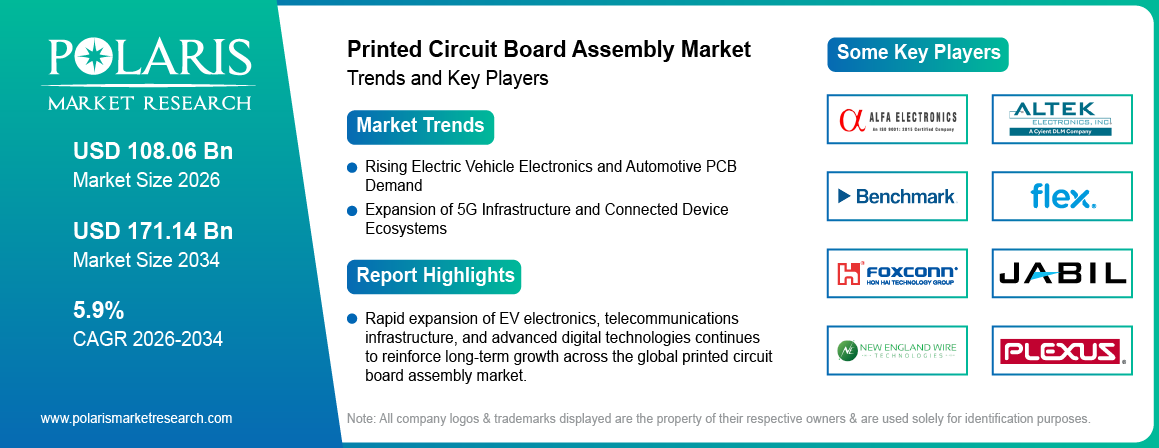
Rising Electric Vehicle Production Increasing Automotive Electronics Demand: The increasing rate of EV adoption has provided a boost for automobile PCBs used in battery management systems, power electronics and others. According to the International Energy Agency, global electric car sales exceeded 17 million units in 2024, rising by more than 25% compared with the previous year. Rising production of EVs are significantly boosting the demand for power control modules, sensors, and communication systems. Therefore, this growth is fueling the overall electronics manufacturing industry and the EV electronics market.
Expansion of 5G Infrastructure and Connected Device Ecosystems: Expansion of 5G technology worldwide is creating a huge demand for high-performance electronic components. The global 5G connections reached 2.25 billion by the end of 2024, according to 5G Americas. This is a significant achievement in the wireless telecommunications industry. The increasing demand for telecommunications equipment, IoT electronics manufacturing, and the overall expansion of 5G technology require high-performance PCB assemblies. This expansion is propelling the growth of the PCB assembly market.
Restraints & Challenges
High manufacturing costs and supply chain risks: The complex process of PCB manufacturing requires costly equipment, skilled labor, and raw materials of high quality. This increases the overall cost of PCB manufacturing. Electronics supply chain challenges are a major manufacturing hindrance for PCB production. Additionally, semiconductor shortage further restrains the market in meeting global demand for PCB.
Opportunity
Growth of AI hardware and advanced electronics manufacturing: Increasing need for AI computing equipment is creating opportunity for advanced PCB technology that handle high-speed and high-density electronic design. In May 2025, Zuken announced the release of the 2025 version of its CR-8000 PCB design solution that includes AI technology for schematic design, intelligent routing, and component placement. Such innovations support smart electronics manufacturing and accelerate development cycles. Increasing demand for industrial electronics and rising need for the manufacturing of AI hardware are expected to boost the market's long-term growth prospects.
PCB Assembly Technology & Manufacturing Process
The printed circuit board assembly (PCBA) is the process by which a bare printed circuit board is converted to a useful electronic product by installing and soldering electronic components onto the board. The process of PCB assembly consists of a group of automated processes for manufacturing PCBs to ensure accurate placement of components, their interconnects, and quality.
Surface Mount Technology (SMT)
Surface mount technology is the most common technology in use in modern electronics manufacturing. In surface mount technology-based PCB assembly, electronic components are attached to the surface of the printed circuit boards. The components used in surface mount technology are compact and lightweight.
Through-Hole Technology (THT)
In this method, the components are inserted into the board after the board is drilled with holes. The components are then soldered to the board on the opposite side of the board. This method is generally used for the manufacture of robust components.
PCB Assembly Process Steps
The steps involved in the manufacture of a PCBA follow a particular sequence that is a part of the overall electronics manufacturing process. The sequence of the steps is as follows:
- Application of Solder Paste - The solder paste is applied to the board with the help of a stencil. This is done to make the required connections to the components to be placed on the board.
- Pick and Place Machine - This machine is required to place the active electronic components on the board where the solder paste is applied.
- Reflow Soldering - The board is taken through a reflow oven to make the required connections to the components placed on the board.
- Inspection - Automated inspection tools are used to identify any error or defects in the board. This is achieved through the use of AOI and X-ray inspection tools.
- Functional Testing - This is the last step of the testing phase for the board, which ensures that the board functions as expected.
This assembly methodology for PCBs ensures accuracy, reliability, and scalability for the electronics industry.
PCB Industry Value Chain Analysis
PCB's value chain forms part of a multi-step electronics industry value chain, which involves raw material suppliers, fabrication houses, and electronics assembly houses. Every step of the value chain in the electronics supply chain is a specific capability in the overall electronics manufacturing infrastructure. The coordination of these capabilities in the electronics supply chain is critical for the consistent manufacture of electronic devices for consumer electronics, automotive, telecommunications, and industrial electronics applications.
-
Raw Material & Component Suppliers
The supply chain of the electronics industry starts with the semiconductor supply chain, which provides various components of the electronics industry, including integrated circuits, microprocessors, resistors, capacitors, connectors, etc. The semiconductor and component manufacturers and suppliers form the foundation for the electronics supply chain.
-
PCB Fabrication
The second step is board fabrication in the PCB fabrication industry. In this step of the supply chain, manufacturers of PCBs fabricate basic boards using various methods, including copper layer lamination, circuit etching, drilling, and plating. Multilayer PCB manufacturing allows for complex electronic circuits, as several conducting layers are integrated into a single board.
-
PCB Assembly & Integration
In the last step, fabricated boards are sent to PCB assembly services providers and EMS providers, where components are placed on the board. Electronics manufacturing services companies perform component placement, soldering, inspection, and testing to complete the assembly process.
Source: Polaris Market Research Analysis
Get Full Segment-Level Forecasts & Insights: Download Sample Report
Segmental Insights
This report offers detailed coverage of the printed circuit board assembly market by assembly type, application, and end-use industry to help readers identify the fastest expanding and most attractive demand segments.
By Assembly Type
-
Surface Mount Technology
Surface Mount Technology leads the SMT PCB market due to high component density and automated assembly capability. SMT facilitates compact circuitry that is required in smartphones, computers, and other electronic devices. The high efficiency of SMT in production, along with its ability to be integrated into automated production lines, ensures its position in all forms of PCB assembly.
-
Mixed Technology
The mixed technology of PCB assembly is growing rapidly, where SMT and through-hole technology are employed in a single PCB assembly process. This is done to cater complex circuitry where some components need strong mechanical connections.
By Application
-
Smartphones
The highest volume of PCB assembly is required in smartphones among all electronic devices that fall under the category of electronics PCB applications. Modern smartphones need multiple high-density PCBs for processors, cameras, sensors, and communication devices. The constant evolution of smartphones is creating a huge demand for PCB assembly.
-
EV Electronics
The fastest-growing segment of the PCB assembly application is EV electronics. Electric vehicles contain sophisticated electronic control systems. There is a rapid expansion of electric vehicles production globally which in turn is increasing the demand for PCBs.
By End-Use Industry
-
Consumer Electronics
Consumer electronics PCBs constitute the highest market share of PCB demand. These devices, including smartphones, laptops, and wearable technology, need compact but high-performance PCB assembly technology. The need for constant product upgrades and increasing production of consumer electronics also contributes to PCB manufacturing volume.
-
Automotive
Automotive industry is expected to grow fastest in PCB assembly industry. The increasing trend of integrating various automotive systems, including ADAS systems and EV technology, is boosting PCB demand in this sector. The trend of electrifying vehicles is also increasing the complexity of PCBs used in these applications.
Source: Polaris Market Research Analysis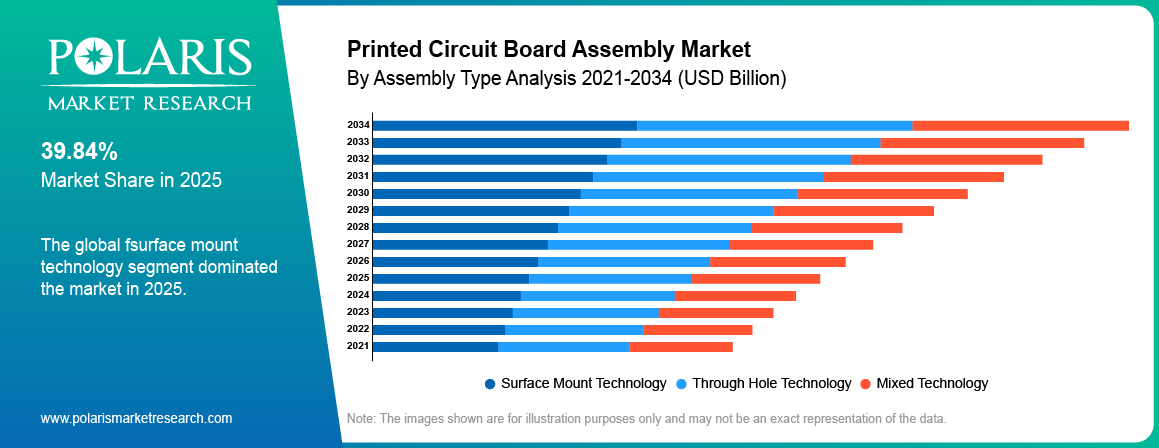
Need Granular Data Across All Market Segments? Request Customization
Regional Analysis
Asia Pacific Printed Circuit Board Assembly Market Assessment
Asia Pacific dominated the PCB market in 2025 globally, supported by major electronics manufacturing hubs in China, Taiwan, South Korea, Japan, and India. The Chinese government’s Ministry of Industry and Information Technology reported that China’s electronic information manufacturing sector recorded steady growth during the first three quarters of 2025, with value-added industrial output increasing by 10.9 percent on a year-over-year basis. The strong output of semiconductors, consumer electronics, and telecommunication equipment are boosting the demand for PCB assemblies in the region.
North America Printed Circuit Board Assembly Market Insight
North America PCB assembly market is projected to grow at a rapid pace due to strong defense electronics investment and advanced manufacturing capabilities. Growing investment in aerospace technology, communication devices, and military electronics is resulting in an increased demand for reliable PCB assemblies. The Stockholm International Peace Research Institute found that the US military expenditure for 2023 was 916 billion dollars, accounting for almost 68% of the total NATO defense expenditure. These type of investment highlights the need for efficient and high-tech PCB’s across US electronics manufacturing, particularly in defense-grade electronic systems.
Europe Printed Circuit Board Assembly Market Overview
Europe was the second largest market in PCB assembly driven by increasing adoption of industrial automation and smart manufacturing technologies. According to the International Federation of Robotics, around 23,000 industrial robots were installed in 2024. This is the second-highest number of installations over the past five years. The rising need for electronics components in automotive production and industrial equipment boosted the usage of PCBA technology in sensors, control systems, and power supplies.
Latin America Printed Circuit Board Assembly Market Assessment
Latin America registered a gradual growth in PCBA as various governments in the region implemented measures aimed at enhancing their electronic manufacturing industries. This saw a rise in the production of electronic components and assemblies, which were aimed at promoting emerging electronic manufacturing markets, especially in regions that wanted to develop their own manufacturing industries.
Source: Polaris Market Research Analysis
Curious About Regional Market Performance? Request Customization
Key Players & Competitive Analysis Report
The competitive analysis of the printed circuit board assembly market emphasized high level of competition from global electronics manufacturing companies providing electronic component manufacturing services. The companies providing PCB assembly services are focused on providing high-end technology solutions to the electronics industry.
Key companies operating in the Printed Circuit Board Assembly market include Alfa Electronics, Altek Electronics, Inc., Benchmark Electronics, Inc., Creation Technologies, Flex Ltd., Foxconn Technology Group, Jabil Inc., Miracle Electronics Devices Pvt Ltd, New England Wire Technologies, Plexus Corp., Sanmina Corporation, TTM Technologies, Inc., Viasion, VSE (Vantage Solutions Electronics), and Zollner Elektronik AG.
Key Players
- Alfa Electronics
- Altek Electronics, Inc.
- Benchmark Electronics, Inc.
- Creation Technologies
- Flex Ltd.
- Foxconn Technology Group
- Jabil Inc.
- Miracle Electronics Devices Pvt Ltd
- New England Wire Technologies
- Plexus Corp.
- Sanmina Corporation
- TTM Technologies, Inc.
- Viasion
- VSE (Vantage Solutions Electronics)
- Zollner Elektronik AG
Investment Opportunities & Future Outlook
The PCBA industry outlook remains strong as global electronics demand expands across multiple high-growth sectors. Rising semiconductor production and increasing electronics content in modern devices are strengthening the PCB market future, particularly for advanced multilayer and high-density assemblies. Governments and private investors are also supporting electronics manufacturing investment through semiconductor fabrication programs and domestic supply chain development initiatives.
Growth in electric vehicle electronics is a major driver. EVs require complex power electronics, battery management systems, and sensor networks, all of which depend on advanced PCB assemblies. AI hardware manufacturing is also expanding demand for high-performance PCBs used in data center servers, GPUs, and accelerator platforms.
In addition, the expanding smart device ecosystem including IoT devices, wearable electronics, and connected home systems is increasing the need for compact and high-density PCB assemblies.
Industry Developments
- March 2026: DCX Systems broadened its capabilities through its subsidiary Raneal Advanced Systems with the launch of an oversized printed circuit board assembly line that accommodate PCBs up to 55 inches in length.
- June 2024: APCT introduced the AdvancedPCB brand that encompasses Advanced Printed Circuit Technology, Advanced Circuits, and San Diego PCB Design under a single brand that offers a range of services from PCB design to fabrication to assembly.
Printed Circuit Board Assembly Market Segmentation
By Assembly Type Outlook (Revenue, USD Billion, 2021-2034)
- Surface Mount Technology
- Through Hole Technology
- Mixed Technology
By Application Outlook (Revenue, USD Billion, 2021-2034)
- Smartphones
- Computers
- EV Electronics
- Communication Infrastructure
- Industrial Automation
By End User Industry Outlook (Revenue, USD Billion, 2021-2034)
- Consumer Electronics
- Automotive
- Telecommunications
- Aerospace & Defense
- Healthcare
- Industrial Electronics
By Regional Outlook (Revenue, USD Billion, 2021-2034)
- North America
- US
- Canada
- Europe
- Germany
- France
- UK
- Italy
- Spain
- Netherlands
- Russia
- Rest of Europe
- Asia Pacific
- China
- Japan
- India
- Malaysia
- South Korea
- Indonesia
- Australia
- Vietnam
- Rest of Asia Pacific
- Middle East & Africa
- Saudi Arabia
- UAE
- Israel
- South Africa
- Rest of Middle East & Africa
- Latin America
- Mexico
- Brazil
- Argentina
- Rest of Latin America
Printed Circuit Board Assembly Market Report Scope
| Report Attributes | Details |
| Market Size in 2025 | USD 102.32 Billion |
| Market Size in 2026 | USD 108.06 Billion |
| Revenue Forecast by 2034 | USD 171.14 Billion |
| CAGR | 5.9% from 2026 to 2034 |
| Base Year | 2025 |
| Historical Data | 2021–2024 |
| Forecast Period | 2026–2034 |
| Quantitative Units | Revenue in USD Billion and CAGR from 2026 to 2034 |
| Report Coverage | Revenue Forecast, Competitive Landscape, Growth Factors, and Industry Trends |
| Segments Covered |
|
| Regional Scope |
|
| Competitive Landscape |
|
| Report Format |
|
| Customization | Report customization as per your requirements with respect to countries, regions, and segmentation. |
Source: Polaris Market Research Analysis
Printed Circuit Board Assembly Market FAQ's
The global market size was valued at USD 102.32 Billion in 2025 and is projected to grow to USD 171.14 Billion by 2034.
Asia Pacific dominated the market share in 2025, due to large-scale electronics manufacturing capacity and strong demand from consumer electronics and automotive industries.
PCB assemblies are widely used in consumer electronics, automotive electronics, telecommunications, aerospace and defense, medical devices, and industrial automation systems.
Key companies include Alfa Electronics, Altek Electronics, Inc., Benchmark Electronics, Inc., Creation Technologies, Flex Ltd., Foxconn Technology Group, Jabil Inc., Miracle Electronics Devices Pvt Ltd, Plexus Corp., Sanmina Corporation, TTM Technologies, Inc., Viasion, VSE (Vantage Solutions Electronics), and Zollner Elektronik AG.
Surface mount technology (SMT), high-density interconnect PCBs, automated inspection technologies, and smart manufacturing technologies are influencing the PCB assembly market.
Growth of the PCB assembly market is influenced by the increasing demand for electronics used in EVs, the growth of 5G networks, the increasing electronics miniaturization trend, and the growth of automated electronics manufacturing technologies.
Download Sample Report of Printed Circuit Board Assembly Market
Please fill out the form to request a customized copy of the research report.


