Purging Compound Market Size, Share, Growth | Trends, 2025-2034
REPORT DETAILS
Market Statistics
Market Overview
The purging compound market size was valued at USD 786.15 million in 2024 and is projected to register a CAGR of 5.3% from 2025 to 2034. The increased use of multimaterial and specialty polymers, such as polycarbonate sheet, PEEK, and nylon, boosts the industry growth. High-performance polymers require precise transitions to prevent contamination, buildup, or defects. It ensures smooth operation by clearing residues, minimizing downtime, and maintaining product quality during frequent material changes, which is contributing to the overall growth.
Key Insights
- In 2024, the mechanical purging segment accounted for the largest share. It is due to its effectiveness in cleaning processing equipment and preventing contamination between different production processes.
- The injection molding segment is expected to register the highest CAGR during the forecast period. The growth is driven by the rising demand for high-quality, precise plastic components across various industries, including automotive and consumer goods.
- In 2024, North America dominated the global revenue share. The increasing government initiatives aimed at promoting sustainable manufacturing practices and reducing environmental impact fuel the dominance.
- The Asia Pacific purging compound industry is expected to register the highest CAGR during the forecast period. The growth is fueled by the rapid industrialization in the region, particularly in sectors such as automotive, consumer goods, and packaging.
Industry Dynamics
- Expanding automotive and consumer goods industries propel the demand for purging compounds.
- The growing adoption of sustainable manufacturing practices propels the market growth.
- Reliance on traditional methods hinders the industry expansion.
- Technological advancements and innovations in compounds, such as hybrid mechanical-chemical purging solutions, are expected to provide lucrative opportunities in the coming years.
Market Statistics
2024 Market Size: USD 786.15 million
Source: Polaris Market Research Analysis
2034 Projected Market Size: USD 1,311.37 millionSource: Polaris Market Research Analysis
CAGR (2025–2034): 5.3%Source: Polaris Market Research Analysis
North America: Largest market in 2024AI Impact on Purging Compound Market
- AI technologies analyze machine performance and cleaning cycles. It reduces downtime and material waste, as well as optimizes production processes.
- Predictive maintenance enabled by AI helps manufacturers predict equipment malfunction and schedule purging operations more effectively. This saves costs and improves uptime.
- Vision capabilities of AI systems can inspect multiple parts per minute. It ensures higher quality standards and minimizes human errors in plastic processing environments.
- Integration of this technology drives the adoption of purging compounds in automotive, healthcare, consumer electronics, and packaging sectors due to the rising demand for cleaner, more efficient production lines.
- AI adoption enables customization in purging solutions by analyzing real-time data. It provides more targeted and effective cleaning processes.
Source: Polaris Market Research Analysis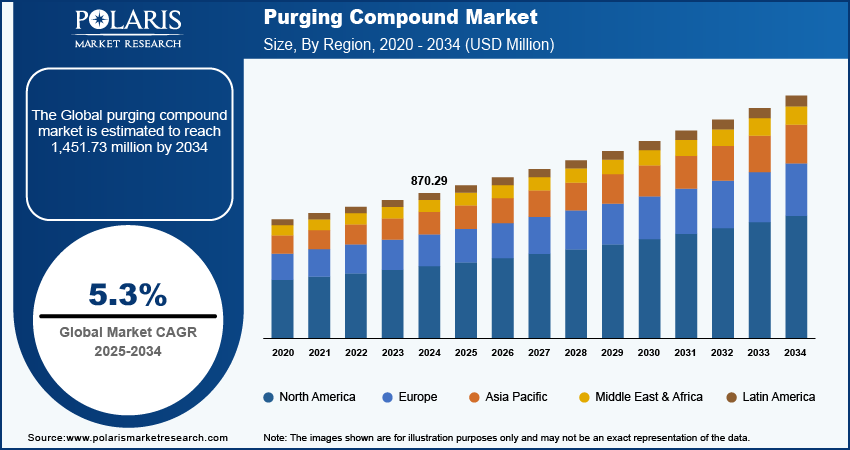
To Understand More About this Research: Download Sample Report
The purging compound market size was valued at USD 786.15 million in 2024 and is projected to grow at a CAGR of 5.3% during the forecast period. The increased use of multimaterial and specialty polymers, such as polycarbonate sheet, PEEK, and nylon. High-performance polymers require precise transitions to prevent contamination, buildup, or defects. It ensures smooth operation by clearing residues, minimizing downtime, and maintaining product quality during frequent material changes, which is further contributing to the overall growth.
It is a specialized cleaning material used to remove contaminants, residual polymers, carbon buildup, and color deposits from plastic processing equipment such as plastic injection molding machines, extruders, and blow molding machines. Furthermore, industries are embracing light weighting and customization, leading to frequent material changes and greater use of diverse polymers. This drives demand for compounds to prevent contamination which ensure smooth transitions, and reduce downtime, further fueling market expansion.
Growth in extrusion and blow molding applications is driving demand for purging compound. Extrusion processes are more prevalent in packaging and industrial applications; they are vital for preventing downtime caused by polymer deposits. Thus, there is a rising demand for, further contributing to the market growth. Moreover, technological advancements and innovations in compounds, such as hybrid mechanical-chemical purging solutions, enable more thorough cleaning, even at higher temperatures, improving their efficiency across diverse applications.
Market Trend Analysis
Expanding Automotive and Consumer Goods Industries
The expanding automotive sector is driving demand, as the industry relies heavily on advanced polymers for components like dashboards, headlight covers, and trims, requiring contamination-free production. For instance, according to the Marklines, US sales for passenger cars and light commercial vehicles combined reached 11.695 million units from January to September 2023, compared to 11.766 million units sold in 2024. Hence, the expanding automotive sector is increasingly adopting the compound, thereby fueling market growth.
The Growing Adoption of Sustainable Manufacturing Practices
The growing emphasis on sustainable manufacturing practices is significantly boosting the demand. For instance, in July 2024, the Healey-Driscoll administration has allocated USD 10.28 million in grants to 13 enterprises as part of the Massachusetts Manufacturing Innovation Initiative, aimed at promoting sustainable alternatives to conventional manufacturing practices. Manufacturers are increasingly prioritizing waste reduction and carbon footprint minimization, aiming to lower material scrap during the purging process. Advanced compounds play a crucial role in this effort by reducing the amount of resin needed for effective cleaning, which enhances efficiency and supports sustainability goals. Additionally, the rise in popularity of biodegradable and recyclable compounds aligns with the industry's to environmentally responsible practices, further driving market growth as companies seek solutions that contribute to the sustainability initiatives.
Source: Polaris Market Research Analysis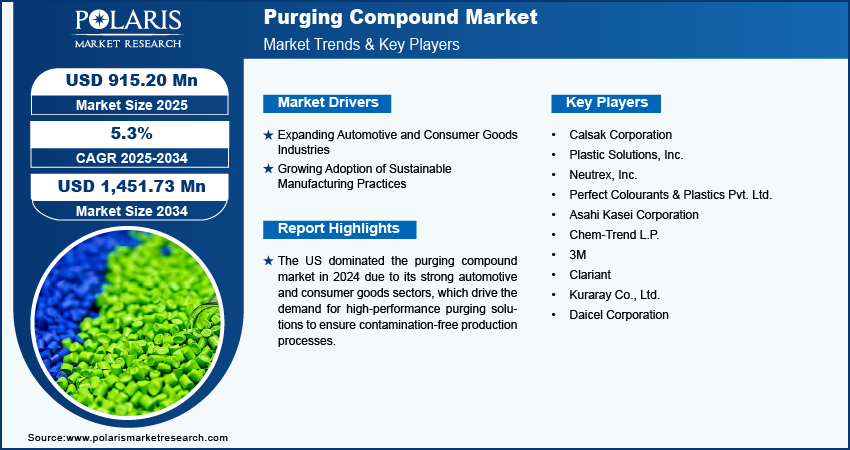
Get Full Segment-Level Forecasts & Insights: Download Sample Report
Market Segment Insights
Market Breakdown by Type Outlook
Based on type, it includes mechanical purging, chemical purging, and liquid purging. In 2024, the mechanical purging segment accounted for the largest market share due to its effectiveness in cleaning processing equipment and preventing contamination between different production process. Mechanical compounds utilize harsh action to remove residual materials, ensuring a thorough cleanse of machinery used in various applications, such as injection molding and extrusion. Furthermore, the increasing demand for efficiency and quality in manufacturing processes, where minimizing downtime and maintaining product integrity are crucial. Thus, the mechanical purging segment accounted for the largest market share in 2023.
Market Breakdown by Process Outlook:
Based on process, it includes extrusion, injection molding, and blow molding. The injection molding segment is expected to grow at fastest CAGR over the forecast period due to the rising demand for high-quality, precise plastic components across various industries, including automotive, consumer goods, and medical devices. This growth is fueled by advancements in injection molding technologies, which enable greater efficiency, reduced cycle times, and enhanced production capabilities. Additionally, the increasing trend towards customization and lightweighting is driving manufacturers to adopt injection molding for producing complex shapes and designs with reduced material waste. Companies strive to meet evolving consumer preferences and regulatory requirements, thus the injection molding segment's robust growth is anticipated to continue throughout the forecast period.
Source: Polaris Market Research Analysis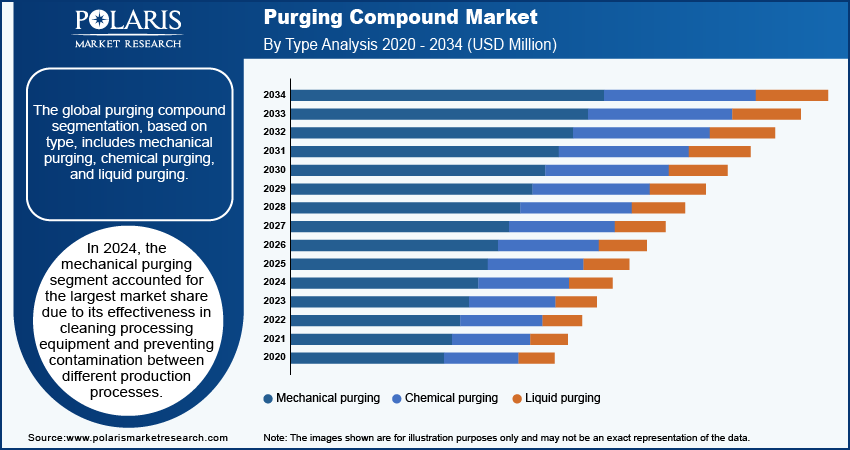
Need Granular Data Across All Market Segments? Request Customization
Regional Analysis
By region, the study provides market insights into North America, Europe, Asia Pacific, Latin America, and the Middle East & Africa. In 2024, North America purging compound market dominated the market due to the increasing government initiatives aimed at promoting sustainable manufacturing practices and reducing environmental impact. For instance, in September 2024, the US Department of Energy has allocated USD 3 million to launch a new initiative aimed at enhancing and expanding the workforce dedicated to industrial decarbonization efforts across America. This funding is intended to support skilled labor in the transition to sustainable industrial practices, facilitating the reduction of carbon emissions in various sectors. These initiatives encourage industries to adopt efficient production methods that minimize waste and energy consumption, leading to increased adoption of compounds as a key component of operational efficiency.
US accounted for the largest share due to its strong automotive and consumer goods sectors drive the demand for high-performance purging solutions to ensure contamination-free production processes.
Source: Polaris Market Research Analysis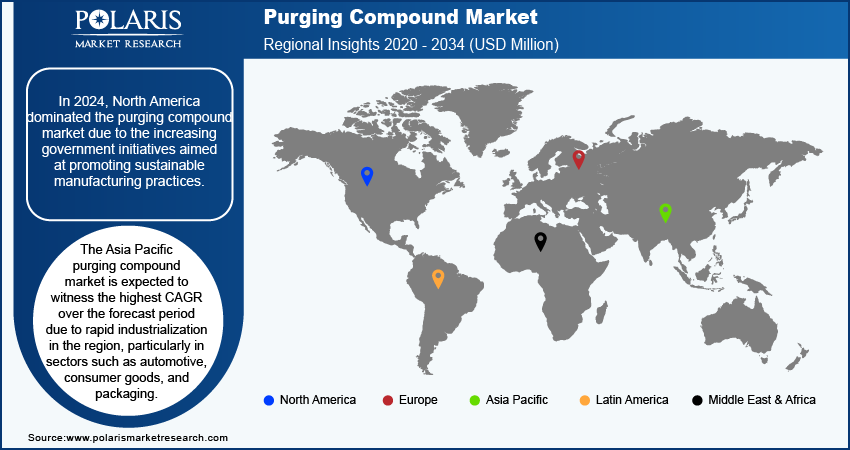
Curious About Regional Market Performance? Request Customization
The Asia Pacific purging compound market is expected to witness the highest CAGR over the forecast period due to rapid industrialization in the region, particularly in sectors such as automotive, consumer goods, and packaging, is driving increased manufacturing activities, which in turn boosts demand for efficient purging solutions to maintain production quality. Additionally, the growing demand for high-performance polymers necessitates effective compounds to prevent contamination and defects during production processes.
China is expected to grow significantly over the forecast period due to the growing automotive sector, particularly with the rise of electric vehicles (EVs). For instance, according to the China Association of Automobile Manufacturers (CAAM), In 2023, China's automotive exports experienced a remarkable year-on-year increase of 57.9%, reaching an unprecedented total of 4.91 million vehicles. China's automotive industry evolves, manufacturers are increasingly adopting advanced polymers and innovative production techniques to meet the growing demand for lightweight, efficient, and high-performance components. The shift towards EVs necessitates the use of specialized materials that require precise handling and cleaning during manufacturing processes, driving the demand for effective compounds.
Key Players and Competitive Insights
The competitive landscape of the purging compound market is characterized by a diverse range of manufacturers and suppliers competing for market share through innovation, product differentiation, and strategic partnerships. Major players in the industry focus on developing advanced formulations that enhance cleaning efficiency and minimize material waste, investing heavily in research and development to create high-performance solutions tailored for specific applications, such as high-temperature processing. Additionally, companies are differentiating their products by incorporating sustainable materials, such as biodegradable and recyclable compounds, to align with the growing emphasis on environmental responsibility and comply with emerging regulations. Strategic partnerships with raw material suppliers and technology providers further enhance market presence, allowing companies to leverage specialized expertise and improve product quality.
A few key major players are Calsak Corporation; Plastic Solutions, Inc.; Neutrex, Inc.; Perfect Colourants & Plastics Pvt. Ltd.; Asahi Kasei Corporation; Chem‑Trend L.P.; 3M; Clariant; Kuraray Co., Ltd.; Daicel Corporation.
Asahi Kasei is a Japanese company engaged in manufacturing, development and distribution of chemicals across the globe. The company has three major sectors materials, healthcare, and household. Each segment is further segment into subsegments as material is further bifurcated into basic materials, specialty solutions, electronics, and performance products. The household sector deals in construction materials and health care into pharmaceutical drugs. Asahi Kasei Plastics North America and Asahi Kasei Asaclean Americas, renowned suppliers of advanced purging compounds and concentrates, have officially merged. The newly formed entity operate under the name APNA and will be headquartered in Fowlerville, Michigan. This consolidation aims to enhance operational efficiencies and expand market reach in the purging solutions sector.
3M is a manufacturer and distributor of industrial products and solutions. The companys portfolio of products includes advanced materials, display materials and systems, home care, home improvement, stationery and office, personal safety, roofing granules, closure and masking systems and others. 3M also offers various solutions such as medical, oral care, consumer health care, food safety, health information systems. 3M serves customers in various industries such as automotive, electronics, health care, safety, energy and consumer. 3M Scotch Weld Purge Material 3756 is an engineered hot melt designed specifically to purge polyurethane reactive thermoset adhesives from bulk dispensing systems. This formulation effectively cleans and clears the equipment, ensuring optimal performance and minimizing cross-contamination between different adhesive applications.
Key Companies
- Calsak Corporation
- Plastic Solutions, Inc.
- Neutrex, Inc.
- Perfect Colourants & Plastics Pvt. Ltd.
- Asahi Kasei Corporation
- Chem‑Trend L.P.
- 3M
- Clariant
- Kuraray Co., Ltd.
- Daicel Corporation
Purging Compound Industry Developments
In March 2024, PolySource partnerd with Asaclean to distribute their purging compounds in the U.S. This collaboration enhances the availability and technical support of Asaclean's products, providing plastics manufacturers access to high-quality materials backed by PolySource’s renowned customer service.
Purging Compound Market Segmentation
By Type Outlook (Revenue, USD Million, 2020–2034)
- Mechanical purging
- Chemical purging
- Liquid purging
By Process Outlook (Revenue, USD Million, 2020–2034)
- Extrusion
- Injection molding
- Blow molding
By Regional Outlook (Revenue, USD Million, 2020–2034)
- North America
- US
- Canada
- Europe
- Germany
- France
- UK
- Italy
- Spain
- Netherlands
- Russia
- Rest of Europe
- Asia Pacific
- China
- Japan
- India
- Malaysia
- South Korea
- Indonesia
- Australia
- Vietnam
- Rest of Asia Pacific
- Middle East & Africa
- Saudi Arabia
- UAE
- Israel
- South Africa
- Rest of Middle East & Africa
- Latin America
- Mexico
- Brazil
- Argentina
- Rest of Latin America
Purging Compound Report Scope
| Report Attributes | Details |
| Market Size Value in 2024 | USD 786.15 million |
| Market Size Value in 2025 | USD 826.71 million |
| Revenue Forecast by 2034 | USD 1,311.37 million |
| CAGR | 5.3% from 2024 to 2032 |
| Base Year | 2024 |
| Historical Data | 2020–2023 |
| Forecast Period | 2025–2034 |
| Quantitative Units | Revenue in USD million and CAGR from 2025 to 2034 |
| Report Coverage | Revenue Forecast, Market Competitive Landscape, Growth Factors, and Trends |
| Segments Covered |
|
| Regional Scope |
|
| Competitive Landscape |
|
| Report Format |
|
| Customization | Report customization as per your requirements with respect to countries, regions, and segmentation. |
Source: Polaris Market Research Analysis
purging compound market FAQ's
The global purging compound market size was valued at USD 870.29 million in 2024 and is projected to grow to USD 1,451.73 million by 2034.
The global market is projected to register a CAGR of 5.3% during the forecast period
In 2024, North America dominated the market due to the increasing government initiatives aimed at promoting sustainable manufacturing practices.
A few key players in the market are Calsak Corporation; Plastic Solutions, Inc.; Neutrex, Inc.; Perfect Colourants & Plastics Pvt. Ltd.; Asahi Kasei Corporation; Chem?Trend L.P.; 3M; Clariant; Kuraray Co., Ltd.; and Daicel Corporation.
In 2024, the mechanical purging segment dominated the market share due to its effectiveness in cleaning processing equipment and preventing contamination between different production processes.
The injection molding segment is expected to witness highest CAGR over the forecast period due to the rising demand for high-quality, precise plastic components across various industries.
Download Sample Report of purging compound market
Please fill out the form to request a customized copy of the research report.


