
Razor Market Size, Share, Industry Growth Report, 2025-2034
REPORT DETAILS
Market Statistics
Market Overview
The global razor market size was valued at USD 14.2 billion in 2024, and it is projected to register a CAGR of 6.50% from 2025 to 2034. Personal grooming trends and product innovations are among the key growth drivers in the market. It is poised for further growth with the rising awareness regarding personal hygiene.
Key Insights
- Based on product type, the cartridge segment dominated the razor market due to the easy application and affordability of this type, making it a popular choice among a broad consumer base.
- The women’s consumer segment is expected to record a higher CAGR over the forecast period. Razor manufacturers focus on offering products designed to meet the specific needs of women as they have begun redefining their grooming and personal care practices due to evolving perceptions of beauty.
- North America leads the global razor manufacturing industry, owing to the strong contribution of manufacturers such as Procter & Gamble (P&G), Schick, and Harry's, Inc.
- The razor industry in Asia Pacific is expected to grow at the fastest CAGR from 2025 to 2034. Increased willingness among consumers to spend on personal care products, including cost-effective hair removal equipment, benefits razor businesses in the region.
Industry Dynamics
- Disposable and cartridge razors significantly contribute to the overall razor market due to their convenience and ease of use, which enable them to cater to fast-paced lifestyles by providing quick and efficient grooming solutions.
- Innovative razor designs, featuring multi-blade heads, pivoting heads, and lubrication strips, have resulted in an enhanced shaving experience for users, in turn fueling razor sales.
- The use of sustainable packaging and eco-friendly raw materials, and an upsurge in the preference for e-commerce as a major sales channel would continue to propel the razor market growth in the future.
- The burgeoning popularity of razors as a hair removal product among women and fading misconceptions regarding their use will likely continue to boost razor demand in the coming years.
- Disposable and cartridge razors lead to considerable waste generation and environmental impact, which limits their use, especially among eco-conscious consumers.
Market Statistics
2024 Market Size: USD 14.2 billion
Source: Polaris Market Research Analysis
2034 Projected Market Size: USD 24.8 billionSource: Polaris Market Research Analysis
CAGR (2025–2034): 6.50%Source: Polaris Market Research Analysis
North America: Largest market in 2024AI Impact on Razor Market
- AI-based automation of manufacturing processes has the potential to transform razor businesses by streamlining design, manufacturing, and product personalization operations, among others.
- The integration of artificial intelligence (AI) and smart technologies has transformed the operations of electric shavers, thereby ushering in a new era in personal care by revolutionizing the hair removal experience.
- AI can impart adaptability to electric razors by aiding in the ability to sense different hair types (such as coarse beard hair or fine facial hair) and adjusting the cutting mechanism accordingly.
Source: Polaris Market Research Analysis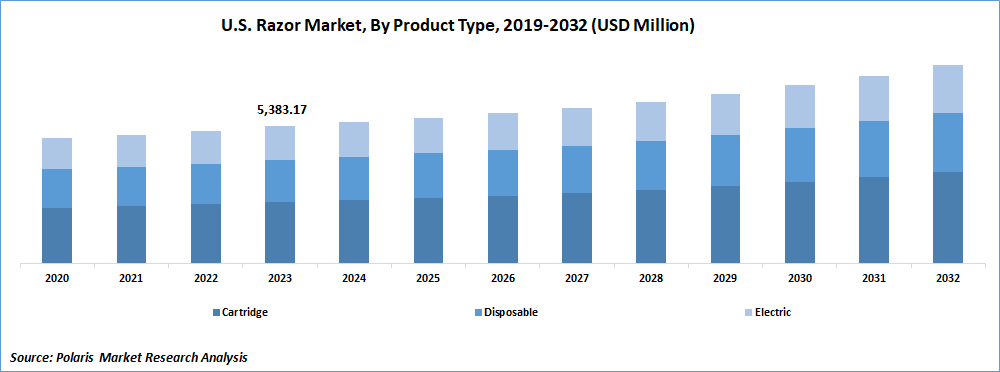
To Understand More About this Research: Download Sample Report
The razor market is poised for sustained growth, driven by an increasing emphasis on men’s grooming and growing consumer awareness regarding personal hygiene. The expansion of men's grooming products is indication of a broader trend towards self-care and an increased focus on appearance. As men increasingly prioritize grooming and aesthetics in their daily routines, demand for these products is rising. Additionally, the adoption of sustainable packaging and eco-friendly raw materials is further driving growth in the razor market.
The evolution of cultural trends particularly in western societies, has ushered in a renewed focus on grooming, spanning both men and women, particularly in the realm of hair care and beard styling. This cultural shift underscores an increasing penchant for meticulous appearance upkeep.
The market is also propelled by the inherent advantages of razors, which include their seamless maneuverability, user-friendly attributes, and widespread accessibility. These attributes are poised to amplify the razor market growth. Also, the expanding e-commerce landscape provides a robust platform for the broad availability of razors, setting the stage for substantial revenue generation within the industry.
Razor Market Trends:
Consumer Convenience and Accessibility is Projected to Spur Growth of Disposable and Cartridge Razors
Disposable and cartridge razors have become pivotal in shaping the razor market due to their convenience and ease of use. Their ability to cater to fast-paced lifestyles by providing quick and efficient grooming solutions has made them indispensable. Disposable razors offer ready-to-use convenience, eliminating the need for preparation associated with traditional straight or safety razors. Similarly, cartridge razors feature systems for rapid blade replacement, enhancing efficiency and reducing downtime. The ergonomic design of both types of razors improves user comfort and shaving quality while minimizing the risk of nicks and cuts.
The widespread adoption is also driven by accessibility and affordability. Disposable razors are readily available in supermarkets and online platforms, making them an attractive choice for budget-conscious consumers and travelers. Cartridge razors, though costlier upfront, provide long-term value through reusable handles and replaceable blades. Their compact and lightweight nature further supports their travel-friendliness, with minimal maintenance requirements, appealing to those seeking hassle-free grooming solutions.
Leading brands such as Gillette leverage the user-friendly attributes of these razors in their marketing strategies, emphasizing features such as ergonomic design, quick blade replacement, and travel convenience. The rise of subscription services for cartridge razors has added a new dimension of convenience, ensuring a steady supply of replacement blades. These factors collectively drive razor market revenue, reflecting strong and sustained demand for these grooming tools as consumer lifestyles increasingly favor efficiency and simplicity.
Innovative Designs and Technology
Innovative designs and technologies have significantly shaped the razor market, enhancing the shaving experience through advanced features such as multi-blade systems, pivoting heads, and lubrication strips. Multi-blade razors reduce the number of passes needed for a close shave and minimize skin irritation while pivoting heads adapt to facial contours, improving comfort and reducing effort. Lubrication strips with moisturizing ingredients further enhance the shave by reducing friction and protecting the skin. Precision trimmers and ergonomic handles address detailed grooming needs and ensure a comfortable grip, respectively.
The use of advanced materials, such as coated blades and high-quality stainless steel, boosts durability and performance. For instance, in March 2024, Procter & Gamble introduced advanced U.S. and German technologies in Vietnam to expand razor and blade production for Asia-Pacific export. The technological advancements cater to evolving consumer demands for superior performance and convenience as well as align with broader societal values. The integration of eco-friendly materials and designs reflects a growing awareness of environmental impact. Such innovations are pivotal in driving razor market growth, as they enhance product appeal and address the diverse needs of modern consumers.
Source: Polaris Market Research Analysis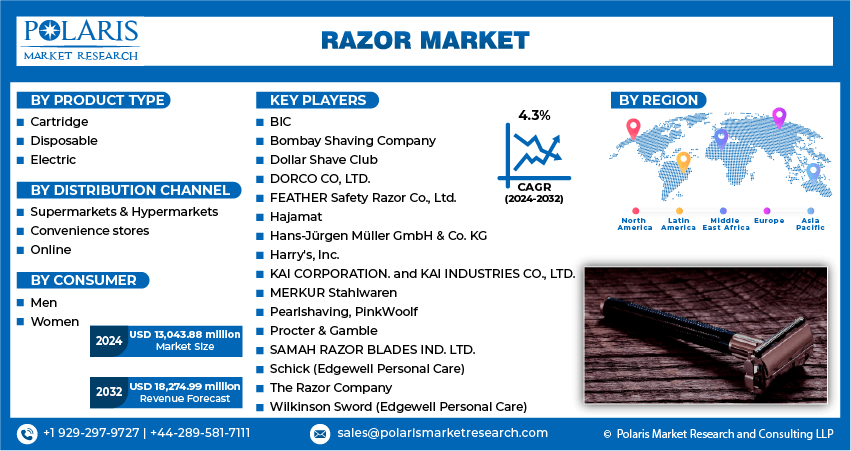
Get Full Segment-Level Forecasts & Insights: Download Sample Report
Segment Insights:
Razor Product Type Insights:
The global razor market segmentation, based on product type includes cartridge, disposable, and electric. In 2024, the cartridge segment dominated the market, accounting for 51.4% of market revenue (6,521.47 Billion). The cartridge segment of the razor market is favored for its easy application and affordable price, making it a popular choice among a broad consumer base. Cartridge razors are designed for quick and simple blade replacements, reducing the time and effort required for maintenance. This convenience, combined with its cost-effectiveness, appeals to many users looking for reliable and budget-friendly grooming solutions. The affordability of cartridge razors makes them accessible to a wide audience, further solidifying their popularity in the razor market.
Cartridge razors are considered safe for all skin types due to their ergonomic designs and advanced features, such as lubrication strips that minimize friction and prevent irritation. For instance, GilletteLabs’ Exfoliating Bar razor features advanced five-blade cartridges, 2D FlexDisc technology, an ergonomic handle, a magnetic stand, and a premium travel kit. Their reusable handles and replaceable blades contribute to long-term savings by reducing the need for frequent purchases. This combination of safety, usability, and cost-effectiveness enhances their appeal, making cartridge razors a practical and economical choice for a diverse range of consumers.
Razor Consumer Insights:
The global razor market segmentation, based on consumers which includes men and women. The women’s consumer segment is expected to grow at 4.7% CAGR over the forecast period. Growing beauty consciousness and evolving fashion trends are significantly driving the demand within the women’s consumer category of the razor market. The market witnesses a rise in tailored products designed to meet specific needs as women increasingly prioritize grooming and personal care.
Companies are capitalizing on this trend by launching innovative razors with features such as multi-blade systems, ergonomic designs, and skin-sensitive technologies. For instance, in April 2023, KAI India launched the new K4 Soft Razor designed specifically for women. The K4 Soft Razor is a disposable razor known for its efficient hair removal experience on the underarms, legs, and bikini. These new products cater to women’s preferences for efficiency, comfort, and style. Brands are effectively boosting interest and driving growth in the women consumer razor market segment by addressing the unique needs and preferences of female consumers.
Global Razor Market, Segmental Coverage, 2020 - 2032 (USD Billion)
Source: Polaris Market Research Analysis
Need Granular Data Across All Market Segments? Request Customization
Source: Secondary Research, Primary Research, PMR Database and Analyst Review
Regional Insights:
By region, the study provides market insights into North America, Europe, Asia-Pacific, Middle East & Africa, and Latin America. North America leads the global razor market due to the strong presence of prominent manufacturers such as Procter & Gamble (P&G). This dominance is driven by the availability of technologically advanced products, which cater to the growing awareness regarding personal grooming. The region's emphasis on innovation ensures that consumers have access to the latest grooming technologies, further boosting product demand.
The rising use of electric trimmers in both homes and salons across the U.S. contributes significantly to the market's expansion. These trimmers offer rapid and effective results, making them a popular choice for consumers seeking efficiency. This growing trend reinforces the dominance of North America in the global razor market, supported by technological advancements and changing grooming preferences.
Source: Polaris Market Research Analysis
Curious About Regional Market Performance? Request Customization
The Asia-Pacific razor market is expected to grow at the fastest CAGR from 2025 to 2034. Increasing consumer spending on personal care products, including cost-effective hair removal equipment, is driving the razor market growth in the Asia Pacific region. Also, more consumers prioritize grooming and seek affordable, high-quality solutions, demand for razors has surged. This trend is fueled by rising disposable incomes and a growing awareness of personal care, leading to a broader adoption of grooming products across diverse demographics. The focus on value-for-money and accessible grooming options is boosting the razor market expansion in Asia Pacific.
Key Market Players & Competitive Insights
Leading market players are investing heavily in research and development in order to expand their product lines, which will help the razor market, grow even more. Market participants are also undertaking a variety of strategic activities to expand their global footprint, with important market developments including new product launches, contractual agreements, mergers and acquisitions, higher investments, and collaboration with other organizations. To expand and survive in a more competitive and rising market climate, the razor industry must offer cost-effective items.
Manufacturing locally to minimize operational costs is one of the key business tactics used by manufacturers in the global razor industry to benefit clients and increase the market sector. In recent years, the razor industry has offered some technological advancements. Major players in the razor market, including Procter & Gamble, Harry's, Inc., Dollar Shave Club, FEATHER Safety Razor Co., Ltd., BIC, DORCO CO., LTD., MERKUR Stahlwaren, Wilkinson Sword (Edgewell Personal Care), Schick (Edgewell Personal Care), Bombay Shaving Company, Pearlshaving, Hajamat, Hans-Jürgen Müller GmbH & Co. KG, The Razor Company, PinkWoolf, KAI CORPORATION and KAI INDUSTRIES CO., LTD., SAMAH RAZOR BLADES IND. LTD
Procter & Gamble, is global company specialized in consumer goods and operates through five segments: grooming, beauty, health care, fabric & home care, and baby, feminine & family care, with brands like Gillette, Olay, and Pampers. In February 2022, P&G introduced Gillette Labs' exfoliating razor with a built-in exfoliation bar, plus new skincare products for a close, comfortable shave.
BIC is a global manufacturer of diverse products, including stationery, shavers, lighters, and more. Their portfolio features brands such as BIC, Cello, and RocketBook, distributed through retail and e-commerce channels. In May 2024, BIC Soleil Escape launched a limited-edition 5 Senses Shave Kit with Lo Bosworth, promoting self-care and indulgent shaving experiences.
Key Companies:
- BIC
- Bombay Shaving Company
- Dollar Shave Club
- DORCO CO, LTD.
- FEATHER Safety Razor Co., Ltd.
- Hajamat
- Hans-Jürgen Müller GmbH & Co. KG
- Harry's, Inc.
- KAI CORPORATION. and KAI INDUSTRIES CO., LTD.
- MERKUR Stahlwaren
- Pearlshaving
- PinkWoolf
- Procter & Gamble
- SAMAH RAZOR BLADES IND. LTD.
- Schick (Edgewell Personal Care)
- The Razor Company
- Wilkinson Sword (Edgewell Personal Care)
Razor Industry Developments
In May 2025, Harry’s launched Harry’s Plus, a pivoting razor with five steel blades and an ergonomic handle, promising a close, comfortable shave. Backed by research, it targets modern male grooming needs affordably.
September 2022: KAI India introduced the XFIT Razor, featuring a 5-blade system razor with 2 cartridges. The razor is equipped with a multidirectional pivoting head, allowing for smooth and effortless shaving around all contours.
March 2021: KAI introduced a plastic-free disposable razor that utilizes paper to transform the razor into a plastic-free item and reduce plastic emissions.
November 2021: Gillette, a Procter & Gamble brand, launched GilletteLabs with Exfoliating Bar, a razor with built-in exfoliation technology for a quick, effortless shave.
Razor Market Segmentation:
Razor Product Type Outlook
- Cartridge
- Disposable
- Electric
Razor Consumer Outlook
- Men
- Women
Razor Distribution Channel Outlook
- Supermarkets & Hypermarkets
- Convenience stores
- Online
Razor Regional Outlook
- North America
- US
- Canada
- Europe
- Germany
- France
- UK
- Italy
- Spain
- Netherlands
- Russia
- Rest of Europe
- Asia-Pacific
- China
- Japan
- India
- Malaysia
- South Korea
- Indonesia
- Australia
- Vietnam
- Rest of Asia-Pacific
- Middle East & Africa
- Saudi Arabia
- UAE
- Israel
- South Africa
- Rest of Middle East & Africa
- Latin America
- Mexico
- Brazil
- Argentina
- Rest of Latin America
Razor Report Scope:
| Report Attributes | Details |
| Market size value in 2024 | USD 14.2 Billion |
| Market size value in 2025 | USD 15.1 Billion |
| Revenue Forecast in 2034 | USD 24.8 Billion |
| CAGR | 6.50% from 2025 – 2034 |
| Base year | 2024 |
| Historical Data | 2020 – 2023 |
| Forecast Period | 2025 – 2034 |
| Quantitative Units | Revenue in USD Billion, Volume in Billion Units and CAGR from 2025 to 2034 |
| Report Coverage | Revenue Forecast, Market Competitive Landscape, Growth Factors, and Trends |
| Segments covered |
|
| Regional Scope |
|
| Competitive Landscape |
|
| Report Format |
|
| Customization | Report customization as per your requirements with respect to countries, region and segmentation. |
Source: Polaris Market Research Analysis
Razor Market FAQ's
The global razor market size was valued at USD 14.2 Billion in 2024 and is projected to grow to USD 24.8 Billion in 2034
The global market is projected to grow at a CAGR of 6.50% during the forecast period, 2025-2034
North America had the largest share in the global market
The key players in the market are Procter & Gamble, Harry's, Inc., Dollar Shave Club, FEATHER Safety Razor Co., Ltd., BIC, DORCO CO., LTD., MERKUR Stahlwaren, Wilkinson Sword (Edgewell Personal Care), Schick (Edgewell Personal Care), Bombay Shaving Company, Pearlshaving, Hajamat, Hans-Jürgen Müller GmbH & Co. KG, The Razor Company, PinkWoolf, KAI CORPORATION and KAI INDUSTRIES CO., LTD., and SAMAH RAZOR BLADES IND. LTD
The cartridge category dominated the market in 2024.
The men had the largest share in the global market.
Download Sample Report of Razor Market
Please fill out the form to request a customized copy of the research report.


