
Real-time PCR, Digital PCR, and End-point PCR Market Size, Report, 2026-2034
REPORT DETAILS
Market Statistics
What is Real-time PCR, Digital PCR, And End-point PCR Market Size?
The Real-time PCR, Digital PCR, And End-point PCR Market size was valued at USD 8.23 billion in 2025 and is anticipated to exhibit the CAGR of 4.3% during the forecast period. The growth is driven by rise in cases of infectious diseases, advancement in the molecular imaging, and increase in investment in the healthcare sector.
Market Statistics
- 2025 Market Size: USD 8.23 Billion
- 2034 Projected Market Size: USD 11.95 Billion
- CAGR (2026-2034): 4.3%
- Largest Market: North America
Market Introduction
The real-time PCR, digital PCR, and end-point PCR market is witnessing substantial growth due to the emergence of new infectious agents. The constant discovery of novel pathogens has intensified the demand for advanced molecular diagnostic techniques. Real-time PCR, digital PCR, and end-point PCR technologies play a pivotal role in swiftly detecting and characterizing these emerging infectious agents with high precision. Their ability to deliver accurate and timely results is crucial in addressing global health crises. The increasing adoption of these PCR methods reflects a growing commitment to innovation and investment in diagnostics, enhancing our capacity to identify and manage emerging threats to public health effectively.
In addition, companies operating in the market are collaborating to expand their market reach and strengthen presence.
For instance, in November 2023, Roche introduced an advanced qPCR system to meet clinical requirements in molecular diagnostics and tackle public health issues. The LightCycler PRO System, the next-generation qPCR technology, stands as a cutting-edge solution for clinical diagnostics and research applications. This innovative system aims to enhance personalized healthcare and bolster readiness for outbreaks by providing versatility and agility in translational research and diagnostics.
Source: Polaris Market Research Analysis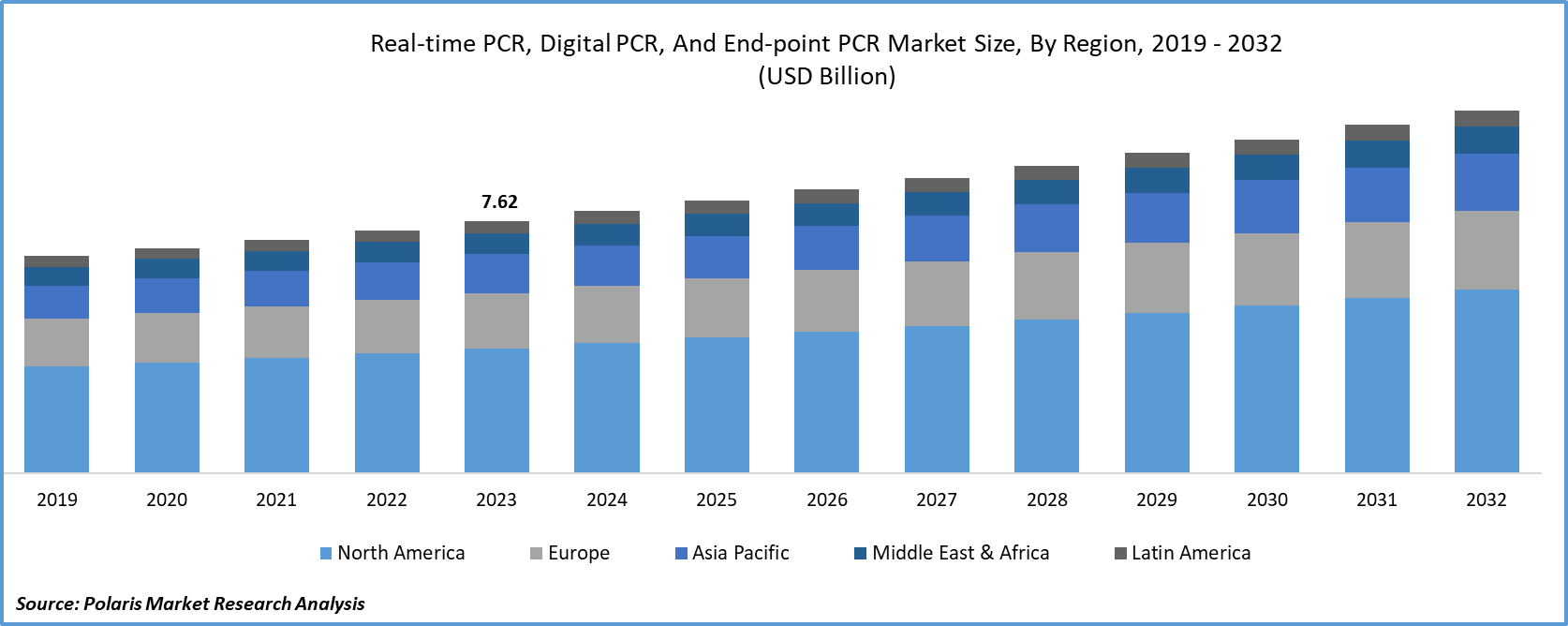
To Understand More About this Research: Download Sample Report
The real-time PCR, digital PCR, and end-point PCR market is also growing due to the escalating advancements in genomic research. Driven by initiatives like precision medicine, these studies demand sophisticated molecular diagnostic tools, with PCR technologies playing a pivotal role. The expanding scope of genomic research, particularly in oncology, rare diseases, and genetic disorders, fuels the demand for these PCR methods.
Market Dynamics
Industry Growth Drivers
Increasing prevalence of infectious diseases is projected to spur the product demand
The real-time PCR, digital PCR, and end-point PCR market is experiencing a surge propelled by the escalating prevalence of infectious diseases worldwide. The heightened incidence of viral and bacterial infections is driving the demand for advanced molecular diagnostic techniques such as PCR. These PCR technologies, including real-time, digital, and end-point PCR, contribute significantly to the rapid and precise identification of pathogens. Their high sensitivity and specificity empower timely disease management and treatment strategies, playing a pivotal role in the global healthcare sector's ongoing efforts to combat infectious diseases.
Advancement in molecular diagnostics is expected to drive real-time PCR, digital PCR, and end-point PCR market growth
Advancements in molecular diagnostics are driving robust growth in the real-time PCR, digital PCR, and end-point PCR Market. Breakthroughs in these PCR technologies have revolutionized molecular testing, offering heightened precision, sensitivity, and speed. Real-time PCR enables simultaneous amplification and monitoring, Digital PCR provides unparalleled quantification accuracy, and End-point PCR remains versatile in genetic analysis. This convergence expands applications in genomics, oncology, and infectious disease diagnostics. Positioned at the forefront of molecular diagnostics evolution, the PCR market meets increasing demand for sophisticated techniques, contributing to early disease detection, personalized medicine, and improved patient outcomes.
Industry Challenges
High instrument and consumable costs are likely to impede the market growth
High instrument and consumable costs present significant constraints on the market. The substantial initial investment for PCR instruments, along with ongoing expenses for consumables, poses financial challenges for laboratories and research facilities. The sophisticated nature of these technologies demands considerable funding, limiting their widespread adoption. Maintenance and updates further contribute to the overall cost burden, potentially impeding smaller laboratories or institutions with limited budgets from embracing these advanced PCR methods fully.
Key Trends in Real-time PCR, Digital PCR, and End-point PCR
| Platform | Description | Technical / application focus | Examples from Practice |
| Real-time PCR (qPCR) | High-throughput microfluidic qPCR with 96–384 well formats and multiplex (up to 6 channels) for rapid pathogen screening. | Large‑batch screening of infectious agents (e.g., IA panels) with <1h time‑to‑result, ideal for clinical labs and surveillance. | 2025 study shows microfluidic real‑time PCR screens tens of targets simultaneously, promising for high‑volume diagnostics. |
| Digital PCR (dPCR) | Droplet digital PCR (ddPCR) advances to ultrasensitive multiplex assays (e.g., ESR1 mutations) and clinical IVDR/CE‑marked systems like QIAcuityDx. | Absolute quantification of low‑abundance targets (cfDNA, viruses) without standards, for oncology, transplant monitoring, and rare variants. | QIAGEN's 2024 QIAcuityDx enables diagnostic ddPCR; Bio‑Rad's ddPLEX ESR1 kit expands multiplex oncology; trends show pathogen diagnostics growth. |
| End-point PCR | Multiplex end‑point PCR with capillary electrophoresis and fluorophores for 20+ targets; anchored multiplex for NGS library prep. | High‑throughput genotyping, SNP screening, structural variants without thermal cycling limits, conserving scarce samples. | Eurogentec notes multiplex endpoint PCR detects 20+ targets via size/fluorescence; anchored multiplex enriches NGS targets efficiently. |
| Digital PCR (dPCR) | Ultra‑dPCR with single‑molecule partitioning over 6‑log dynamic range using clear emulsions and 3D imaging. | Rare molecule detection, 222‑plex assays, and precise copy number without Poisson corrections in single‑molecule regime. | 2022 UltraPCR achieves 6‑log range linearity at single‑copy; partitioning ensures no competition in multiplex. |
| Real-time PCR (qPCR) | Multiplex RT‑qPCR master mixes (e.g., Takyon Ultra) for respiratory viruses with IPC/SPC controls. | Sensitive RNA detection (SARS‑CoV‑2, Flu, RSV) in single reactions, streamlining diagnostics. | Takyon Ultra enables multiplex RT‑qPCR with high sensitivity for viral panels. |
| Digital PCR (dPCR) | Machine learning (AMCA) coupled with multiplex ddPCR for carbapenem‑resistant gene detection in clinical isolates. | Enhancing multiplex accuracy via amplification/melting curve analysis, no hardware changes needed. | 2021 study shows ML‑ddPCR boosts CPO detection throughput and precision in diagnostics. |
| All platforms | Droplet digital PCR global trends in pathogen diagnostics; miniaturization and automation across PCR types. | Workflow automation, clinical translation for cfDNA, viruses, with partitioning minimizing competition. | 2025 review analyzes ddPCR application trends; absolute quantification via partitioning outperforms qPCR for rare targets. |
| End-point PCR | High‑throughput screening via conventional endpoint PCR for genotyping projects. | Cost‑effective, scalable detection post‑amplification via gel/electrophoresis for large cohorts. | Takara Bio confirms endpoint PCR suits high‑throughput genotyping reliably. |
Source: Polaris Market Research Analysis
Source: Polaris Market Research Analysis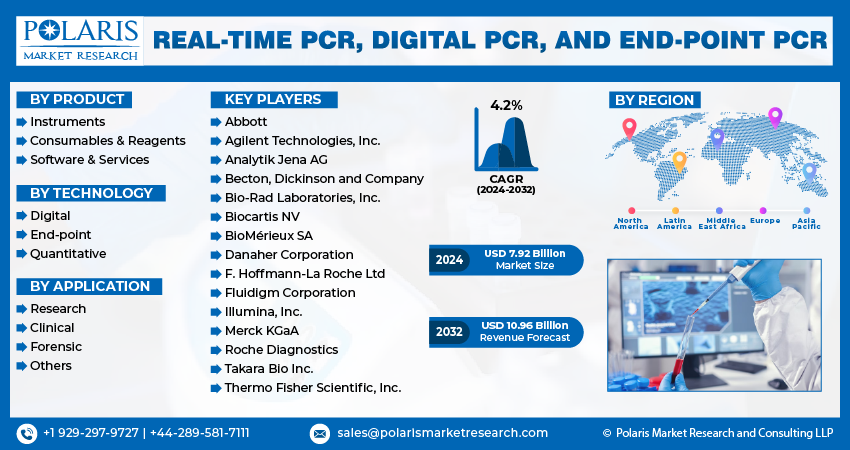
Get Full Segment-Level Forecasts & Insights: Download Sample Report
Report Segmentation
The real-time PCR, digital PCR, and end-point PCR market analysis is primarily segmented based on product, technology, application, and region.
| By Product | By Technology | By Application | By Region |
|
|
|
|
Source: Polaris Market Research Analysis
To Understand the Scope of this Report: Request Customization
By Product Analysis
Consumables & reagents segment held significant market revenue share in 2025
The consumables & reagents segment held significant market revenue share in 2025. Advancements in molecular diagnostics, like liquid biopsy techniques, propel demand for specialized consumables in Real-time PCR, Digital PCR, and End-point PCR. Genomic research requires diverse materials, such as primers and fluorescent probes. The crucial role of PCR consumables in infectious disease diagnostics calls for continuous innovation. In drug development, precise consumables support pharmacogenomics and drug target identification. Ongoing technological innovations mandate constant evolution in consumables. The shift toward precision medicine amplifies the need for specialized consumables in accurate genetic profiling and companion diagnostics.
By Technology Analysis
Quantitative segment held significant market revenue share in 2025
The quantitative segment held significant market revenue share in 2025. Quantitative PCR (qPCR), also known as real-time PCR, is a sophisticated molecular biology technique used to measure and quantify the amount of DNA or RNA present in a sample. It provides precise and accurate quantification by monitoring the amplification of the target nucleic acid during each cycle of the PCR reaction in real-time. Fluorescent dyes or probes are commonly employed to track the accumulation of amplified DNA, allowing researchers to determine the initial concentration of the target sequence. qPCR is widely utilized in various applications, including gene expression analysis, microbial quantification, and viral load determination. Its quantitative nature makes it a crucial tool in both research and diagnostic settings, providing valuable insights into the abundance of specific nucleic acid sequences.
By Application Analysis
Clinical segment held significant market revenue share in 2025
The clinical segment held significant revenue share in 2025. Clinical PCR stands at the forefront of diagnostic and research endeavors in medical settings. This specialized application involves amplifying specific DNA or RNA sequences from patient samples, such as blood or tissues, facilitating the precise detection of pathogens, genetic mutations, and disease biomarkers. Clinical PCR is instrumental in diagnosing infectious diseases like COVID-19, HIV, and hepatitis. It plays a pivotal role in genetic testing for inherited disorders, aids in cancer diagnostics through genetic marker analysis, identifies microbial species in infections, and contributes to forensic testing for criminal investigations or paternity determination. This sophisticated molecular technique revolutionizes diagnostic medicine, guiding personalized treatments and effective disease management.
Source: Polaris Market Research Analysis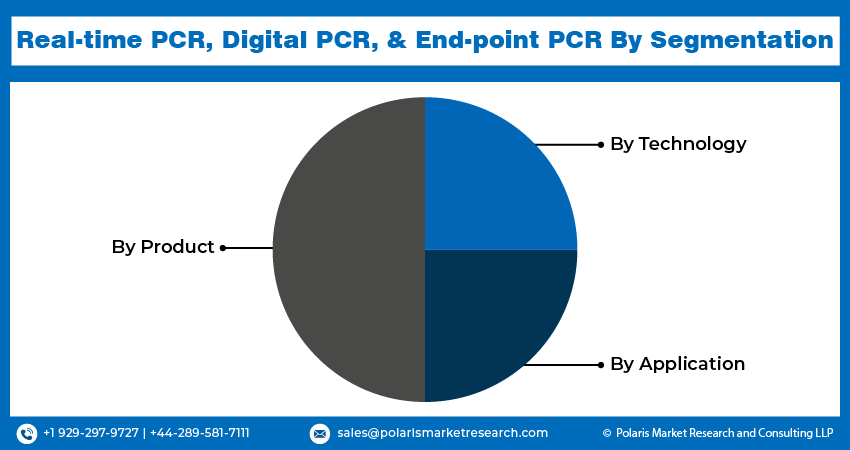
Need Granular Data Across All Market Segments? Request Customization
Regional Insights
North America region accounted for significant market share in 2025
North America region accounted for significant market share in 2025. The North American market for Real-time PCR, Digital PCR, and End-point PCR is characterized by a dynamic landscape driven by robust research and development, high prevalence of chronic diseases, and advanced healthcare infrastructure. The region's strategic collaborations between academia and industry, continuous technological innovations, and government support for genomics research contribute to the leadership in PCR technologies. Stringent regulatory standards ensure reliability, positioning North America as a key player in the global molecular diagnostics arena.
Asia-Pacific is expected to experience significant growth during the forecast period. Increasing initiatives to raise healthcare awareness among the populace are driving demand for advanced molecular diagnostic technologies in Asia-Pacific. The region's susceptibility to infectious diseases has heightened the urgency for accurate diagnostics. Real-time PCR, Digital PCR, and End-point PCR technologies are pivotal in the rapid and precise identification of pathogens, addressing the pressing healthcare challenges.
Source: Polaris Market Research Analysis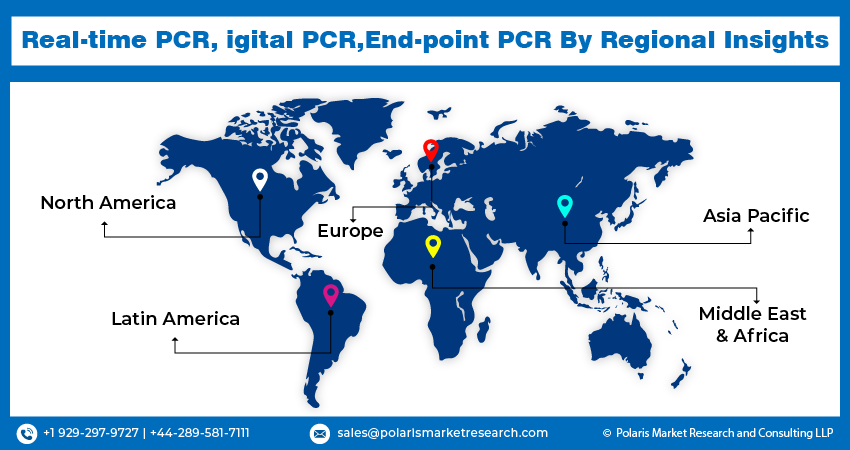
Curious About Regional Market Performance? Request Customization
Key Market Players & Competitive Insights
The real-time PCR, digital PCR, and end-point PCR market encompasses a variety of participants, and the anticipated influx of numerous new entrants is set to heighten competition. Established market leaders continually improve their technologies to sustain a competitive edge, with a significant focus on efficiency, reliability, and safety. These entities prioritize strategic initiatives, such as forming partnerships, enhancing products, and engaging in collaborative ventures, all with the aim of surpassing their industry peers. Their objective is to secure a noteworthy real-time PCR, digital PCR, and end-point PCR market share.
Some of the major players operating in the global real-time PCR, digital PCR, and end-point PCR market include:
- Abbott
- Agilent Technologies, Inc.
- Analytik Jena AG
- Becton, Dickinson and Company
- Bio-Rad Laboratories, Inc.
- Biocartis NV
- BioMérieux SA
- Danaher Corporation
- F. Hoffmann-La Roche Ltd
- Fluidigm Corporation
- Illumina, Inc.
- Merck KGaA
- Roche Diagnostics
- Takara Bio Inc.
- Thermo Fisher Scientific, Inc.
Recent Developments
- In November 2023, QIAGEN has revealed the introduction of three novel kits compatible with its QIAcuity systems, accompanied by a substantial software update. This update is strategically designed to broaden the spectrum of applications for digital PCR technology. The expanded applications encompass diverse fields such as cell and gene therapies, DNA and RNA quantification, and safety assessments in the food and pharmaceutical industries. The incorporation of these new kits and the software upgrade signifies QIAGEN's commitment to enhancing the versatility and efficacy of digital PCR technology, catering to the evolving needs across various scientific domains.
- In April 2020, Dropworks was in the process of creating an automated digital PCR system named Continuum. The fundamental technology at the heart of the Dropworks system involves a licensed continuous-flow spatial thermal cycling method acquired from Arizona State University.
Marker Analysis & Report Coverage
The real-time PCR, digital PCR, and end-point PCR market report emphasizes on key regions across the globe to provide better understanding of the product to the users. Also, the report provides market insights into recent developments, trends and analyzes the technologies that are gaining traction around the globe. Furthermore, the report covers in-depth qualitative analysis pertaining to various paradigm shifts associated with the transformation of these solutions.
The report provides detailed analysis of the market while focusing on various key aspects such as competitive analysis, products, technologies, applications, and their futuristic growth opportunities.
Real-time PCR, Digital PCR, and End-point PCR Market Report Scope
| Report Attributes | Details |
| Market size in 2025 | USD 8.23 billion |
| Market size in 2026 | USD 8.56 billion |
| Revenue forecast in 2034 | USD 11.95 billion |
| CAGR | 4.3% from 2026 – 2034 |
| Base year | 2025 |
| Historical data | 2021 – 2024 |
| Forecast period | 2026 – 2034 |
| Quantitative units | Revenue in USD billion and CAGR from 2026 to 2034 |
| Segments covered |
|
| Regional scope |
|
| Competitive Landscape |
|
| Report Format |
|
| Customization | Report customization as per your requirements with respect to countries, region and segmentation. |
Source: Polaris Market Research Analysis
Real Time Pcr Digital Pcr And End Point Pcr Market FAQ's
The global Real-time PCR, Digital PCR, And End-point PCR market size is expected to reach USD 11.95 billion by 2034
Key players in the market are Abbott, Agilent Technologies, Inc., Biocartis NV, BioMérieux SA, F. Hoffmann-La Roche Ltd
Asia-Pacific contribute notably towards the global Real-time PCR, Digital PCR, and End-point PCR Market
Real-time PCR, Digital PCR, And End-point PCR Market exhibiting the CAGR of 4.3% during the forecast period.
The Real-time PCR, Digital PCR, and End-point PCR Market report covering key segments are product, technology, application, and region.
Download Sample Report of Real-time PCR, Digital PCR, and End-point PCR Market Size, Report, 2026-2034
Please fill out the form to request a customized copy of the research report.


