
Small Cell 5G Network Market Size, forecast Report, 2024-2032
REPORT DETAILS
Market Statistics
Small Cell 5G Network Market size was valued at USD 3.17 billion in 2023. The market is anticipated to grow from USD 4.93 billion in 2024 to USD 172.32 billion by 2032, exhibiting the CAGR of 55.9% during the forecast period.
Market Overview
Small cell technology is a key component of 5G network infrastructure. It is designed to complement traditional macrocell towers by providing localized coverage and capacity in areas with high user density or limited macrocell coverage. Small cell networks can be deployed in various scenarios, including urban areas, indoor environments (such as stadiums, shopping malls, and office buildings), rural regions, and areas with network coverage gaps. This flexibility allows for targeted deployment to address specific connectivity needs.
Source: Polaris Market Research Analysis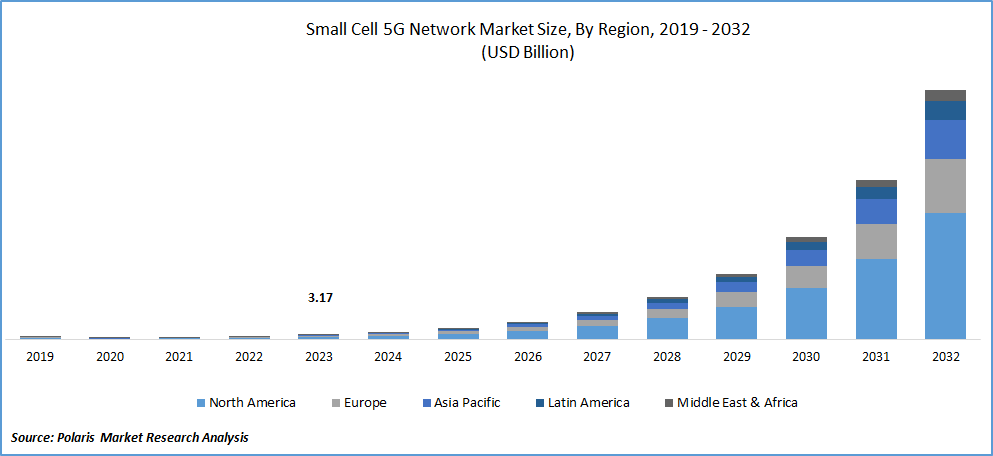
To Understand More About this Research:Download Sample Report
The proliferation of bandwidth-intensive applications such as streaming video, online gaming, augmented reality (AR), and virtual reality (VR) drives the demand for high-speed data connectivity. Small cell networks help meet this demand by offloading traffic from macrocell networks and providing localized capacity where it's needed most.
The growth of IoT devices and applications, including smart cities, connected vehicles, industrial automation, and healthcare monitoring, requires reliable and low-latency connectivity. Small cell networks enable efficient IoT connectivity by supporting a large number of simultaneous connections and providing coverage in dense urban environments.
Small cell 5G networks are gaining adoption nowadays, driven by the increasing need for high connectivity. COVID-19 contributed to the work-from-home culture globally, facilitating the demand for superior network coverage among employees. One of the major factors driving its demand in the market is its affordability, in line with microcells, which have huge installation and consumption costs. Additionally, the growing number of innovations among the market players is anticipated to facilitate significant demand for the whole cell 5G network in the coming years.
For instance, in November 2023, Picocom announced the launch of the New PHY SoC to install 5G cellular networks and revealed the development of its initial system-in-chip for small cell 5G open RAN radio units.
Moreover, the increasing research activities, rising investments, and collaborative frameworks to gain a competitive edge are boosting its use of the small cell 5G network. The global rollout of 5G networks accelerates the demand for small cell technology, as 5G requires denser network deployments to deliver its promised performance improvements, including higher data speeds, lower latency, and greater network reliability. There are opportunities for technology innovation and product development in the small cell space, including advancements in hardware design, network management software, interference mitigation techniques, and energy efficiency solutions.
Growth Drivers
Rising Adoption of 5G Network
The rising work-from-home culture across the globe offered by the companies necessitates robust internet connections with high speeds. This is boosting 5G subscriptions in the market. As per the Ericsson Mobility Report 2023, Indian 5G subscriptions are expected to reach 860 Mn by 2029, up from 130 Mn in 2023. The demand for 5G subscriptions is likely to register 600 Mn subscriptions globally in 2023, majorly driven by a surge in demand for high-performance internet connectivity. It can cover the most populous regions, from rural to urban, with flexibility and ease of deployment driving the adoption across the globe.
A Growing Number of People are Consuming Smartphones
People across the globe are purchasing smartphones due to the rise in disposable net income, followed by the increased smartphone production, causing availability & affordability. As per the Cisco Internet Report from 2018-2023, around 66% of the population across the globe had internet accessibility in 2023, an increase from 55% in 2018. Furthermore, the global machine-to-machine networks are expected to be around 50% of the network-accessed connections in 2023, which has grown from 33% in 2018.
Restraining Factors
Limited Knowledge About the Small Cell 5G Network
The propensity to cover smaller areas and limited awareness about the small cell 5G network will lower its use in the global market. The need for extensive equipment and technologies, such as backhaul connectivity, site selection, and maintenance costs, are major factors that can reduce the growth pace of small cell 5G networks in the coming years.
Source: Polaris Market Research Analysis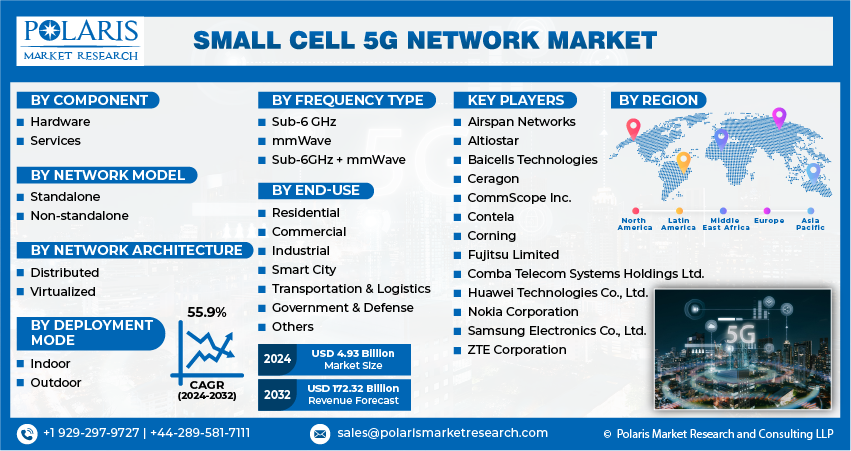
Get Full Segment-Level Forecasts & Insights: Download Sample Report
Report Segmentation
The market is primarily segmented based on component, network model, network architecture, deployment mode, frequency type, end-use, and region.
| By Component | By Network Model | By Network Architecture | By Deployment Mode | By Frequency Type | By End-use | By Region |
|
|
|
|
|
|
|
Source: Polaris Market Research Analysis
To Understand the Scope of this Report:Request Customization
By Component Analysis
Hardware Segment is Expected to Witness the Highest Growth During the Forecast Period
The hardware segment is projected to grow at the highest CAGR during the projected period, mainly driven by the growing demand for uniform bandwidth coverage among end users, specifically for hospitals, offices, and residential areas. The significant uptick in the adoption of smaller coverage is enabling the adoption of femtocells due to their ability to cover 50 meters and lower costs of deployment. In addition, picocell is likely to register significant growth driven by its capacity to offer larger coverage, gaining utility from locations like festivals, stadiums, and others.
By Network Model Analysis
The Non-Standalone Segment Accounted for the Largest Market Share in 2023
In 2023, the non-standalone segment accounted for the largest share. This is due to its convenience to install from prevailing legacy connections, making it a more affordable and less time-consuming option for users. However, the standalone segment is likely to witness significant adoption in the coming years due to its ability to provide long-lasting internet connections among machines.
By End-User Analysis
The Commercial Segment Held a Significant Market Revenue Share in 2023
The commercial segment held a significant revenue share in 2023, which was accelerated by the continuous rise in the number of companies opting for technological solutions in their business operations. This strictly demonstrates the demand for extensive network connectivity technologies that can offer speedy internet, bolstering the adoption of small cell 5G networks among enterprises.
Source: Polaris Market Research Analysis
Need Granular Data Across All Market Segments? Request Customization
Regional Insights
Asia Pacific Region Registered the Largest Share of the Global Market in 2023
The Asia Pacific region held the dominant share in 2023. The government policies to empower digital society are likely to support the adoption of the 5G network and, thereby, the small cell 5G network, specifically in India. For instance, in January 2024, the Indian government announced the launch of the Submarine Optical Fiber Connection for Kochi-Lakshadweep Islands with an investment of INR 1,150 crore to assist in having a high-speed network through 4G/5G connections. These initiatives are creating a favorable market for small-cell 5G networks in the region.
The European region will grow rapidly, owing to the growing number of internet users, including businesses. As per the GSMA Report 2023, European mobile data traffic is estimated to triple in the next five years. By 2030, 5G technology use is expected to be adopted by 87% of all mobile users, driven by significant adoption in the UK and Germany. 83% of the 5G business benefits are likely to come from the service sector, while 33% are from manufacturing due to increasing smart cities, smart grids, and smart factory development.
Source: Polaris Market Research Analysis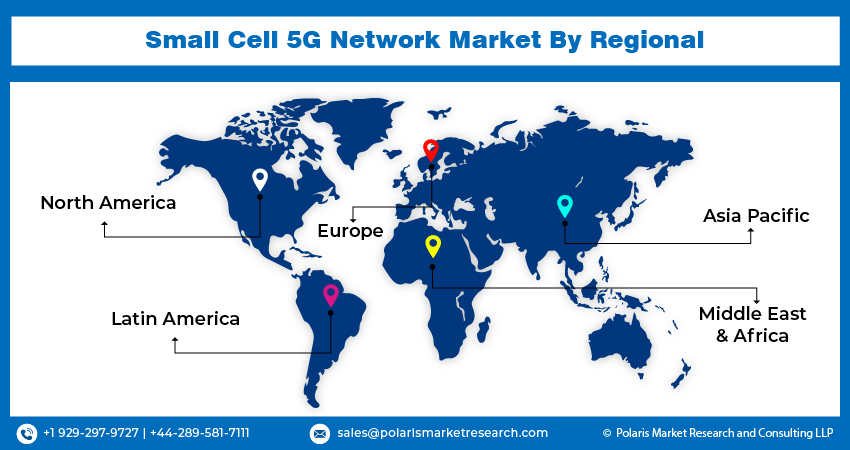
Curious About Regional Market Performance? Request Customization
Key Market Players & Competitive Insights
The small cell 5G network market is fragmented. Major companies are making ties with competitors to fuel their ability to provide effective technological solutions and a wide range of internet connectivity to end users. For instance, in October 2023, Samsung announced the launch of its 5G strand small cell access to cable businesses, which was launched in 2022 in partnership with Comcast.
Some of the major players operating in the global market include:
- Airspan Networks
- Altiostar
- Baicells Technologies
- Ceragon
- CommScope Inc.
- Comba Telecom Systems Holdings Ltd.
- Contela
- Corning
- Fujitsu Limited
- Huawei Technologies Co., Ltd.
- Nokia Corporation
- Samsung Electronics Co., Ltd.
- ZTE Corporation
Recent Developments in the Industry
- June 2025: Ericsson and Google Cloud introduced a carrier-grade 5G Core-as-a-Service solution, allowing rapid deployment within minutes and AI-driven network issue resolution.
- June 2025: Nokia announced major advancements in mmWave performance along with strong growth forecasts for fixed wireless access.
- March 2025: RANsemi and ACES formed a partnership to develop an Open RAN neutral-host small-cell solution.
- February 2025: Crown Castle halted 7,000 planned small-cell installations, releasing approximately USD 800 million in capital expenditure.
- May 2024, One New Zealand has moved a step nearer to improving its mobile network abilities, including contest support to acquire Dense Air's New Zealand business and spectrum. This acquisition paves the way for further spectrum allocation for 5G, which is poised to improve the network experience for One NZ customers.
Report Coverage
The small cell 5G network market report emphasizes on key regions across the globe to provide better understanding of the product to the users. Also, the report provides market insights into recent developments, trends and analyzes the technologies that are gaining traction around the globe. Furthermore, the report covers in-depth qualitative analysis pertaining to various paradigm shifts associated with the transformation of these solutions.
The report provides detailed analysis of the market while focusing on various key aspects such as competitive analysis, component, network model, network architecture, deployment mode, frequency type, end-use, and their futuristic growth opportunities.
Small Cell 5G Network Market Report Scope
| Report Attributes | Details |
| Market size value in 2024 | USD 4.93 billion |
| Revenue forecast in 2032 | USD 172.32 billion |
| CAGR | 55.9% from 2024 – 2032 |
| Base year | 2023 |
| Historical data | 2019 – 2022 |
| Forecast period | 2024 – 2032 |
| Quantitative units | Revenue in USD billion and CAGR from 2024 to 2032 |
| Segments covered |
|
| Regional scope |
|
| Competitive Landscape |
|
| Report Format |
|
| Customization | Report customization as per your requirements with respect to countries, region, and segmentation. |
Source: Polaris Market Research Analysis
Small Cell 5G Network Market FAQ's
Small Cell 5G Network Market report covering key segments arecomponent, network model, network architecture, deployment mode, frequency type, end-use, and region
Small Cell 5G Network Market Size Worth $ 172.32 Billion By 2032 | CAGR: 55.9%
Small Cell 5G Network Market exhibiting the CAGR of 55.9% during the forecast period.
Asia Pacific is leading the global market.
The key driving factors in Small Cell 5G Network Market are Rising adoption of 5G network
Download Sample Report of Small Cell 5G Network Market
Please fill out the form to request a customized copy of the research report.


