
Small Modular Reactor Market Size, Share Global Analysis Report, 2026-2034
REPORT DETAILS
Market Statistics
Small Modular Reactor Market Overview
The global small modular reactor market size was valued at USD 6.14 billion in 2025, growing at a CAGR of 2.97% from 2025 to 2034. Government support and policy incentives along with increasing global demand for low-carbon energy solutions is propelling the market growth.
Key Insights
- Based on module, the single-module reactors segment led the market in 2025 with 64.35% share due to its scalability, reduced initial capital outlay, and applicability for small grids or stand-alone areas.
- In terms of type, the fast reactors segment is projected to grow at a CAGR of 14.6%, due to fuel efficiency and contributions to long-term nuclear waste management planning.
- Asia Pacific region dominated the market in 2025 with 38.61%, driven by increasing urbanization and explosive industrialization across China and India.
- China dominated regional market growth with 43.10% share, supported by national grid expansion of infrastructure and increasing focus on local and resilient power sources.
- North America expected to grow at a fast rate of 5.6% CAGR, propelled by the slow phasing out of aging nuclear power plants in favor of more sophisticated SMRs.
Industry Dynamics
- Policy incentives and government support are promoting SMR adoption, facilitating quicker deployment and investor confidence in the nuclear industry.
- Growing international demand for low-carbon energy alternatives is further boosting the demand for advanced nuclear technologies.
- High initial capital expenses and extended development cycles are restraining the market growth, particularly for small and medium businesses.
- Introduction of AI- and digital twin–based reactors are creating new market opportunities, enabling predictive maintenance, real-time analytics, and improved operational safety.
Market Statistics
- 2025 Market Size: USD 6.14 Billion
- 2034 Projected Market Size: USD 7.95 Billion
- CAGR (2026–2034): 2.97%
- Asia Pacific: Largest Market Share
What are Small Modular Reactors (SMRs)?
Small Modular Reactors (SMRs) are advanced nuclear reactors. They have a power capacity up to 300 MW(e) per unit, much smaller than conventional nuclear plants. They are used for factory fabrication, easier transport, and flexible deployment. SMRs are suitable for remote areas, industrial sites, and grid support applications.
How Modular Nuclear Reactors Work
Modular nuclear reactors operate using the same basic principle as traditional nuclear plants. Nuclear fission generates heat. It produces steam to drive turbines and generate electricity. Their modular design enables major components to be pre-built in factories and assembled on-site. It reduces construction time, costs, and operational complexity.
Key Benefits of Small Modular Reactors
- Faster construction and deployment due to factory-built modules
- Improved safety features with passive cooling and simplified designs
- Flexible scalability by adding multiple modules based on demand
- Reliable low-carbon electricity generation for clean energy transition
- Suitable for remote locations, industrial zones, and off-grid applications
- Potential integration with hydrogen production and district heating
Comparison Matrix: Small Modular Reactors (SMRs) vs Conventional Nuclear Reactors
| Parameter | Small Modular Reactors (SMRs) | Conventional Nuclear Reactors |
| Power Capacity | Up to 300 MW(e) per unit | Typically 700–1,600+ MW(e) per unit |
| Plant Size | Compact and modular | Large-scale centralized facilities |
| Construction Method | Factory-built modules assembled on-site | Fully constructed on-site |
| Construction Time | Shorter due to modular manufacturing | Longer due to complex infrastructure |
| Initial Capital Cost | Lower upfront investment | Very high capital requirement |
| Scalability | Can be expanded by adding modules | Expansion requires new large units |
| Safety Features | Advanced passive safety systems | Active and passive safety systems |
| Land Requirement | Smaller land footprint | Larger land and infrastructure needs |
| Deployment Areas | Remote areas, industrial sites, small grids | Large urban grids and national power systems |
| Operational Flexibility | High flexibility for variable demand | Designed mainly for baseload power generation |
Source: Polaris Market Research Analysis
The small modular reactor (SMR) industry comprises small nuclear power reactors that produce clean and secure electricity with improved safety, lower capital expenses, and flexible installation. They are commonly proposed for remote locations, industrial power demand, grid resilience, and decarbonization efforts because of their scalable, factory-fabricated modular design. Improvements in passive safety systems, advanced reactor fuel, and modular construction are enhancing efficiency of operations, security, and project schedules.
The market is expanding rapidly due to the increasing need for decentralized and flexible energy solutions in rural areas and small power grids. In October 2025, Amazon plans for small modular reactor (SMR) plant in Washington, U.S., expanding the project to feature 12 reactors with a total capacity of 960 MW, three times the originally proposed size and an indication of strong demand for scalable nuclear solutions. These advancements highlight the capability of SMRs that deliver dependable, on-site power without exacerbating infrastructure concerns.
Source: Polaris Market Research Analysis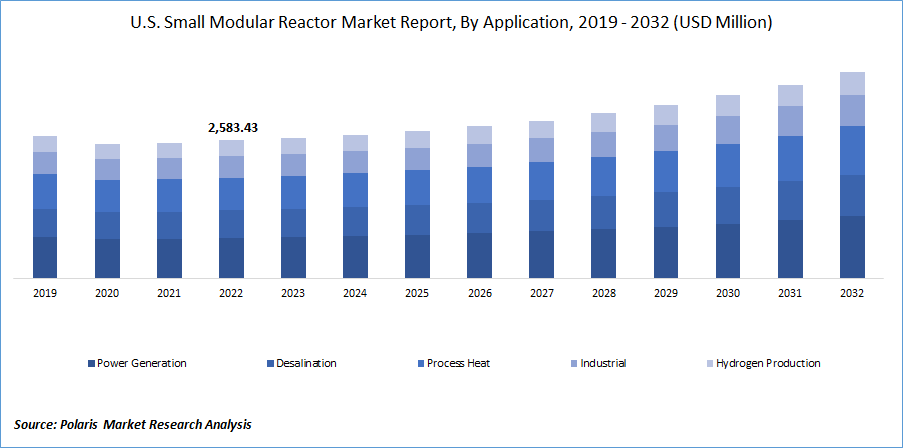
Want a Deeper Look at Key Market Players? Download Sample Report
Modular reactor design technology is improving with reduced construction schedules, lower operational risks, and reduced overall project costs. Such improvements are making SMRs a more competitive and attractive source for public and private power generation companies to obtain clean and flexible power. Improvements in modular designs are projected to expedite the demand for SMRs in various regions.
Drivers & Opportunities
Government support and policy incentives: Governments globally are encouraging SMR development by providing policy incentives, finance programs, and regulatory backing to diversify energy mixes and improve energy security. In February 2025, India's Ministry of Finance unveiled the Nuclear Energy Mission for Viksit Bharat, committing federal funding to construct at least five Indian-designed SMRs by 2033. Such efforts are fostering a supportive climate for rapid SMR deployment.
Increasing global demand for low-carbon energy solutions: The rising need for low-carbon, dependable energy to address climate targets is fueling demand for SMRs as part of wider decarbonization plans. In September 2025, Elcogen commissioned a high-volume solid oxide fuel cell and electrolyser production plant in Tallinn, Estonia, doubling its manufacturing capacity from 10 MW to 360 MW and making it one of Europe's largest producers in the industry. This trend is increasing the demand for advanced fuel cell and nuclear technologies in powering the shift to clean energy.
Source: Polaris Market Research Analysis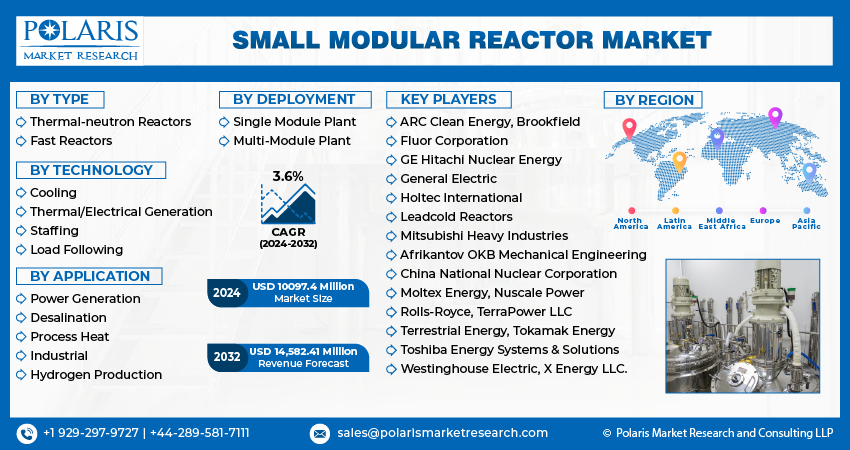
Get Full Segment-Level Forecasts & Insights: Download Sample Report
Segmental Insights
By Module
Based on module the market is divided into multi-module and single-module systems. Single-module reactors held the largest market share in 20245, due to its scalability, reduced initial capital outlay, and appropriateness for smaller grids or remote areas.
Multi-module reactors are anticipated to record robust growth during the forecast period, driven by rising modular expansion, greater operational flexibility, and optimized load allocation for large-sized power generation projects.
By Type
Based on type, the market is divided into thermal-neutron reactors and fast reactors. Thermal-neutron reactors held the largest market share in 2025 propelled by its mature technology, well-established safety record, and prevalent installation in demonstration and pilot projects.
Fast reactors are expected to increase steadily fueled by its improved fuel utilization and contribution to nuclear waste management plans over the long term.
By Technology
In terms of technology the market is classified into cooling systems, thermal/electrical generation, staffing solutions, and load-following capabilities. Cooling technology held the highest share in 2025, driven by its effective removal of heat is paramount to SMR performance and safety.
Load-following capabilities are anticipated to grow rapidly due to the necessity for SMRs to complement variable renewable energy sources while ensuring grid stability.
By Deployment
In terms of deployment, SMRs are classified into single-module plants and multi-module plants. Single-module plants led the market in 2025 due to it’s easy to build, fast commission feature, and are best for small-scale power projects.
Multi-module plants are projected to grow strongly, providing flexibility for phased addition of capacity and efficient operation for industrial and utility-sized power applications.
By Application
The SMR market is utilized in power generation, desalination, process heat, industrial uses, and hydrogen production. Power generation accounted for the largest share in 2025, propelled by the increasing global need for low-carbon, dependable sources of energy.
Hydrogen production is anticipated to experience significant growth, driven by the rising demand for clean fuel technologies and decarbonization efforts in energy and industrial sectors.
Source: Polaris Market Research Analysis
Need Granular Data Across All Market Segments? Request Customization
Regional Analysis
Asia Pacific led the small modular reactor market propelled by the increasing urbanization and fast industrialization in China and India. The growth is strongly escalating a strong demand for flexible, decentralized, and reliable power options. Government programs and favorable policies encouraging clean energy and nuclear power are also speeding up the use and installation of small modular reactors in the region.
China Small Modular Reactor Market Overview
China led the market in Asia Pacific, driven by growing national grid infrastructure, and the need for local and sustainable power sources. China's State Grid announced investment of more than USD 88.7 billion in country's power grid by the end of 2025, an increase from USD 60 billion in 2024. This rise in investment highlights the nation's robust commitment to upgrading its energy network and fueling decentralized power generation.
North America Small Modular Reactor Market Insights
North America is anticipated to grow rapidly during the forecast period, led by rising replacement of old nuclear power plants with futuristics SMRs. These advanced reactors are embraced to provide grid stability, respond to growing energy needs, and enhance system reliability. Furthermore, robust emphasis on decarbonization and net-zero emissions goals is also propelling the implementation of emerging nuclear technologies.
The U.S. Small Modular Reactor Market Analysis
The U.S. led the market within North America, due to strong government investment and regulatory support. In March 2025, the U.S. Department of Energy (DOE) re-issued USD 900 million solicitation to assist in the deployment of SMRs, in alignment with national interests to enhance energy security, grow clean energy capacity, and retain technological leadership in cutting-edge nuclear solutions.
Europe Small Modular Reactor Market Assessment
Europe maintained substantial market share in small modular reactor. Encouraging nuclear policies and incentives by nations such as the UK, France, and Poland are fostering the adoption of SMRs in order to achieve climate, energy security, and net-zero emissions goals. Robust public-private partnerships, research and development activities, and regulatory support are also boosting SMR technology development and deployment. In the UK, government announced to unlock more sites for SMR development supplement megaprojects like Hinkley Point C and Sizewell C, putting SMRs at the forefront of to boost the country's nuclear capacity to 24 GW by 2050 as part of its Net Zero by 2050 initiative.
Source: Polaris Market Research Analysis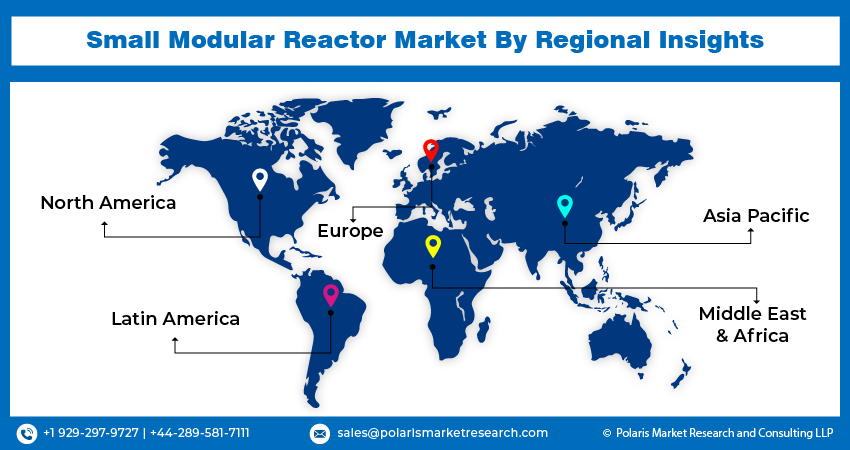
Curious About Regional Market Performance? Request Customization
Key Players & Competitive Analysis
The global small modular reactor (SMR) market is relatively competitive, with firms prioritizing reactor safety, modularity, efficiency, and regulatory compliance. Advances involve compact designs, new fuel technologies, and digital monitoring systems for improving operating reliability and limiting construction schedules. Strategic collaborations with governments, energy utilities, and research institutions are opening up deployment opportunities, while continuous development targets cost savings, scalable energy solutions, and addressing the increased demand for low-carbon power.
Key companies operating in the global small modular reactor market include ARC Energy LLC, BWX Technologies, Inc., Brookfield Asset Management Inc., Candu Energy Inc. (SNC-Lavalin Group Inc.), Fluor Corporation, General Atomics, Inc., General Electric Company (GE Hitachi Nuclear Energy), Holtec International, Inc., Kairos Power, Inc., LeadCold Reactors Oy, Moltex Energy Limited, NuScale Power, LLC, Rolls-Royce SMR Limited, Terrestrial Energy Inc., and Westinghouse Electric Company LLC.
Key Players
- ARC Energy LLC
- BWX Technologies, Inc.
- Brookfield Asset Management Inc.
- Candu Energy Inc. (SNC-Lavalin Group Inc.)
- Fluor Corporation
- General Atomics, Inc.
- General Electric Company (GE Hitachi Nuclear Energy)
- Holtec International, Inc.
- Kairos Power, Inc.
- LeadCold Reactors Oy
- Moltex Energy Limited
- NuScale Power, LLC
- Rolls-Royce SMR Limited
- Terrestrial Energy Inc.
- Westinghouse Electric Company LLC
Small Modular Reactor Industry Developments
- February 2026: Natura Resources LLC signed an agreement with NGL Water Solutions Permian LLC. The partnership will enable Large-Scale Produced Water Treatment with Small Modular Nuclear Reactors in the Permian Basin. (Source: naturaresources.com)
- August, 2025: GE Vernova / Hitachi Nuclear Energy reported that their BWRX-300 small modular reactor (SMR) design was down-selected by Vattenfall as part of the process for consideration to build new nuclear reactors at the Ringhals facility on Sweden's Värö Peninsula. (Source: gevernova.com)
- April 2025: Ontario Power Generation obtained a construction license for a BWRX-300 at Darlington, launching the first SMR project in a G7 country. (Source: world-nuclear-news.org)
Future of Small Modular Reactor (SMR) Market
The SMR market is expected to experience strong growth as countries accelerate their clean energy transition and seek reliable low-carbon power sources. Rising electricity demand from AI-driven data centers, industrial electrification, and hydrogen production would create lucrative opportunities for SMR deployment. Governments across North America, Europe, and Asia-Pacific are increasing investments, policy support, and public-private partnerships to advance SMR commercialization. Technological advancements in reactor safety, modular manufacturing, and fuel efficiency would strengthen SMR adoption
Small Modular Reactor Market Segmentation
By Module Outlook (Revenue, USD Billion, 2021–2034)
- Multi Module
- Single Module
By Type Outlook (Revenue, USD Billion, 2021–2034)
- Thermal-neutron Reactors
- Fast Reactors
By Technology Outlook (Revenue, USD Billion, 2021–2034)
- Cooling
- Thermal/Electrical Generation
- Staffing
- Load Following
By Deployment Outlook (Revenue, USD Billion, 2021–2034)
- Single Module Plant
- Multi-Module Plant
By Application Outlook (Revenue, USD Billion, 2021–2034)
- Power Generation
- Desalination
- Process Heat
- Industrial
- Hydrogen Production
By Regional Outlook (Revenue, USD Billion, 2021–2034)
- North America
- U.S.
- Canada
- Europe
- Germany
- France
- UK
- Italy
- Spain
- Netherlands
- Russia
- Rest of Europe
- Asia Pacific
- China
- Japan
- India
- Malaysia
- South Korea
- Indonesia
- Australia
- Vietnam
- Rest of Asia Pacific
- Middle East & Africa
- Saudi Arabia
- UAE
- Israel
- South Africa
- Rest of Middle East & Africa
- Latin America
- Mexico
- Brazil
- Argentina
- Rest of Latin America
Small Modular Reactor Market Report Scope
| Report Attributes | Details |
| Market Size in 2025 | USD 6.14 Billion |
| Market Size in 2026 | USD 6.32 Billion |
| Revenue Forecast by 2034 | USD 7.95 Billion |
| CAGR | 2.97% from 2026 to 2034 |
| Base Year | 2025 |
| Historical Data | 2021–2024 |
| Forecast Period | 2026–2034 |
| Quantitative Units | Revenue in USD Billion, Volume in Kilotons and CAGR from 2026 to 2034 |
| Report Coverage | Revenue Forecast, Competitive Landscape, Growth Factors, and Industry Trends |
| Segments Covered |
|
| Regional Scope |
|
| Competitive Landscape |
|
| Report Format |
|
| Customization | Report customization as per your requirements with respect to countries, regions, and segmentation. |
Source: Polaris Market Research Analysis
Small Modular Reactor Market FAQ's
The global market size was valued at USD 6.14 billion in 2025 and is projected to grow to USD 7.95 billion by 2034.
The global market is projected to register a CAGR of 2.97% during the forecast period.
Asia Pacific dominated the market in 2025.
A few of the key players in the market are ARC Energy LLC, BWX Technologies, Inc., Brookfield Asset Management Inc., Candu Energy Inc. (SNC-Lavalin Group Inc.), Fluor Corporation, General Atomics, Inc., General Electric Company (GE Hitachi Nuclear Energy), Holtec International, Inc., Kairos Power, Inc., LeadCold Reactors Oy, Moltex Energy Limited, NuScale Power, LLC, Rolls-Royce SMR Limited, Terrestrial Energy Inc., and Westinghouse Electric Company LLC.
The single-module reactors segment dominated the market revenue share in 2025.
The fast reactors segment is projected to witness the fastest growth during the forecast period.
Small modular reactors are compact nuclear power reactors that produce clean, secure electricity with improved safety, lower capital expenses, and flexible installation using scalable, factory-fabricated modular designs.
Key trends include rising government policy incentives, growing low-carbon energy demand, AI and digital twin integration, hydrogen production applications, and increasing adoption for remote and decentralized power generation.
Download Sample Report of Small Modular Reactor Market
Please fill out the form to request a customized copy of the research report.


