
Solar Control Window Films Market Size, Growth Analysis Report, 2025-2034
REPORT DETAILS
Market Statistics
The global Solar Control Window Films Market was valued at USD 1,586.40 million in 2024 and is anticipated to grow at a CAGR of 8.8% from 2025 to 2034. Increasing focus on energy efficiency in buildings, coupled with government initiatives promoting sustainable construction practices, is a key factor driving adoption.
Solar control window films play a crucial role in protecting individuals from harmful radiation in both cars and rooms, as intense ultraviolet (UV) rays can pose health risks, including the potential for skin cancer. Furthermore, these films are effective in preventing the fading of furniture within car interiors and homes. The installation of solar control window films is cost-effective and user-friendly, contributing to an enhanced aesthetic appeal for buildings. According to the U.S. Department of Energy, approximately 1/3 of a building's cooling costs are via heat gained through the windows.
Source: Polaris Market Research Analysis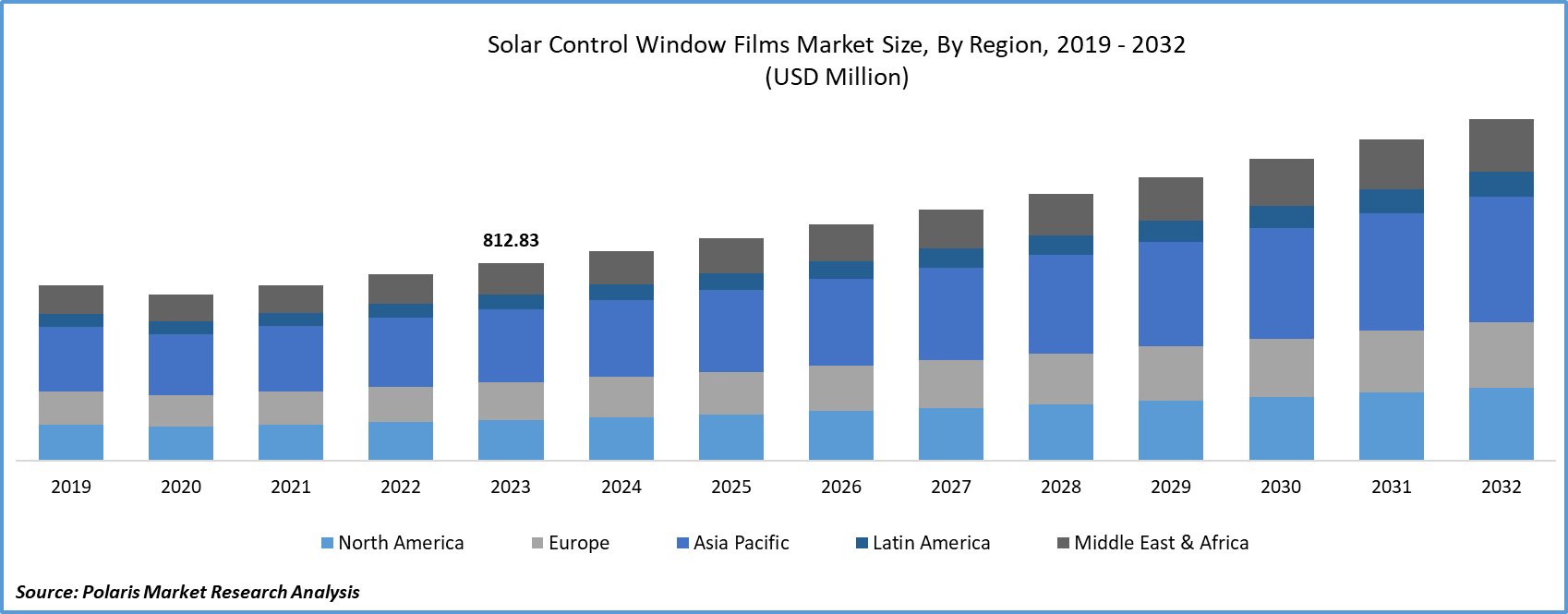
To Understand More About this Research: Download Sample Report
While solar control glass offers several benefits, including energy efficiency and heat reduction, its adoption comes with a significant drawback. Installing solar control glass involves the complete replacement of the existing glass in a building, which can be a complex and expensive process. This requirement for full glass replacement contributes to higher installation costs and may pose a challenge for widespread adoption, especially in existing structures where retrofitting can be logistically challenging and financially burdensome.
In contrast, window tinting, with its cost-effective and relatively straightforward installation process, continues to be a preferred choice for many vehicle owners and commercial establishments. The ability to enhance the appearance of a vehicle, protect the interior from UV rays, and contribute to a more comfortable driving experience makes window tinting a practical and accessible solution.
The research report offers a quantitative and qualitative analysis of the Solar Control Window Films Market to enable effective decision-making. It covers the key trends and growth opportunities anticipated to have a favorable impact on the market. Besides, the study covers segment and regional revenue forecasts for market assessment.
In the United States, the market has experienced growth propelled by favorable government policies and the expanding automotive sector. The extreme weather conditions prevalent in the country have incentivized people to opt for vacuum-coated films. These films can reflect sunlight away from buildings or vehicles, providing effective solar control. Dyed films, commonly utilized in the automotive sector, are anticipated to see heightened demand due to the growth of the automotive industry in the U.S.
Source: Polaris Market Research Analysis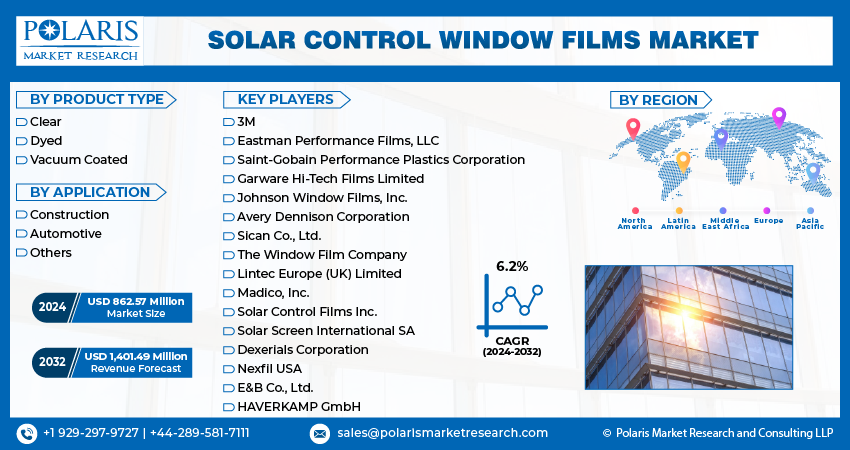
Get Full Segment-Level Forecasts & Insights: Download Sample Report
Industry Dynamics
Growth Drivers
Rising Awareness of Decreasing Carbon Footprint
Solar control window films play a crucial role in regulating the heat that enters buildings through windows, leading to a reduction in the energy and cost required for cooling, which includes the use of appliances like air conditioners. This, in turn, contributes to a decrease in the carbon footprint associated with energy consumption. Key industry players such as 3M, Johnson Laminating, Eastman Chemical, and Madico Inc. are headquartered in the U.S. The country has witnessed a resurgence in the construction sector, particularly in the residential space, further driving the demand for solar control window films.
Report Segmentation
The market is primarily segmented based on product type, application, and region.
| By Product Type | By Application | By Region |
|
|
|
Source: Polaris Market Research Analysis
To Understand the Scope of this Report: Request Customization
By Product Type Analysis
Vacuum Coated Segment Accounted for the Largest Market Share in 2024
The vacuum-coated segment accounted for the largest share in 2024. This is primarily due to its effectiveness in reflecting a substantial amount of solar radiation. These films, also known as reflective films, contribute to keeping interior spaces cooler compared to other types of films. The global market for solar control window films is being propelled by the rise in construction activities worldwide and the expanding automotive industry. The reflective properties of vacuum-coated films make them a popular choice for individuals seeking efficient solutions to control solar heat gain and enhance interior comfort in various applications, including construction and automotive settings.
The sun's incoming heat and harmful UV rays can be effectively managed by solar control window films that incorporate metal content. These films undergo metallization through various methods like sputtering, vapor deposition, and beam deposition. Among the diverse types, dyed solar control window films, also referred to as non-reflective films, represent another significant product category in the market. Primarily used on automotive windows, these films play a crucial role in the growing automotive industry globally. Beyond the automotive sector, they also find applications in the construction industry, especially in tropical regions, where effective solar control is essential for maintaining comfortable indoor environments.
By Application Analysis
Flat Roof Segment Held the Significant Market Share in 2024
The flat roof segment held a significant market share in 2024. Flat-roof solar installations offer easier access, involve less complex racking systems, and often require shorter cable runs. These characteristics streamline the installation process, leading to reduced labor and material costs. Additionally, maintenance for flat roof installations is more straightforward, contributing to lower overall operational expenses. The combination of these factors makes flat-roof solar installations a preferred choice for many, driving their prominence in the market.
The preference for flat roofs in solar installations is further enhanced by the ample, unobstructed space they offer for the placement of solar panels. This characteristic implies that a substantial solar capacity can be deployed on a relatively small footprint. Particularly for commercial and industrial buildings where available land space may be limited, flat roofs provide an ideal location for installing solar arrays. The ability to maximize solar capacity in constrained spaces makes flat roof installations a practical and efficient solution, contributing to increased demand for this approach in the forecast period.
Source: Polaris Market Research Analysis
Need Granular Data Across All Market Segments? Request Customization
Regional Insights
APAC Region Dominated the Global Market in 2024
APAC region dominated the global market in 2024. The region's developing economies are actively enhancing their energy infrastructure to address the increasing demand for power. In tandem with this, regulatory policies and norms emphasizing the reduction of carbon emissions have become more stringent. Additionally, there is a growing consumer preference for renewable electricity infrastructure in the region.
These collective efforts align with the market's trajectory, creating a favorable environment for the adoption of solar control window films. As governments and consumers increasingly prioritize sustainable energy solutions, the demand for these films is expected to grow in the region, contributing to the substantial revenue share in the global market.
North America will grow at a substantial pace during the forecast period. The region benefits from the expanding automotive industry, where solar control window films find significant applications. The automotive sector's demand for these films, particularly dyed films used in automotive windows, contributes to the overall market growth.
Additionally, the construction industry in the region is experiencing an upward trajectory. This growth is attributed to lenient lending policies and the recovery of the residential construction sector. As construction activities increase, there is a rising demand for solar control window films in both residential and commercial buildings. These films play a crucial role in reducing heat penetration, enhancing energy efficiency, and providing UV protection, making them a valuable addition to the construction industry. Overall, the combination of automotive and construction sector dynamics contributes to the expansion of the market.
Source: Polaris Market Research Analysis
Curious About Regional Market Performance? Request Customization
Key Market Players & Competitive Insights
The Solar Control Window Films market is fragmented and is anticipated to witness competition due to several players' presence. Major service providers in the market are constantly upgrading their technologies to stay ahead of the competition and to ensure efficiency, integrity, and safety. These players focus on partnership, product upgrades, and collaboration to gain a competitive edge over their peers and capture a significant market share.
Some of the major players operating in the global market include:
- 3M
- Eastman Performance Films, LLC
- Saint-Gobain Performance Plastics Corporation
- Garware Hi-Tech Films Limited
- Johnson Window Films, Inc.
- Avery Dennison Corporation
- Sican Co., Ltd.
- The Window Film Company
- Lintec Europe (UK) Limited
- Madico, Inc.
- Solar Control Films Inc.
- Solar Screen International SA
- Dexerials Corporation
- Nexfil USA
- E&B Co., Ltd.
- HAVERKAMP GmbH
Recent Developments
In February 2025, NGS became a nationally authorized dealer-installer of Invisicade, providing advanced glazing solutions like Crisis Shield CS-650, Crisis Shield+, solar control films, and window inserts for schools, retailers, and building owners.
In January 2025, LINTEC Corporation introduced a WINCOS solar control window film made with 100% recycled PET resin in the facestock.
In November 2024, Toray Industries unveiled a high heat-insulating solar control film for advanced mobility windshields using its PICASUS nano-multilayer technology.
In July 2024, Hyundai Motor Company debuted the world’s first nano-cooling window tint for vehicles, offering significantly improved heat reduction over conventional films—an innovation that underscores the rising application of advanced solar control solutions to enhance interior comfort and energy efficiency in the automotive sector
In March 2022, GHL is set to amplify its production capacity in the SPF sector by 75%, escalating from the existing 2,400 lakh sq. ft to 4,200 lakh sq. ft. This expansion initiative involves significant capital expenditure for the establishment of a new Greenfield facility located in Waluj, India.
Solar Control Window Films Market Report Scope
| Report Attributes | Details |
| Market size value in 2025 | USD 1725.11 million |
| Revenue forecast in 2034 | USD 3696.01 million |
| CAGR | 8.80% from 2025 – 2034 |
| Base year | 2024 |
| Historical data | 2020 – 2023 |
| Forecast period | 2025 – 2034 |
| Quantitative units | Revenue in USD million and CAGR from 2025 to 2034 |
| Segments covered | By Product Type, By Application, By Region |
| Regional scope | North America, Europe, Asia Pacific, Latin America, Middle East & Africa |
| Customization | Report customization as per your requirements with respect to countries, region, and segmentation. |
Source: Polaris Market Research Analysis
The Solar Control Window Films Market report details key market dynamics to help industry players align their business strategies with current and future trends. It examines technological advances and breakthroughs in the industry and their impact on the market presence. Furthermore, a detailed regional analysis of the industry at the local, national, and global levels has been provided.
Browse Our Top Selling Reports
Endobronchial Valves Market Size, Share 2024 Research Report
Train Suspension System Market Size, Share 2024 Research Report
Supplier Management Market Size, Share 2024 Research Report
Self Service Technology Market Size, Share 2024 Research Report
Solar Control Window Films Market Size, Share 2024 Research Report
Solar Control Window Films Market FAQ's
The global solar control window films market size is expected to reach USD 3696.01 million by 2034
Key players in the market are Garware Hi-Tech Films, Johnson Window Films, Sican, The Window Film
Asia Pacific contribute notably towards the global solar control window films market
The global solar control window films market is expected to grow at a CAGR of 8.80% during the forecast period.
The solar control window films market report covering key segments are product type, application, and region.
Download Sample Report of Solar Control Window Films Market
Please fill out the form to request a customized copy of the research report.


