
Space Tourism Market Size, Growth, Opportunity, Report, 2026-2034
REPORT DETAILS
Market Statistics
What is Space Tourism Market Size?
Space tourism market size was valued at USD 1.84 billion in 2025 and is anticipated to exhibit the CAGR of 47.5% during the forecast period. The growth is driven by rising interest in different type of space tourism, increase in the investment by key players, and technological advancement.
Market Statistics
- 2025 Market Size: USD 1.84 Billion
- 2034 Projected Market Size: USD 60.81 Billion
- CAGR (2026-2034): 47.5%
- Largest Market: North America
Market Overview
Rising technological advancements, a growing interest among adventure travelers, elevated attention on research and development efforts, and a high net worth of the individuals in spaceflight are driving the space tourism market growth. Space tourism allows people to journey beyond Earth's orbit for leisure or business purposes. In the future, space tourism will become more accessible to the general public, even to those who are not trained astronauts. This will allow more people to explore space and experience its wonders.
For instance, in April 2022, Axiom, SpaceX, and NASA cooperated to send a SpaceX Dragon spacecraft to the International Space Station (ISS) with four people on board - three civilians and a former NASA astronaut. The journey, which lasted for a week, cost USD 55 billion per participant and involved scientific research, outreach efforts, and various commercial activities.
Space tourism is offering space travel experiences to tourists or private individuals, primarily for leisure, recreational, and adventure processes. It consists of a range of activities, including orbital and suborbital spaceflights, deep space or lunar missions, and other space-based related adventures that allow customers to travel near the Earth's atmosphere and get firsthand experience. Space tourism is an emerging industry that has been gaining popularity in recent years. Key players in this industry include those that offer space exploration experiences, spacecraft manufacturers, spaceports, and related service providers. These companies work to provide high-end encounters to a growing number of customers who are willing to pay for such experiences.
Source: Polaris Market Research Analysis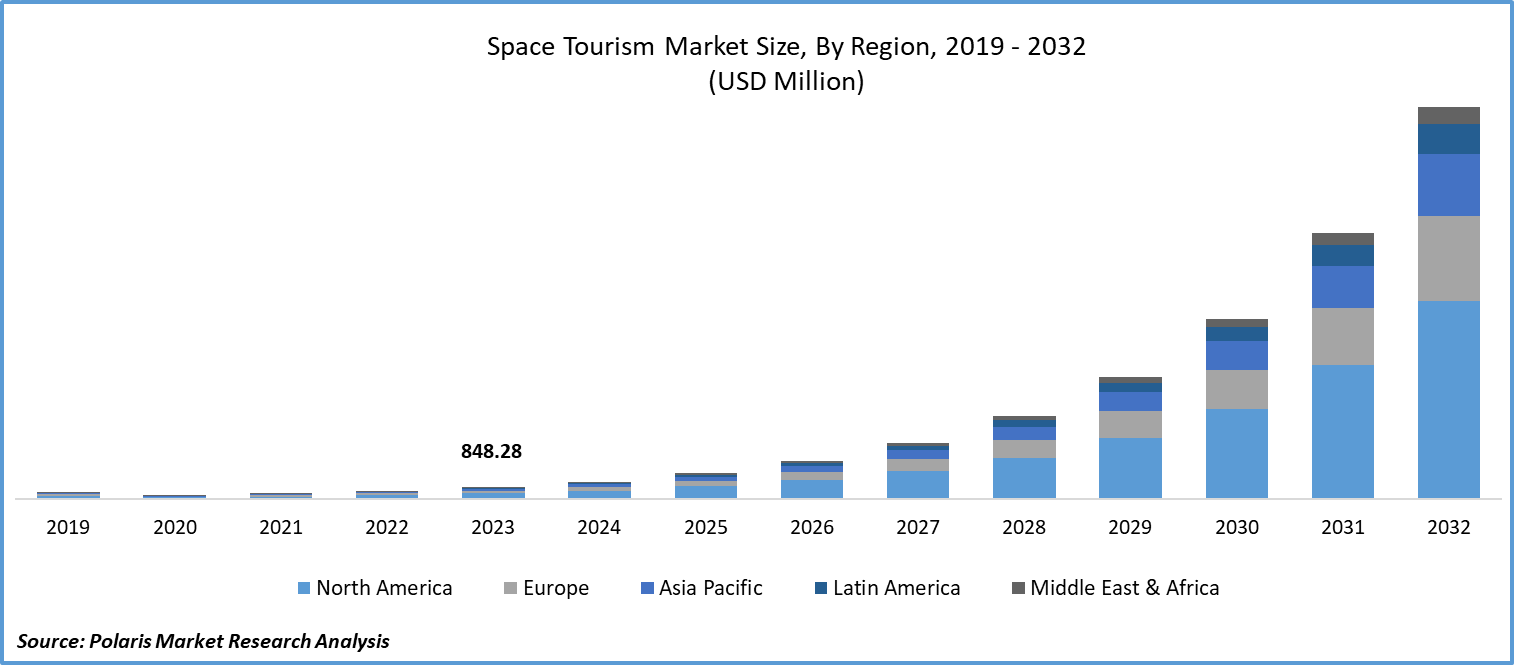
To Understand More About this Research: Download Sample Report
The space tourism market is expected to experience growth due to the rising number of suborbital space offerings from key market players. This increase in demand for space tourism is also expected to create ample opportunities in the future. Additionally, the growing awareness of moon tourism and the increased efforts by key players to send people to the moon are expected to offer further possibilities for growth in the space tourism market.
As the market continues to evolve, companies are seeking strategic partnerships, acquisitions, and collaborative ventures to combine resources, share expertise, and overcome financial and technological challenges. Mergers and acquisitions present businesses with opportunities to leverage synergies, enhance operational efficiency, and facilitate the exchange of knowledge and technologies. This dynamic corporate transaction landscape highlights the industry's dedication to achieving economies of scale and creating a collaborative environment that fosters innovation.
The COVID-19 pandemic has had a significant negative impact on the space tourism market. As the governments implemented the lockdown across all the nations around the globe, the key market players suspended their operations, and the manufacturing plants were forced to shut down owing to the shortages of labor. COVID-19 has also affected supply chain management as there are border restrictions imposed by the government, which results in the decline of the space tourism market growth rate.
Source: Polaris Market Research Analysis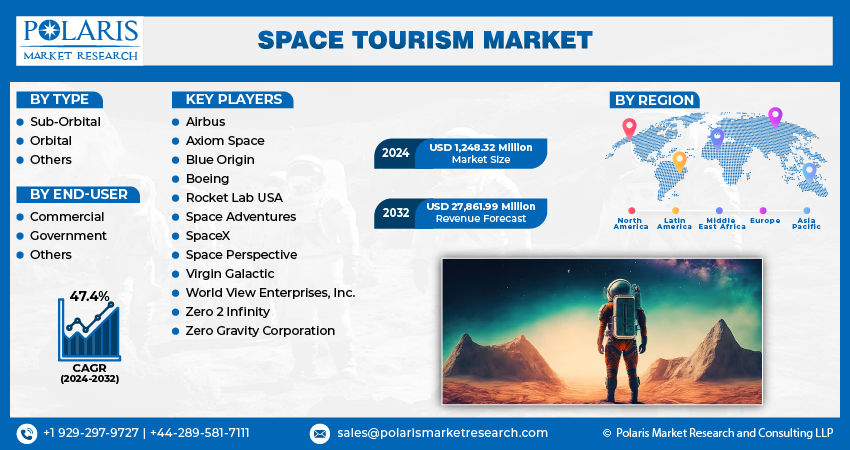
Get Full Segment-Level Forecasts & Insights: Download Sample Report
Market Drivers
Technological advancements in space tourism drive the growth of the market
The technological advancements in space tourism drive the space tourism market growth. Advancements in spacecraft design and engineering have significantly enhanced efficiency, safety, and overall experience for passengers. The introduction of reusable rockets and spacecraft has significantly reduced launch and transportation costs, making space travel more economically attractive and viable to a broader audience. Improved life support systems, upgraded habitats, and advanced onboard medical facilities have instilled greater confidence in prospective space tourists regarding the safety and comfort of their space expedition.
Advancements in immersive technologies like virtual reality allow for pre-flight training to prepare passengers for their space trip. Also, internet and communication capabilities on spacecraft enable visitors to instantly share their experiences, creating a sense of community and sparking interest among potential space explorers worldwide.
The development of private space enterprises and partnerships with government space agencies have given rise to innovative business models in recent years. These models offer a range of space tourism experiences, from short suborbital joyrides to longer stays on space stations. This variety of options appeals to a wide audience, attracting adventurers, scientists, researchers, and enthusiasts alike. With advancements in technology, space tourism is becoming more accessible, providing humanity with unprecedented opportunities to explore the cosmos.
Rising interest beyond the different types of space tourism is facilitating the growth of the market
Rising interest among the billionaires and billionaires in various types of space tourism is driving the space tourism market growth. Suborbital space tourism offers short but exciting trips to the outer reaches of Earth's atmosphere. It is particularly attractive to people who want an experience of space exploration without committing to prolonged journeys. The fascination with experiencing weightlessness and marveling at Earth from an exclusive perspective fuel both interest and financial backing for suborbital initiatives.
Orbital space tourism involves longer stays on space stations such as the International Space Station (ISS), providing people with a more immersive space experience. This opportunity appeals to wealthy individuals who are attracted by the prospect of conducting research, advancing science, and enhancing their space travel experiences.
Lunar tourism is an ambitious and forward-thinking concept that involves missions to the Moon and potential excursions on its surface. Venturing beyond Earth's orbit is a daring endeavor that captures the fascination and curiosity of high-net-worth individuals, contributing to the expansion of lunar tourism initiatives. The prospect of setting foot on the Moon, along with the prestige of participating in lunar exploration history, serves as a persuasive reason for wealthy individuals to support these pioneering ventures financially.
Market Restraints
Environmental concerns associated with the rocket launching and space shuttle hampering on the growth of the market
Environmental concerns associated with the rocket launching and space shuttle hampering the growth of the market
The space tourism industry is facing a challenge as environmentally conscious consumers are becoming increasingly concerned about the environmental impact of space launches. Issues like greenhouse gas emissions and pollution of air and water are forcing the industry to prioritize environmentally friendly practices. As regulations on environmental sustainability become more stringent, companies in the space tourism sector must allocate resources to research and development to minimize the ecological impact of their launches. This is necessary to ensure long-term sustainability and growth prospects of the space tourism market, as sustainability becomes a crucial factor in consumer decision-making and industry advancement.
The growing concern over the environmental damage caused by space shuttle and rocket launches is hindering the space tourism market growth. The chemical pollutants, carbon emissions, and other environmental effects associated with these launches are viewed as harmful to the planet. This increased awareness is causing potential space tourists to opt for more environmentally friendly options, dampening their enthusiasm for space travel experiences. This will ensure a more eco-conscious approach that aligns with the changing expectations of environmentally conscious consumers today, ultimately reducing the factors that are anticipated to hinder space tourism market growth.
Key Trends in Space Tourism
| Trend | Description | Technical / application focus | Examples from Practice |
| Reusable suborbital vehicles | Blue Origin's New Shepard and Virgin Galactic's SpaceShipTwo offer vertical suborbital hops to ~100 km for 4–6 passengers with 3–6 min microgravity. | FAA/AST licenses focus on public/property safety; vehicles designed for frequent reuse from runways or pads. | FAA cleared Virgin Galactic for passenger flights post‑2021 test; Blue Origin licensed for human spaceflight through 2023. |
| Orbital crewed missions to ISS | SpaceX Crew Dragon transports private astronauts (e.g., Axiom missions) to ISS for multi‑day stays under NASA/FAA oversight. | Human‑rated capsules with docking/life support; commercial astronaut wings for licensed flights >50 miles altitude. | FAA verifies vehicles for human ops; CRS report details licensing under 2004 Act until full certification post‑2023. |
| Rotating space hotels | Voyager Station (400 guests) and Pioneer Station (28 guests) by Orbital Assembly use centrifugal force for ~0.38g artificial gravity. | Luxury amenities (restaurants, spas, cinemas) in orbital rings; 3–7 day stays launched via reusable rockets. | Voyager targets 2027 opening as first commercial hotel; Pioneer prototypes by 2025–26 for tech validation. |
| Point‑to‑point suborbital transport | Horizontal suborbital ballistic flights for rapid Earth travel (e.g., NY–Tokyo <1h) post‑vertical tourism. | Revenue driver for reusable vehicles; FAA studies airport/launch site integration. | 2024 study projects USD 1.1B revenue by 2032; FAA 2010 report analyzes P2P ops feasibility. |
Source: Polaris Market Research Analysis
Report Segmentation
The market is primarily segmented based on type, end-user, and region.
| By Type | By End-User | By Region |
|
|
|
Source: Polaris Market Research Analysis
To Understand the Scope of this Report: Request Customization
Segmental Analysis
By Type Analysis
The sub-orbital segment held the largest market share in 2025. Suborbital tourism allows individuals to experience weightlessness and see space without leaving Earth's orbit. This advancement in human spaceflight expands the possibility of space travel without requiring spaceships to enter orbit. Suborbital flights are slower and need more acceleration to enter orbit. Instead, they go up to a predetermined altitude and then come back down when the engines shut off. Many companies are focusing on suborbital flights because they can reuse rockets, which reduces the cost of manufacturing.
The orbital segment has witnessed the fastest growth in the market. Orbital missions can last from a few days to several weeks, depending on the destination, such as Mars, the Moon, or the International Space Station (ISS). Companies like Orion Span and SpaceX are primarily focused on achieving orbital flights, while Virgin Galactic and Blue Origin mostly concentrate on suborbital missions.
By End-User Analysis
Based on end-user analysis, the market has been segmented on the basis of commercial, government, and others. The commercial segment dominated the space tourism market in 2023. In 2021, thirteen commercial spaceflight missions were undertaken by numerous government and private organizations; out of them, seven missions were executed successfully. The space tourism industry is on the rise, and technological innovations are making it easier to expand commercial space tourism. Industry stakeholders are putting in their best efforts to make space experiences more accessible by reducing the barriers associated with space tourism.
The government segment has witnessed the fastest growth in the space tourism market. Governments and space agencies around the world have sent astronauts beyond Earth's atmosphere. For example, NASA currently permits amateur astronauts to visit the International Space Station (ISS). To promote commercial space tourism in Low Earth Orbit, NASA has formed a partnership with SpaceX and Axiom.
Source: Polaris Market Research Analysis
Need Granular Data Across All Market Segments? Request Customization
Regional Insights
North America dominated the largest market in 2025
North America dominates the space tourism market; the region has a wide research and development base and is equipped with a hugely developed infrastructure that makes the region a top revenue contributor in the space tourism market over the forecast period. North America is anticipated to maintain its dominance over the forecast period due to the leaning of rich individuals towards space tourism and increasing technological investment in the region.
Asia-Pacific has witnessed for the fastest growth in the space tourism market. China has been manufacturing rockets in more numbers for commercial satellite launches. Also, the Indian Space Research Organizations (ISRO), Japan Aerospace Exploration Agency (JAXA), and China National Space Administration (CNSA), are the substantial contributors for the space tourism market growth in the region.
Source: Polaris Market Research Analysis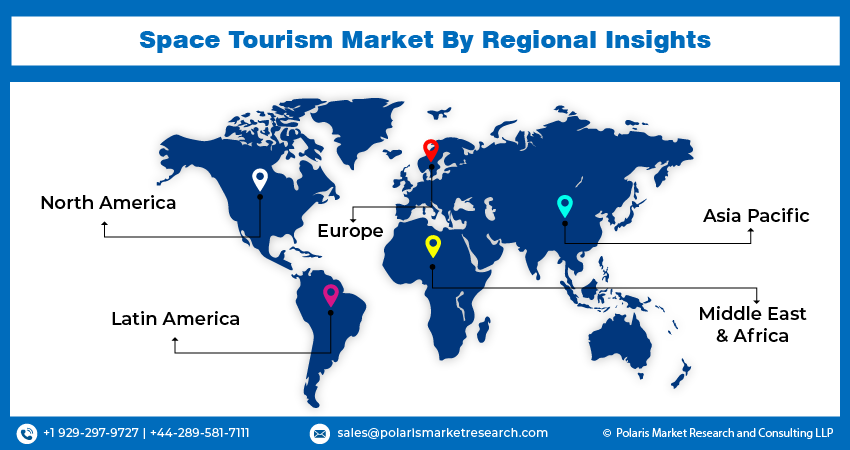
Curious About Regional Market Performance? Request Customization
Competitive Landscape
The space tourism market is characterized by intense competition, with established players relying on advanced technology, high-quality products, and a strong brand image to drive revenue growth. These companies employ various strategies such as research and development, mergers and acquisitions, and technological innovations to expand their product portfolios and maintain a competitive edge in the market.
Some of the major players operating in the global market include:
- Airbus
- Axiom Space
- Blue Origin
- Boeing
- Rocket Lab USA
- Space Adventures
- SpaceX
- Space Perspective
- Virgin Galactic
- World View Enterprises, Inc.
- Zero 2 Infinity
- Zero Gravity Corporation
Recent Developments
October 2025, Blue Origin successfully launched its 15th space tourism mission, NS-36, carrying six passengers, including a previously unidentified traveler, on a suborbital New Shepard flight from West Texas, completing a 10-minute journey beyond the Kármán line and safely returning all crew.
October 2024, Deep Blue Aerospace, a China-based aerospace firm, announced plans to sell two tickets for its 2027 commercial spaceflight at 1.5 billion yuan (about USD 211,000). The experience will provide passengers with several minutes of weightlessness, reflecting progress in the space tourism sector.
February 2024, Florida-based startup Space Perspective unveiled a test capsule for its Neptune spacecraft. Designed to carry passengers to the stratosphere via a giant balloon rather than rockets, Neptune could begin flights as early as next year. The company positions it as the third commercial suborbital spacecraft, following Virgin Galactic’s SpaceShipTwo and Blue Origin’s New Shepard.
June 2023, Virgin Galactic launched its commercial spaceflight service, with the first-ever commercial space voyage scheduled to begin on June 27 and run through June 30 during the first "Galactic-01" flight window.
May 2023, Vast plans to launch Vast Haven-1, the first commercial space station, on a Falcon 9 rocket with two crewed spaceflights in August 2025. They are also developing a larger space station to be integrated into Haven-1. The partnership with SpaceX aims to expand space exploration and make space more accessible.
November 2022, Axiom Space and Virgin Galactic partnered up to perform a mission that centers around microgravity research and training. The two companies will combine their expertise and resources to conduct the mission, promote scientific advancement, and offer valuable training opportunities in the field of microgravity.
Report Coverage
The space tourism market report emphasizes on key regions across the globe to provide better understanding of the product to the users. Also, the report provides market insights into recent developments, trends and analyzes the technologies that are gaining traction around the globe. Furthermore, the report covers in-depth qualitative analysis pertaining to various paradigm shifts associated with the transformation of these solutions.
The report provides detailed analysis of the market while focusing on various key aspects such as competitive analysis, type, end-user, and their futuristic growth opportunities.
Report Scope
| Report Attributes | Details |
| Market size in 2025 | USD 1.84 billion |
| Market size in 2026 | USD 2.71 billion |
| Revenue forecast in 2034 | USD 60.81 billion |
| CAGR | 47.5% from 2026 – 2034 |
| Base year | 2025 |
| Historical data | 2021 – 2024 |
| Forecast period | 2026 – 2034 |
| Quantitative units | Revenue in USD billion and CAGR from 2026 to 2034 |
| Segments Covered | By Type, By End-User, By Region |
| Regional scope | North America, Europe, Asia Pacific, Latin America; Middle East & Africa |
| Customization | Report customization as per your requirements with respect to countries, region and segmentation |
Source: Polaris Market Research Analysis
space tourism market FAQ's
The space tourism market size is expected to reach USD 60.81 billion by 2034, according to a new study by Polaris Market Research.
Key players in the market are Airbus, Axiom Space, Blue Origin, Boeing, Rocket Lab USA, Space Adventures, SpaceX, Space Perspective, Virgin Galactic
North America contribute notably towards the global Space Tourism Market
Space tourism market exhibiting the CAGR of 47.5% during the forecast period.
The Space Tourism Market report covering key segments are type, end-user, and region.
Download Sample Report of space tourism market
Please fill out the form to request a customized copy of the research report.


