Textile Chemicals Market Size & Share Global Analysis Report, 2026-2034
REPORT DETAILS
Market Statistics
Textile Chemicals Market Overview
The global textile chemicals market size was valued at USD 24.45 billion in 2025 and is expected to grow at a CAGR of 4.3% from 2026 to 2034. The market is growing due to the increasing demand for functional textile finishes in the textile industry. The emphasis on enhancing fabric properties and ensuring regulatory compliance is driving the demand for advanced textile chemical formulations. The market is also gaining from the adoption of sustainable manufacturing processes.
Textile chemicals are various chemical compounds used at different stages of textile processing and manufacturing. These chemicals have an important role in improving the performance, appearance, and functionality of textiles. They are used in textile processes such as pre-treatment, textile dyeing, printing, and finishing. Their use imparts specific properties, such as color fastness, water repellency, durability, and fire-resistant coatings. The increasing use of textile processing chemicals in technical textiles, performance clothing, and home furnishings has widened the demand for specialty and sustainable textile chemicals.
Key Insights
- The colorants segment led the market in 2025. This is due to increasing demand for vibrant and appealing textiles across various industries.
- The apparel segment is projected to have the largest revenue share, as fashion and apparel rely heavily on chemicals for various stages of the manufacturing process.
- Asia Pacific led the global market in 2025. The strong textile and apparel manufacturing industry is one of the factors that lead to the dominance of the regional market.
- The Europe market is expected to have the highest growth rate. Changes in consumer behavior and government policies are some of the factors that influence the growth of the regional market.
Industry Dynamics
- The growing demand for technical textiles across sectors such as healthcare and aerospace is contributing to the market expansion.
- The textile chemicals market is benefiting from the increased demand for functional textile finishes in the textile industry.
- The increasing interest in sustainable and bio-based formulations is expected to create several opportunities in the market in the coming years.
- The price variations of raw materials and petroleum-based chemicals may act as a hindrance to the growth of the market.
Market Statistics
- 2025 Market Size: USD 24.45 billion
- Market Forecast 2034: USD 35.62 billion
- CAGR (2026–2034): 4.3%
- Largest Market: Asia Pacific
AI Impact on Textile Chemicals Market
- AI is assisting textile chemical manufacturers in understanding better what the fabric brands require, making it easier to develop finishes and treatments that are in line with the latest fashion and performance trends.
- It assists in better planning in manufacturing, reducing trial-and-error methods, which in turn helps in saving raw materials, reducing costs, and minimizing waste.
- Quality testing is becoming more reliable as AI assists in identifying potential problems early on, resulting in more consistent color, texture, and fabric performance.
- AI also promotes sustainable practices by advising on the use of safer chemicals and optimizing water and energy consumption in textile processing.
Source: Polaris Market Research Analysis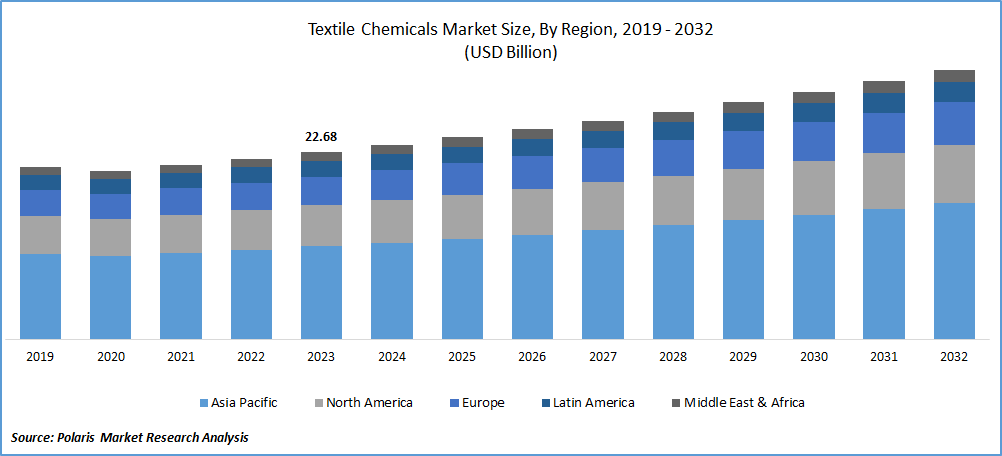
Want a Deeper Look at Key Market Players? Download Sample Report
The use of chemicals in the textile industry has become a specialized area where a number of organic and inorganic chemicals are used to create specific properties. The recent advancements in wet processing textile chemicals have made it possible to produce lower water, energy, and cost consumption with improved quality of fabric. The growing convergence of materials science and textile chemistry is accelerating innovation across the textile chain.
The rising living standards, especially in both developed and developing countries, have driven the production of textiles for upholstery. At the same time, the growing focus on chemical exposure, safety, and environmental concerns has heightened demand for eco-friendly textile chemicals.
Several factors are currently hampering the market's growth. With the increasing awareness about sustainability, there is a growing need for sustainable practices in the textile industry. This has resulted in a decrease in the use of certain conventional chemicals. In addition, environmental issues have also influenced consumers to opt for safer alternatives. This has resulted in stricter regulations that restrict the use of certain chemicals in textile production.
Industry Dynamics
Growth Drivers
Rising Demand for Technical Textiles Drives Market Growth
There has been an increase in the demand for technical textiles. Technical textiles include products such as medical textiles, geotextiles, and protective clothing. These products need specialized characteristics. They must be highly durable and chemically resistant. They also need to have advanced functionality. Producing technical textiles involves complex processes. These processes often demand the use of textile chemicals for coating, finishing, and functional enhancements.
With the growing use of technical textiles in various sectors like automobile, healthcare, construction, and aerospace, the demand for textile chemicals corresponding to these technical textiles has increased significantly. Textile chemicals have a major application in providing the required properties to technical textiles, such as water resistance, flame retardancy, and antimicrobial properties. The growing focus on innovation and performance in technical textiles has led to the development of advanced textile chemicals.
Source: Polaris Market Research Analysis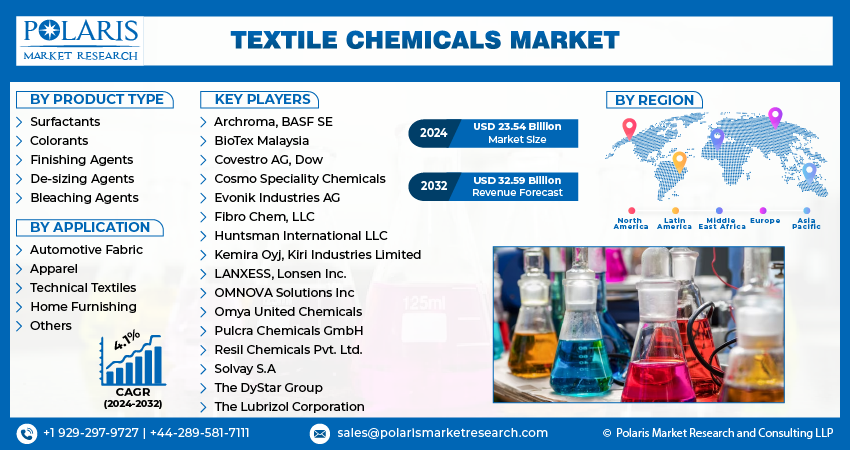
Get Full Segment-Level Forecasts & Insights: Download Sample Report
Report Segmentation
By Product Type Analysis
In 2025, the colorants segment held a prominent market position in the textile chemicals market, driven by increasing demand for aesthetically pleasing textiles across the fashion, home textiles, and automotive industries. Dyes and pigments are important components in enhancing textile aesthetics, as consumers increasingly demand a variety of colorful, attractive shades. Innovation in this segment has also been supported, as eco-friendly, sustainable dyes have gained popularity. Moreover, the flexibility of colorants allows them to be applied to a variety of fabric types and colors. All of these factors have contributed to their leading market position.
By Application Analysis
The apparel industry is expected to be the leading revenue contributor to the textile chemicals market, as it is among the largest consumers of textile chemicals. Textile chemicals are required for enhancing the most important properties of apparel, such as colorfastness, durability, and comfort. With consumers' evolving preferences, there is increasing demand for apparel with advanced properties, such as stain resistance, wrinkle resistance, and moisture management. These properties can be achieved by using specialized chemical formulations. Furthermore, the fashion industry is highly dynamic. It experiences constant changes in trends and has shorter product life cycles. This is driving the adoption of innovative textile chemical solutions to allow efficient production.
Source: Polaris Market Research Analysis
Need Granular Data Across All Market Segments? Request Customization
Regional Insights
In 2025, the Asia Pacific market for textile chemicals had the largest market share. This is because the Asia Pacific region has a well-developed textile and apparel industry, especially in countries such as China, India, and Bangladesh. These countries have been identified as major textile producers. They have access to low-cost labor, raw materials, and well-developed manufacturing infrastructure. Moreover, the Asia Pacific region has a large population and rising per capita income, which has fueled domestic demand for textiles and apparel. This has generated a demand for superior textile chemicals.
The Europe textile chemical market is anticipated to register the fastest growth. The textile chemical market in the Europe region is fueled by the increasing focus on consumer preferences, government policies, and the rising demand for innovative textile production technology. The Europe region has been at the forefront of adopting and promoting environmentally friendly and sustainable manufacturing processes. The Europe market has been fueled by the increasing stringent regulations on the use of chemicals and their effects on the environment. This has led textile manufacturers to focus on innovative technologies and environmentally friendly formulations for textile chemicals.
Source: Polaris Market Research Analysis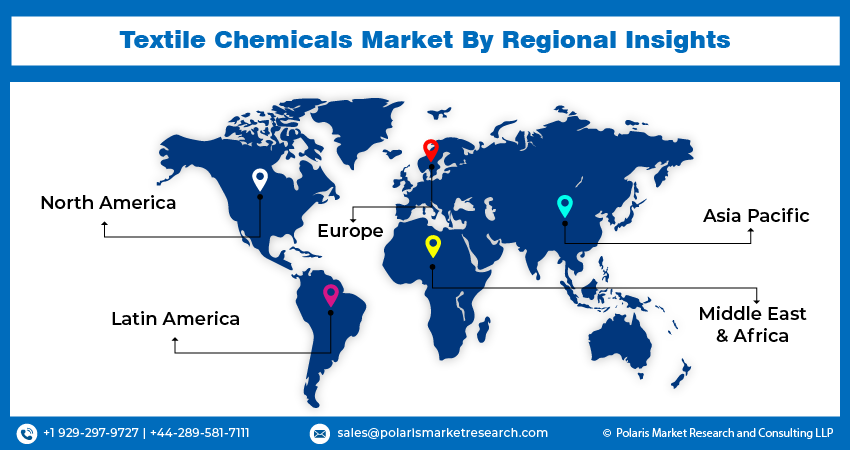
Curious About Regional Market Performance? Request Customization
Key Market Players & Competitive Insights
The market is highly competitive due to the presence of many manufacturers worldwide. Companies' strategies have focused on digitalization, artificial intelligence, and the Internet of Things (IoT) in manufacturing. The adoption of strategic initiatives, such as the launch of new products and acquisitions, is another activity in which market participants actively engage to compete with other manufacturers.
List of Key Companies
- Archroma
- BASF SE
- BioTex Malaysia
- Covestro AG
- Dow
- Cosmo Speciality Chemicals
- Evonik Industries AG
- Fibro Chem, LLC
- Huntsman International LLC
- Kemira Oyj
- Kiri Industries Limited
- LANXESS
- Lonsen Inc.
- OMNOVA Solutions Inc
- Omya United Chemicals
- Pulcra Chemicals GmbH
- Resil Chemicals Pvt. Ltd.
- Solvay S.A
- The DyStar Group
- The Lubrizol Corporation
Recent Developments
In November 2025, DuPont introduced Tyvek APX, an advanced chemical formulated for the production of protective garments.
In October 2025, Clariant unveiled a titanium-based catalyst solution, specifically designed for manufacturing polyester garments, according to EcoTextile.
In March 2025, Aquafil began its first demonstration plant in Slovenia. According to the company, the plant will chemically separate elastic fiber from nylon. With this, Aquafil aims to promote R&D in the textile fiber industry.
In February 2025, Techtextil announced the launch of a new Textile Chemicals & Dyes category for the 2026 show. This move intends to emphasize the significance of the growing industry, encouraging collaboration and synergies.
In April 2022, Cosmo Speciality Chemicals introduced the Wetofast range, an eco-friendly alternative that helps maintain fabric quality. The range consists of three new products: Wetofast GN, Wetofast LOR, and Wetofast LD.
Textile Chemicals Market Segmentation
By Product Type Outlook (Revenue, USD Billion, 2021–2034)
- Surfactants
- Colorants
- Finishing Agents
- De-sizing Agents
- Bleaching Agents
By Application Outlook (Revenue, USD Billion, 2021–2034)
- Automotive Fabric
- Apparel
- Technical Textiles
- Home Furnishing
- Others
By Regional Outlook (Revenue, USD Billion, 2021–2034)
- North America
- US
- Canada
- Europe
- Germany
- France
- UK
- Italy
- Spain
- Netherlands
- Russia
- Rest of Europe
- Asia Pacific
- China
- Japan
- India
- Malaysia
- South Korea
- Indonesia
- Australia
- Vietnam
- Rest of Asia Pacific
- Middle East & Africa
- Saudi Arabia
- UAE
- Israel
- South Africa
- Rest of Middle East & Africa
- Latin America
- Mexico
- Brazil
- Argentina
- Rest of Latin America
Textile Chemicals Market Report Scope
| Report Attributes | Details |
| Market Size in 2025 | USD 24.45 billion |
| Market Size in 2026 | USD 25.42 billion |
| Revenue Forecast by 2034 | USD 35.62 billion |
| CAGR | 4.3% |
| Base Year | 2025 |
| Historical Data | 2021–2024 |
| Forecast Period | 2026–2034 |
| Quantitative Units | Revenue in USD billion, and CAGR from 2026 to 2034 |
| Report Coverage | Revenue Forecast, Market Competitive Landscape, Growth Factors, and Trends |
| Segments Covered |
|
| Regional Scope |
|
| Competitive Landscape | Textile Chemicals Industry Trend Analysis (2025) Company profiles/industry participants profiling include company overview, financial information, product/service benchmarking, and recent developments |
| Report Format | PDF + Excel |
| Customization | Report customization as per your requirements with respect to countries, regions, and segmentation. |
Source: Polaris Market Research Analysis
Textile Chemicals Market FAQ's
Asia Pacific leads the textile chemicals market. The regional market dominance is attributed to its strong manufacturing base and export capabilities.
Types include surfactants, colorants, finishing agents, de-sizing agents, and bleaching agents. These are used during various textile production stages to improve fabric properties.
The textile chemicals market was valued at USD 24.45 billion in 2025. It is projected to grow to USD 35.62 billion by 2034, growing at a 4.3% CAGR.
Textile chemicals are used in pre-treatment, printing, and finishing processes. Their use improves textile performance and fire resistance properties.
Rising demand for functional finishes and sustainable processing chemicals is driving the textile chemicals market growth. The market is also benefiting from innovations in eco-friendly formulations.
Download Sample Report of Textile Chemicals Market
Please fill out the form to request a customized copy of the research report.


