
Trim Tabs Market Size, Trends, Reach Analysis Report, 2026-2034
REPORT DETAILS
Market Statistics
What is Trim Tabs Market Size?
The Trim Tabs Market is anticipated to reach USD 1.63 billion in 2024 and grow at a CAGR of 5.3% from 2025 to 2034. Increasing demand for lightweight marine control systems, rising recreational boating, and naval modernization efforts support market expansion.
Market Statistics
- 2025 Market Size: USD 1.63 Billion
- 2034 Projected Market Size: USD 2.54 Billion
- CAGR (2026-2034): 5.3%
- Largest Market: North America
The rising need to improve the fuel efficiency from the aviation and marine industries and their growing use to trim or counteract hydro and aerodynamic forces and also stabilize the aircraft or boat in a particular attitude are the primary factors influencing the growth of the global market. Additionally, the growing relevance of air and sea travel all over the world, the emerging tourism industry, the surge in import and export activities, and change in people's lifestyles across the globe coupled with the increasing inclination of aviation and marine industries towards better optimal safety of passengers, are further anticipated to boost market's growth.
Source: Polaris Market Research Analysis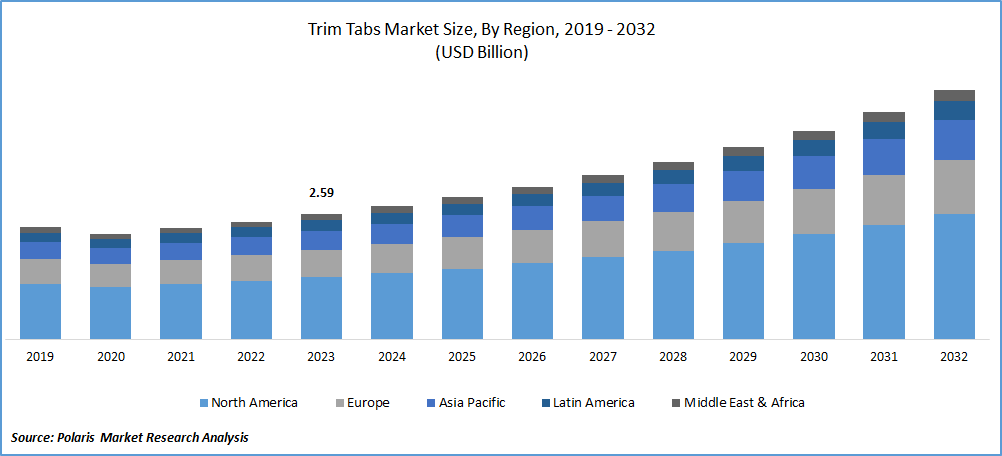
To Understand More About this Research: Download Sample Report
For instance, according to a recent report by the Central Statistics Office, air & sea travel overtook the levels in April 2023, with more than 1.8 Mn people arriving in the Republic from overseas in April, with an increase of almost 4.2 percent in the same month of 2019.
In recent years, key companies operating in the market have increasingly introduced trim tabs integrated with advanced electronic control systems that allow for more precise adjustments, automation, and even remote control through smartphone apps or dedicated control panels and help companies boost their revenue and sales.
Industry Dynamics
Growth Drivers
Expansion of aviation and marine sectors and growing number of aircrafts spurring the market growth
The continuous expansion of aviation and marine sectors and growing implementation of stringent aviation safety regulations, coupled with the proliferation of advancements in trailing edge technologies for boats and aircraft, which resulted in increased demand for trim tabs, driving the global market at a significant pace. In addition, there has been a drastic increase in the number of aircraft and military jest worldwide that use trim tabs for various purposes, including passenger travel, defense operations, and landscape inspection, which is further influencing the market for trim tabs exponentially. For instance, according to a recent report, the total number of aircraft worldwide currently counts 28,674 aircraft, with almost 23,513 and 5,161 grounded, with an increase of 3% in the number of active aircraft
Key Trim Tab Trends
| Trend | Description | Key Drivers | Examples from Practice |
| Optimal trim tab deployment for planing | Adjustable trim tabs reduce hydrodynamic resistance, lower hump resistance peaks, and enable earlier planing transitions with lower power needs. | High-speed vessel demands for efficiency, stability during acceleration, and reduced bow impacts. | Configuration B (12 mm height, 70 mm chord) outperformed A (6 mm height, 50 mm chord) in towing tank tests, stabilizing spray patterns up to 5.04° trim. |
| Convex/curved forward-facing surfaces | Trim tabs with convex leading edges generate 60% more lift than flat interceptors, transitioning interceptor-like behavior at low speeds to full trim tab lift at high speeds. | Need for low actuation force like interceptors combined with high lift/control authority across speed regimes (below/above 18 knots). | US Patent US20160001849A1: Curved surface deflects water, adjusts pitch/roll/yaw; performs well from slow to planing speeds. |
| Electric vs. hydraulic actuation | Electric actuators for smaller/recreational boats offer precision/smart integration; hydraulic for larger vessels provide high power/durability. | Affordability, ease of control, and compatibility with vessel size/power systems. | Electric systems (e.g., integrated sensors) for real-time adjustments; hydraulic dual actuators for heavy-duty use. |
| Interceptor-trim tab hybrids | Compact vertical blades (0.5% wetted length height) for trim control where transom space limits traditional tabs; lighter with simpler mechanics. | Space constraints, weight reduction, and consistent stability without max lift focus. | Heights 50-75 mm for 18-60m vessels; embedded in boundary layer to avoid separation. |
| Automatic/smart control integration | Real-time sensors/actuators for dynamic trim adjustment responding to sea state, load, speed; reduces manual input. | Crew workload reduction, fuel efficiency, and safety in variable conditions. | Humphree Interceptor Tabs auto-adjust for trim/stability; digital systems with monitoring. |
| Perforated/faceted surface variants | Slits, holes, facets, strakes on curved faces modify lift, pressure, cavitation; eccentric/stepped for tuned performance. | Customization for hull type, speed, sea state to optimize drag reduction/stability. | Diamond faces, horizontal slits, triangular holes, inverted plow shapes for varied flow control. |
Source: Polaris Market Research Analysis
Source: Polaris Market Research Analysis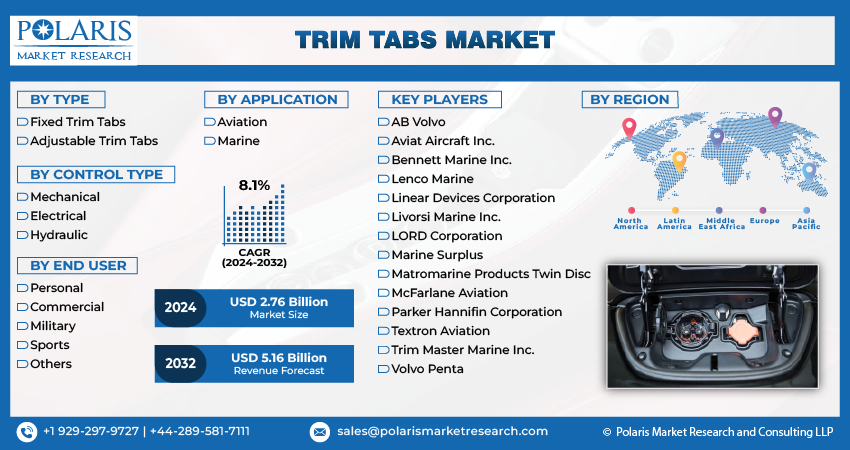
Get Full Segment-Level Forecasts & Insights: Download Sample Report
Report Segmentation
The market is primarily segmented based on type, control type, end user, application, and region.
| By Type | By Control Type | By End User | By Application | By Region |
|
|
|
|
|
Source: Polaris Market Research Analysis
To Understand the Scope of this Report: Request Customization
By Type Analysis
Fixed trim tabs segment accounted for the largest market share in 2025
The fixed trim tabs segment accounted for the largest share. The growth of the segment market is highly attributable to its ability to improve or enhance the stability and control of boats, particularly in rough or turbulent waters, along with the capability to improve the fuel efficiency of boats by reducing drag. Furthermore, there have been growing advances in fixed trim tab technology, such as the development of more efficient and durable materials, sensors, and control systems, which could drive the segment market growth, as these innovations can enhance the performance and functionality of fixed trim tabs and make them more appealing to boat owners and operators than others.
By Control Type Analysis
Electric segment is expected to hold substantial market share over the forecasted years
The electric segment is expected to hold a substantial market share throughout the study period, mainly due to its widespread adoption and popularity as it provides precise control over a boat's trim, resulting in better stability, improved handling, smoother ride, and also reduced fuel consumption as compared to other types available in the market. Leading companies in the market are focusing on the integration of electric trim tabs with several modern boat control systems and navigation electronics, allowing for convenient as well as automatic adjustments. For instance, in October 2021, Dometic unveiled its new standard version of the innovative trim tab system that uses an intuitive dial controller, providing boaters superior ride control and simple operation on a wider variety of boats. The company's electric actuators reduce the complexity of the system and increase long-term reliability
By End User Analysis
Commercial segment led the industry market in 2025
The commercial segment led the market with substantial revenue share in 2025, which is majorly driven by continuous growth in international transportation and rising globalization that fuels the demand for solutions that significantly reduce maintenance costs and extend the lifespan of the equipment. Besides this, the growing focus on sustainability across different industries and rising awareness about the importance of trim tabs to reduce fuel consumption and emissions is further influencing product demand in the commercial segment.
By Application Analysis
Aviation segment lead the market with majority share in 2025
The aviation segment leads the market with the maximum share due to the exponential growth of the aircraft industry with the surge in the number of aircraft production and expansion of commercial as well as military aircraft fleets. As the global aviation industry is increasingly focusing on fuel efficiency and reducing emissions, they are opting for trim tabs that improve aircraft aerodynamics, which, in turn, opens up new growth avenues for the segment market.
Source: Polaris Market Research Analysis
Need Granular Data Across All Market Segments? Request Customization
Regional Insights
North America region dominated the global market in 2025
The North America region dominated the global market. The regional market growth can be highly attributed to the robust presence of highly established and developed aviation sectors across the region, the robust presence of stringent aviation safety regulations, and surging government initiatives and funding promoting the development of solutions that help improve fuel efficiency and consumption, like trim tabs.
The Asia Pacific region is anticipated to emerge as the fastest growing region, owing to a notable increase in the number of passengers traveling by air and sea and constant growth in consumer disposable income in countries like India, China, and Indonesia, allowing them to spend higher on recreational boating and water sports. For instance, according to a report by IATA, the airline industry in the Asia Pacific has recovered sharply and has grown by almost 125.6% in the first quarter of 2023 as compared to the same period of 2022. The APAC region jumped from 35.1% of 2019 levels in H1 2022 to 79.7% in H1 2023
Source: Polaris Market Research Analysis
Curious About Regional Market Performance? Request Customization
Key Market Players & Competitive Insights
The trim tabs market is highly consolidated in nature, with several global and regional players competing for market share and consolidating their position ahead of their competitors. These market players are constantly focusing on innovating new products with advanced or improved capabilities to help end users better handling of applications in the marine and aviation sectors during traveling.
Some of the major players operating in the global market include:
- AB Volvo
- Aviat Aircraft Inc.
- Bennett Marine Inc.
- Lenco Marine
- Linear Devices Corporation
- Livorsi Marine Inc.
- LORD Corporation
- Marine Surplus
- Matromarine Products Twin Disc
- McFarlane Aviation
- Parker Hannifin Corporation
- Textron Aviation
- Trim Master Marine Inc.
- Volvo Penta
Recent Developments
- January 2025, Quick Intercepta “plug & play” automatic trim tab system launches in New Zealand
- January 2022, The Limestone Boat introduced new Limestone Boats L-200R Runabout & also introduced the Aquasport brand in Canada. The newly launched L-220R offers various additional options, including synthetic teak decking, electric trim tabs with indicators, and docking lights.
- September 2023, Yamaha Marine introduced its new marketing campaign that is specially designed to create content that brings together boating commuting with a story-telling approach. The company includes manufacturing divisions for rotational molding, trim tabs, & stainless-steel propellers.
Trim Tabs Market Report Scope
| Report Attributes | Details |
| Market size in 2025 | USD 1.63 billion |
| Market size in 2026 | USD 1.69 billion |
| Revenue forecast in 2034 | USD 2.54 billion |
| CAGR | 5.3% from 2026 – 2034 |
| Base year | 2025 |
| Historical data | 2021 – 2024 |
| Forecast period | 2026 – 2034 |
| Quantitative units | Revenue in USD billion and CAGR from 2026 to 2034 |
| Segments covered | By Type, By Control Type, By End User, By Application, By Region |
| Regional scope | North America, Europe, Asia Pacific, Latin America; Middle East & Africa |
| Customization | Report customization as per your requirements with respect to countries, region and segmentation. |
Source: Polaris Market Research Analysis
Trim Tabs Market FAQ's
The global trim tabs market size is expected to reach USD 2.54 billion by 2034
Linear Devices Corporation, Marine Surplus, Textron Aviation, Trim Master Marine are the top market players in the market.
North America region contribute notably towards the global Trim Tabs Market.
The global trim tabs market is expected to grow at a CAGR of 5.3% during the forecast period.
Type, control type, end user, application, and region are the key segments in the Trim Tabs Market.
Download Sample Report of Trim Tabs Market
Please fill out the form to request a customized copy of the research report.


