
Universal Remote Controls Market Size, Share Global Analysis Report, 2026-2034
REPORT DETAILS
Market Statistics
What is Universal Remote Controls Market Size?
The global universal remote controls market was valued at USD 4.52 billion in 2025 and is expected to grow at a CAGR of 5.9% during the forecast period.
Market Statistics
- 2025 Market Size: USD 4.52 Billion
- 2034 Projected Market Size: USD 7.48 Billion
- CAGR (2026-2034): 5.9%
- Largest Market: Asia Pacific
Rising home entertainment industry growth worldwide is fueling the demand for household electronics, such as TVs, audio systems, streaming devices, and more, complementarily creating the need for efficient remote controls in the marketplace. Furthermore, the growing popularity of smart home mechanisms is empowering companies to innovate effective remote controls for the population. The increasing usage of household appliances, such as smart TVs and smart ACs, and the adoption of surveillance systems at houses for security reasons are driving the adoption of the Internet of Things (IoT) with a view to saving energy and costs for households. This trend necessitates the need for advanced, unified remote controls among consumers. In addition, growing product upgrades by the major players in the market are leading to increased consumer satisfaction.
Source: Polaris Market Research Analysis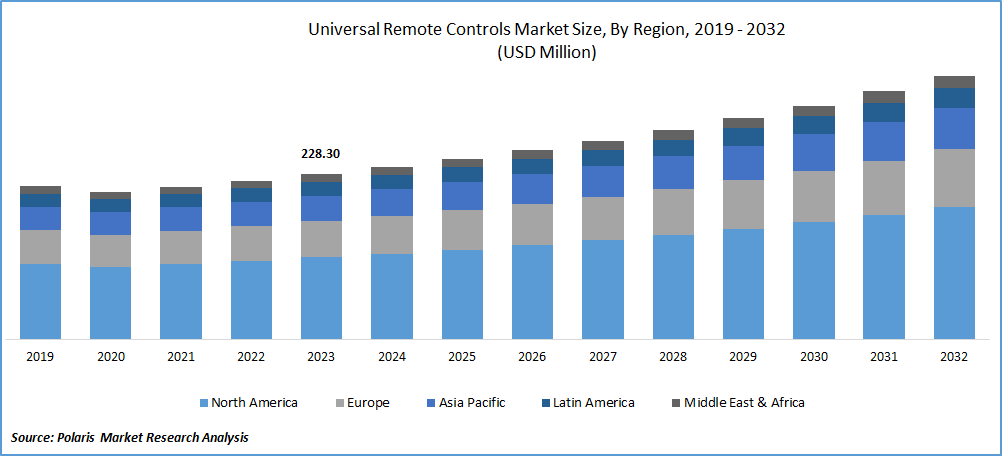
To Understand More About this Research: Download Sample Report
For instance, in December 2022, Google, a tech giant, introduced new remote-control features into its Google TV app. As a part of this, it updated the remote design by adding a collapsible panel at the bottom rather than opening a separate page for Android TV OS devices. It also permitted users to cast their movies and TV shows on numerous streaming devices from a single device. Moreover, the increasing adoption of home automation systems among the population, driven by increased convenience and lower utility bills, is expected to widen the demand for remote control systems in the coming years.
Source: Polaris Market Research Analysis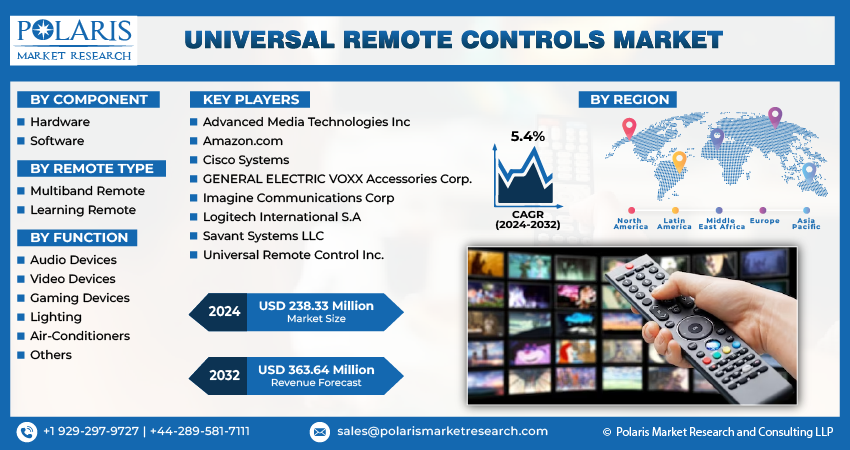
Get Full Segment-Level Forecasts & Insights: Download Sample Report
Industry Dynamics
Growth Drivers
Rising development of modern remote controls
The rising technological advancements in household appliances are contributing to the new product launches in remote control systems. For instance, in September 2023, Huawei unveiled a large smart TV, the V5 Pro, with the Lingxi pointing remote control. This TV is available in two sizes, such as 85-inch and 98-inch, and has Super MiniLED screens. Its latest remote allows users to point out on the screen rather than clicking real buttons or sliding fingers across remote buttons. This also enables users to play mobile games on TV with the application of the air touch feature. These innovations are expected to enhance product innovations and upgrades among the companies in the study period, contributing to the increased availability of universal remote controls market to larger consumers with the additional features.
Key Universal Remote Trends
| Trend | Description | Key Drivers | Examples from Practice |
| Smartphone as universal remote | Mobile apps with IR blasters or external hardware (RPi/LIRC) learn and replay IR codes from multiple remotes for home appliances. | Multiple remotes clutter; desire for single-point control via existing smartphones. | Raspberry Pi with LIRC records fan/TV/AC IR signals, controls via Python GUI/Ubidots IoT dashboard/Telegram bot. |
| IoT/cloud-based remote access | MQTT/Ubidots platforms enable remote control of IR devices via web/mobile dashboards from anywhere. | Pervasive internet access; need for remote home automation beyond local range. | Ubidots dashboard publishes commands (e.g., "SPEED1") to RPi MQTT topics, triggering IR transmission. |
| Self-learning IR protocols | Systems capture/decode IR bit patterns (e.g., NEC, Sony SIRCS) from any remote, store in config files for reuse. | Manufacturer-specific codes; need for device-agnostic control without databases. | LIRC |
| URC standardization (ISO/IEC 24752) | Framework for alternative UIs across devices via sockets/descriptions; supports accessibility, language adaptation. | Device UI variability; disability access; multi-language needs. | URC-HTTP with UPnP RemoteUI (CEA-2014) enables controller-target communication. |
| Voice/app hybrid control | Integration with Telegram bots, voice assistants for macro commands across IR/Wi-Fi devices. | Hands-free operation; macro programming (e.g., "movie mode"). | Telegram bot sends MQTT payloads to control multiple appliances sequentially. |
| BLE/Wi-Fi enhanced connectivity | Shift from IR to Bluetooth Low Energy/Wi-Fi for modern devices; backward compatibility with IR learners. | FCC-noted RF/Bluetooth in 62%+ of 2023 consumer electronics. | Smart remotes with macro programming, haptic feedback for TVs/streamers. |
Source: Polaris Market Research Analysis
Report Segmentation
The market is primarily segmented based on component, remote type, function and region.
| By Component | By Remote Type | By Function | By Region |
|
|
|
|
Source: Polaris Market Research Analysis
To Understand the Scope of this Report: Request Customization
By Component Analysis
Hardware segment is expected to witness the highest growth during the forecast period
The hardware segment is projected to grow at a CAGR during the projected period, mainly driven by the ease of application among the younger to the elderly population, as they are traditionally more aware of TV operations using hardware remotes. The increased comfort of operating a TV with buttons and intuitive interfaces plays a significant role among consumers, as they are perceived to be vital.
The software segment dominated the market, largely attributable to the rising adoption of smartphones among the population. The ongoing trend of smart homes and integration with IoT is driving the demand for software remote solutions as they enable users to operate multiple devices instantly.
By Remote Type Analysis
Learning remote segment accounted for the largest market share in 2025
The learning remote segment accounted for the largest share. The compatibility of this remote enables users to operate multiple electrical appliances, including air conditioners, light devices, and more, making it a cost-effective option for consumers. The multi-band remote segment is expected to grow at the fastest rate over the next few years on account of the ease of set-up due to the user-friendly configuration, removing the need for manual programming.
By Function Analysis
Audio devices segment held the significant market revenue share in 2025
The audio devices segment held a significant market share in revenue in 2025, which is highly accelerated due to the surging demand for home entertainment after the COVID-19 pandemic outbreak, driven by stringent lockdowns that led to the adoption of audio and video devices among the population, which in a way contributed to the demand for audio remote controls in the market. The ongoing developments of remote controls, particularly for audio devices, are expected to favor the growth of the market in the study period.
Source: Polaris Market Research Analysis
Need Granular Data Across All Market Segments? Request Customization
Regional Insights
Asia Pacific region registered the largest share of global market in 2025
The Asia Pacific region held the global market with the largest market share in 2025 and is expected to continue its dominance over the study period. The presence of a larger population in the region, increasing disposable income, and the introduction of lower-cost consumer electronics by countries like China are facilitating the demand for universal remote controls in the region. For example, in September 2023, Xiaomi introduced the Redmi Smart Fire TV 4K series in India, along with the new remote with TV guide buttons, mute, up/down, and shortcuts to additional apps. It also has Alexa, an AI voice assistant, which can assist users in TV operations. This rising product offering of smart and advanced consumer electronics in the region may stimulate the need for efficient remote controls during the forecast timeframe.
The North American region will grow at a healthy CAGR, owing to the existence of larger producers of remote-control systems and rising product innovations in the region. In March 2023, Ztv, LLC, introduced a universal TV remote with a simplified sleep timer, designed to work with numerous TV brands and models as a tool to improve the quality of users' sleep and prevent them from waking up at night to switch off the plugin as it automatically turns off TV after users fall asleep.
It improves convenience and works as a sleep aid device, influencing the demand from health-conscious consumers around the world and leading to an increased demand for exports. As more companies step forward to innovate new remote controls to cater to ongoing consumer demand, there will be a huge opportunity for market growth in this region.
Source: Polaris Market Research Analysis
Curious About Regional Market Performance? Request Customization
Key Market Players & Competitive Insights
The universal remote controls market is fragmented and is expected to witness strong competition due to several players' presence. The rising focus on the development of cost-effective, environmental, and user-friendly remote-control systems by the companies, along with the collaborations, mergers, and acquisitions among the key players to gain a competitive edge over their adversaries, is driving the expansion of the market. For instance, in February 2022, UR, a manufacturer of smart home automation and control for residential and commercial applications, and Carrier, an expert in home comfort solutions, entered into a collaboration, allowing Carrier consumers to control their Bryant Evolution, ICP ION systems, Infinity, and Connexin on-site and remotely with Total Control, URC's commercial automation platform.
Some of the major players operating in the global market include:
- Advanced Media Technologies Inc
- Amazon.com
- Cisco Systems
- GENERAL ELECTRIC VOXX Accessories Corp.
- Imagine Communications Corp
- Logitech International S.A
- Savant Systems LLC
- Universal Remote Control Inc.
Recent Developments
- September 2024, SwitchBot introduced the SwitchBot Universal Remote, a smart remote designed to work seamlessly with SwitchBot Hub 2 or Hub Mini Matter Enabled. This innovative device allows users to control multiple home appliances effortlessly, enhancing smart home convenience and connectivity.
- September 2023, AVA unveiled its three new luxury products, primarily focused on control, at the CEDIA Expo. This includes the AVA Cinema Remote, AVA OS, and AVA Nano Brain.
- March 2023, Allente, a provider of pay-TV, along with 3 Screen Solutions (3SS) & SEI Robotics, unveiled Allente's new 4K dongle for the Google TV OTT (over-the-top) service.
Universal Remote Controls Market Report Scope
| Report Attributes | Details |
| Market size in 2025 | USD 4.52 billion |
| Market size in 2026 | USD 4.74 billion |
| Revenue forecast in 2034 | USD 7.48 billion |
| CAGR | 5.9% from 2026 – 2034 |
| Base year | 2025 |
| Historical data | 2021 – 2024 |
| Forecast period | 2026 – 2034 |
| Quantitative units | Revenue in USD billion and CAGR from 2026 to 2034 |
| Segments covered | By Component, By Remote Type, By Function, By Region |
| Regional scope | North America, Europe, Asia Pacific, Latin America, Middle East & Africa |
| Customization | Report customization as per your requirements with respect to countries, region and segmentation. |
Source: Polaris Market Research Analysis
Universal Remote Controls Market FAQ's
Component, remote type, function and region are the key segments in the Universal Remote Controls Market.
The global universal remote controls market size is expected to reach USD 7.48 billion by 2034
The global universal remote controls market is expected to grow at a CAGR of 5.9% during the forecast period.
Asia Pacific regions is leading the global market.
Increasing Number of Smart Devices are the key driving factors in Universal Remote Controls Market.
Download Sample Report of Universal Remote Controls Market Size, Share Global Analysis Report, 2026-2034
Please fill out the form to request a customized copy of the research report.


