
U.S. Plastic-coated Wire Ropes Market Growth Drivers, Report Insights, 2025-2034
REPORT DETAILS
Market Statistics
Market Overview
The U.S. plastic-coated wire ropes market size was valued at USD 342.48 million in 2024 and is anticipated to register a CAGR of 6.5% from 2025 to 2034. The market is mainly driven by the growing demand from the construction industry. These ropes are used in various large infrastructure projects. Additionally, the marine and industrial rigging sectors contribute to the demand due to ropes' resistance to corrosion and abrasion.
Key Insights
- By material type, the galvanized steel segment held the largest share in 2024 because it offers a great mix of strong performance and affordability.
- Based on diameter, the greater than 1/4 inch segment held the largest share in 2024 due to their essential role in heavy-duty tasks across major industries.
- By coating type, the PVC (polyvinyl chloride) segment held the largest share in 2024 due to its low cost, flexibility, and strong resistance to moisture and UV exposure.
- In terms of application, the construction industry held the largest share. Continuous need for these ropes in building projects, large infrastructure work, and other similar activities propels the segment dominance.
Industry Dynamics
- The rising number of infrastructure projects and the growth of the construction industry are key factors. These ropes are highly needed for cranes, rigging, and various lifting applications in residential, commercial, and large-scale public works. This strong demand from the construction sector is a major driver of U.S. market growth.
- The increased use of these products in the marine and fishing industries is also a major driver. Due to their ability to resist corrosion and moisture, they are very useful for mooring, towing, and other maritime tasks. This makes them a great choice for use in boats and other marine equipment.
- Growth in the oil and gas and mining sectors also propels the demand for these ropes. These industries need strong and durable ropes for heavy lifting, drilling, and other demanding jobs. The protective plastic coating makes them last longer in harsh environments, which helps increase their adoption.
Market Statistics
- 2024 Market Size: USD 342.48 million
- 2034 Projected Market Size: USD 641.37 million
- CAGR (2025–2034): 6.5%
The U.S. plastic-coated wire ropes market focuses on wire ropes made of steel or other metal wires that are covered with a protective plastic layer. This coating, which is usually made from materials such as PVC or polypropylene, protects the ropes from damage caused by corrosion, weather, and abrasion. These ropes are highly valued for their strength, durability, and ability to perform well in harsh conditions.
Source: Polaris Market Research Analysis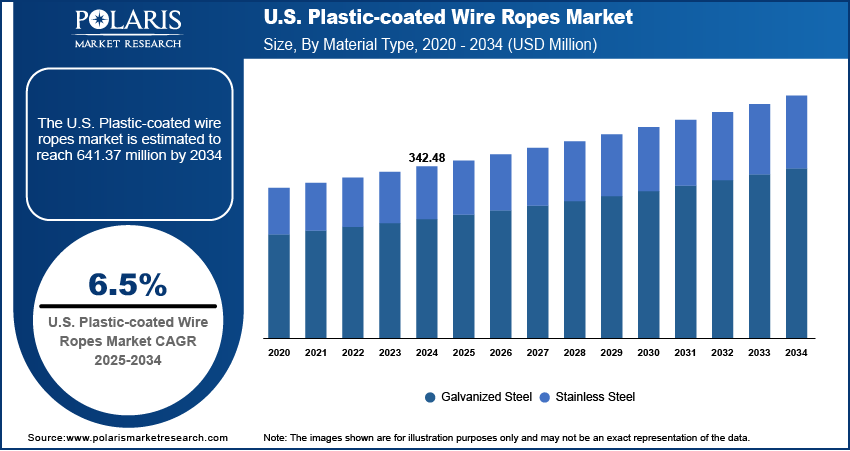
Want a Deeper Look at Key Market Players? Download Sample Report
One of the drivers for this market is the growing trend toward renewable energy. As the country invests more in projects such as offshore wind farms, there is a rising need for strong, reliable ropes. These ropes are essential for the installation and maintenance of wind turbines and other equipment in marine environments. The plastic coating helps them withstand salt water and other corrosive elements, making them an ideal choice for these types of projects.
Another important driver is the increasing focus on recreational and outdoor activities. These ropes are widely used in a variety of nonindustrial applications, including outdoor gym equipment, playground equipment, and even sports such as rock climbing. The plastic coating provides a smooth finish that makes them easier and safer to handle. For example, the use of plastic-coated ropes in public playgrounds is a common practice, as it helps prevent rust and splinters while providing a more comfortable grip for users.
Drivers and Trends
Rising Construction and Infrastructure Development: In the U.S., heavy construction is driving the plastic-coated wire ropes industry. Many parts of construction sites, such as cranes, hoists, and other rigging equipment, rely on these ropes. As long as the construction of new buildings and other monumental infrastructure continues, the demand for plastic-coated wire ropes to withstand the test of time and reliability is on the rise. These ropes are ideal for deployment in harsh climates, as the protective plastic coating allows outdoor use and eliminates the risk of rust and weathering damage.
According to the Congressional Budget Office (CBO), the law will provide hundreds of billions of dollars in new spending for transportation and water infrastructure over several years. This massive investment in highways, bridges, and other public projects directly increases the need for modular construction materials, including wire ropes for lifting and structural support. This trend is expected to continue to drive the market forward as these projects move from the planning stage to construction.
Marine and Fishing Industries: The marine and fishing industries contribute to the demand for these ropes. Equipment in these industries is in constant contact with the rigors of salt water and moisture, along with extremely demanding operating conditions. In these circumstances, coated wire ropes are the best option. This is because the plastic coating shields the wire from corrosion and rust, making these ropes ideal for towing, mooring, and fishing nets.
The value of the marine economy has been on the rise. Based on the "Marine Economy Satellite Account, 2023" report from the U.S. Bureau of Economic Analysis (BEA), the marine economy contributed over $511 billion to the U.S. gross domestic product in 2023, which was an increase from the previous year. This growth in the overall marine sector, which includes everything from shipbuilding to fishing, leads to a higher demand for robust and dependable equipment, including plastic-coated wire ropes, to support various operations.
Source: Polaris Market Research Analysis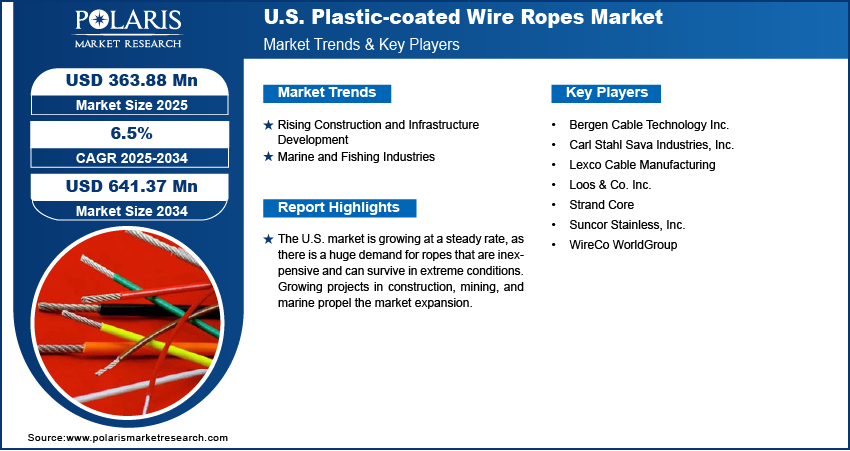
Get Full Segment-Level Forecasts & Insights: Download Sample Report
Segmental Insights
Material Type Analysis
Based on material type, the segmentation includes galvanized steel and stainless steel. The galvanized steel segment held a larger share in 2024. Galvanized steel is more protected against rust than bare steel, but the coating of zinc significantly improves the lifespan of any steel construct placed outdoors or in corrosive conditions. These benefits only improve when plastic coatings are added. These factors make galvanized steel the go-to solution for many commercial and industrial applications.
The stainless steel segment is anticipated to register a higher growth rate during the forecast period. This is due to the growing demand where its remarkable anti-corrosive properties come into play. Applications in extreme environments, such as stainless steel ropes used in the Marine industry, offshore drilling, and chemical plants, are examples of these conditions.
Diameter Analysis
Based on diameter, the segmentation includes <1/4 inch and >1/4 inch. The >1/4 inch segment held a larger share in 2024. This is largely due to their necessity for critical operations that require high tensile strength and superior load-bearing capacity. The thicker ropes are commonly used in industries such as construction, mining, and large-scale marine operations. Other applications include crane operations, supporting major infrastructures, and even the docking of large vessels. The ropes are plastic-coated, which adds to their strength and durability, making them ideal candidates for critical and safety mission-reliant jobs.
The <1/4 inch segment is anticipated to register the highest growth rate during the forecast period. This is a result of their adoption for a range of tasks that require a high level of precision, bending, and lower mass. The thinner ropes are increasingly in demand for civilian and commercial use in items such as gym apparatus, playground accessories, and other recreational equipment.
Coating Type Analysis
Based on coating type, the segmentation includes PVC, PE, PP, and others. The PVC segment held the largest share in 2024. Its low cost of production, abundance, and versatility in applications are the major reasons for its popularity. Moisture, UV, and abrasion resistance make PVC useful for construction and recreational rigging. Its flexibility and ease of use in manufacturing increase popularity amongst producers. PVC also has the ability to easily get colored, which benefits applications that require color-coding for safety, efficiency, or design.
The coated polypropylene (PP) segments are anticipated to register the highest growth rate during the forecast period. PP is a lightweight coating that has great resistance to moisture and a variety of chemicals. It is also economical and durable for specific applications. The ever-growing need for lightweight and strong materials for the fishing and marine industries is a crucial factor. PP is made to float, which is a great advantage for many marine and water applications, and has a higher resistance to many chemicals compared to other coatings.
Application Analysis
Based on application, the segmentation includes construction, mining, marine, and others. The construction segment held the largest share in 2024. This is primarily attributed to the endless supply of sturdy and dependable materials for ropes on different job sites. Ropes are critical for the lifting, hoisting, and rigging of heavy materials, as well as for some types of safety barriers and cable railings. Their protective plastic layer, specially designed to withstand the rigors of a tough construction site, ensures that ropes are free from rust, abrasion, and a host of damaging chemicals. With new construction and maintenance of existing infrastructure, the demand from this industry is always at a peak, which contributes to the segment dominance.
The marine sector is anticipated to register the highest growth rate during the forecast period. This is the result of the growing employment of these ropes in various marine and fishing activities. Because of the plastic-coated wire ropes’ formidable resistance to corrosion from salt water and their ability to withstand extreme weather conditions, they are particularly suited for use on ships, in fishing gear, and at mooring. The continuous development of coastal infrastructure and the expansion of the marine economy, including fishing and offshore operations, are driving this demand.
Source: Polaris Market Research Analysis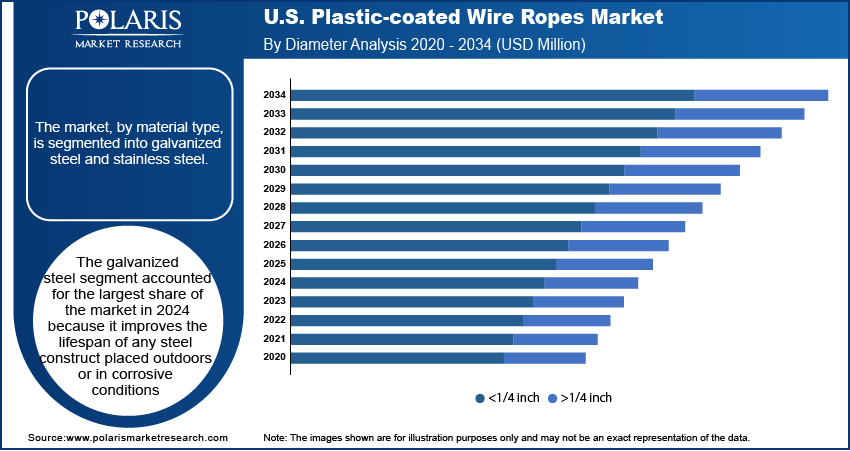
Need Granular Data Across All Market Segments? Request Customization
Key Players and Competitive Insights
In the U.S., the market for plastic-coated wire ropes is competitive. It contains international players alongside domestic small companies. Key players are Loos & Co. Inc., WireCo WorldGroup, and Lexco Cable Manufacturing. These companies strive for competition by developing new improved manufacturing processes and tailored product development, alongside the expansion of their product lines. Many companies are also trying to address the market failure of durable and performing paints and coatings and materials.
A few prominent companies in the industry include Loos & Co. Inc.; WireCo WorldGroup; Lexco Cable Manufacturing; Suncor Stainless, Inc.; Bergen Cable Technology Inc.; Carl Stahl Sava Industries, Inc.; and Strand Core.
Key Players
- Bergen Cable Technology Inc.
- Carl Stahl Sava Industries, Inc.
- Lexco Cable Manufacturing
- Loos & Co. Inc.
- Strand Core
- Suncor Stainless, Inc.
- WireCo WorldGroup
Industry Developments
May 2025: WireCo announced the launch of a new product called Boomfit. This special steel rope is designed for use in telescopic, crawler, and large tower cranes.
April 2025: WireCo introduced Lazerlift, a new generation of hoist ropes. This product is designed for large telescopic, crawler, and high-capacity tower cranes and was unveiled at a major industry event in Munich.
U.S. Plastic-coated Wire Ropes Market Segmentation
By Material Type Outlook (Revenue – USD Million, 2020–2034)
- Galvanized Steel
- Stainless Steel
By Diameter Outlook (Revenue – USD Million, 2020–2034)
- <1/4 Inch
- >1/4 Inch
By Coating Type Outlook (Revenue – USD Million, 2020–2034)
- PVC
- PE
- PP
- Others
By Application Outlook (Revenue – USD Million, 2020–2034)
- Construction
- Mining
- Marine
- Others
U.S. Plastic-coated Wire Ropes Market Report Scope
| Report Attributes | Details |
| Market Size in 2024 | USD 342.48 million |
| Market Size in 2025 | USD 363.88 million |
| Revenue Forecast by 2034 | USD 641.37 million |
| CAGR | 6.5% from 2025 to 2034 |
| Base Year | 2024 |
| Historical Data | 2020–2023 |
| Forecast Period | 2025–2034 |
| Quantitative Units | Revenue in USD million and CAGR from 2025 to 2034 |
| Report Coverage | Revenue Forecast, Competitive Landscape, Growth Factors, and Industry Insights |
| Segments Covered |
|
| Competitive Landscape |
|
| Report Format |
|
| Customization | Report customization as per your requirements with respect to countries, regions, and segmentation. |
Source: Polaris Market Research Analysis
U.S. Plastic-coated Wire Ropes Market FAQ's
The market size was valued at USD 342.48 million in 2024 and is projected to grow to USD 641.37 million by 2034.
The market is projected to register a CAGR of 6.5% during the forecast period.
A few key players in the market include Loos & Co. Inc.; WireCo WorldGroup; Lexco Cable Manufacturing; Suncor Stainless, Inc.; Bergen Cable Technology Inc.; Carl Stahl Sava Industries, Inc.; and Strand Core.
The galvanized steel segment accounted for a larger share of the market in 2024.
The <1/4 inch segment is expected to witness the fastest growth during the forecast period.
Download Sample Report of U.S. Plastic-coated Wire Ropes Market
Please fill out the form to request a customized copy of the research report.


