
U.S. Sensitive Compartmented Information Facility Market Growth Analysis, 2026-2034
REPORT DETAILS
Market Statistics
What is U.S. SCIF Market Size?
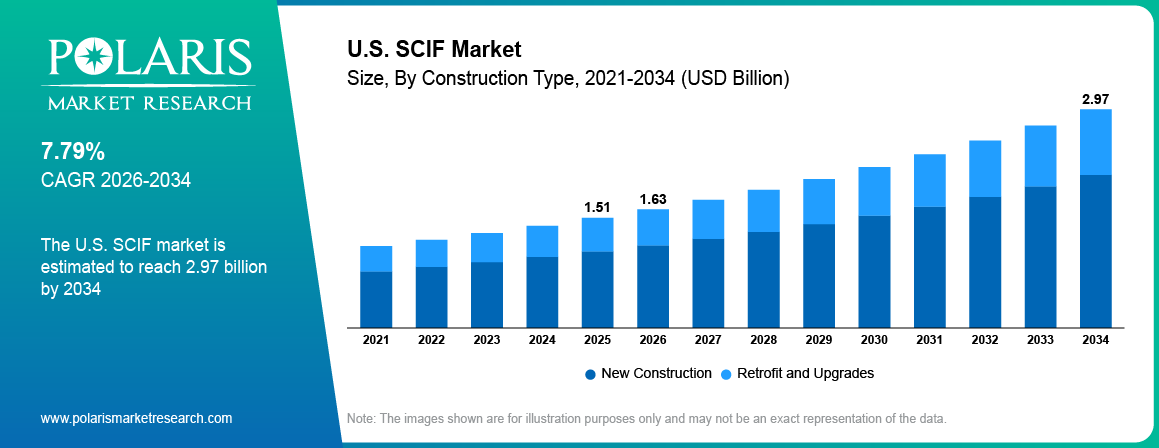
The U.S. SCIF market size was valued at USD 1.51 billion in 2025, growing at a CAGR of 7.79% from 2026–2034. Key factors driving the growth is due to geopolitical tensions and national security concerns and escalating cybersecurity threats.
Key Insights
- Based on type, the permanent SCIFs segment accounted for 72.83% share of the market.
- Based on construction type, the retrofit and upgrade market is expected to grow at the highest CAGR of 7.24%.
- Based on application, the government segment dominated the U.S. SCIF market due to the presence of sensitive data and analysis, communication, and storage needs that require secure environments.
Market Statistics
- 2025 Market Size: USD 1.51 Billion
- 2034 Projected Market Size: USD 2.97 Billion
- CAGR (2026-2034): 7.79%
Industry Dynamics
- Geopolitical tensions and national security concerns drives the growth as government bodies and defense agencies are focusing more on secure environment for the processing of classified information.
- Escalating cybersecurity threats is due to organizations which require the resource secure environment to protect critical digital intelligence and sensitive communications
- Rising demand for mobile and modular scif solutions is creating opportunities for mobile and modular SCIFs.
- High initial costs create challenges due to initial expenses, including specialized construction materials, advanced security systems, and compliance certifications
What is SCIF?
A sensitive compartmented information facility (SCIF) is an enclosed area within a building that is used to hold, process, and discuss sensitive or classified intelligence information, and which is constructed to deny access to persons not cleared for access to the information or to prevent electronic or photographic surveillance. The U.S. SCIF industry is reshaping by government, and defense and intelligence agencies, are the end users expecting a growing demand for SCP platforms with the capability to integrate with future technology trends. The increase in the volume of classified information, more collaboration between defense and intelligence networks, and use of digital platforms for intelligence operations are driving an investment in secure environments. In September 2025, AWS and Westway Services Group collaborated to deliver rapid, cost-effective access to classified environments for mission solution development. However, the buildings must meet stringent federal security standards while providing space for state-of-the-art communications capabilities and secure information technology. Keeping with the changing national security priorities, many organizations are upgrading and expanding their own SCIF capabilities to maintain information protection and intelligence justice. This trend is increasing demand for both new building and renovating secure facilities throughout America.
Source: Polaris Market Research Analysis
To Understand More About this Research:Download Sample Report
Infrastructure aging and demand for retrofitting and restoration are some of the factors boosting the growth of the U.S. A number of existing SCIFs were designed many years ago and were constructed to accommodate pre-existing communication technologies and mission requirements. The old guard SCIFs need to be upgraded so that they comply with the new security requirements with changes to security policies, surveillance threats, and electronic intelligence systems. Modifications to shielding systems, access control systems, communications protection systems, monitoring systems are now required in order to maintain compliance and dependability of operations. Furthermore, retrofitting older government buildings and defense facilities with state-of-the-art SCIF technology enables agencies to preserve their high levels of information security without having to design and build an entirely new facility. The modernization of these sites also brings increased energy efficiency through advanced data processing and intelligence collaboration. Consequently, infrastructural development along with retrofitting is emerging as a significant element for SCIF market prosperity.
Drivers & Opportunities
What are Factors Driving Industry Growth?
Geopolitical Tensions and National Security Concerns: Geopolitical tensions and national security issues are driving the U.S. SCIF market growth as government bodies and defense agencies are focusing more on secure environment for the processing of classified information. The increasing strategic competition and emerging security challenges rise the need for a place, such as a high security building, where sensitive intelligence may be analyzed, reviewed, and stored without the risk of compromise to the information or exposure of the agent. Secure compartmented information facilities (SCIFs) offer unique architectural and technological layers of protection that mitigate against the leakage of information via electronic, acoustic, or physical means. The agencies are expanding their infrastructure to support intelligence analysis, defense planning, and interagency collaboration with national security operations growing more complex. According to a report from Congress Government in Nov 2025, NIP and MIP total funding requested for FY2026 was USD 115.5 billion in U.S. Moreover, the requirement to stay in line with stringent federal security specifications just adds to the demand for custom built SCIFs. Furthermore, increased participation of private defense contractors and intelligence partners in national security programs also propelled exponential growth in demand for certified secure facilities at government and contractor sites.
Escalating Cybersecurity Threats: Growing cybersecurity threats are also the key factors which drive the market growth as organizations require the resource secure environment to protect critical digital intelligence and sensitive communications. The increasing sophistication of cyber-espionage, electronic surveillance and data interception has added to fears over classified information being exposed. In 2024, the number of complaints was 859,532, amounting to a loss of USD 16.6 billion, a 33 % increase from the year 2023. 256,256 complaints have been associated with an actual loss. In terms of complaints, the mean loss was USD19,372. SCIF facilities offer a regulated environment in which sophisticated cyber security technologies can be integrated with stringent physical security requirements to reduce the threat of unauthorized access. These are based on keeping out electromagnetics and digital seepage, while supporting secure communications networks for use in intelligence, defense and the like. Safeguarding data against cyber intrusion has become a priority with digital information playing an ever more central role in national security activities. Moreover, government agencies, defense contractors and intelligence agencies are increasingly turning to SCIF certified areas to perform secure digital analysis, planning and communications. The demand for protecting sensitive digital infrastructure is increasing, which is further boosting investments in SCIF facilities in the U.S.
Source: Polaris Market Research Analysis
Get Full Segment-Level Forecasts & Insights: Download Sample Report
Segmental Insights
Which Segment by Type Dominated in 2025?
In 2025, the permanent SCIFs segment accounted for 72.83% share of the market. This is due to the increasing need of this for business sector which is now long-term, end-to-end secure space for the processing of classified data. Permanent facilities are purpose-built using specialized construction materials and shielding systems with rigorous physical security measures based on an assessed threat. These permanent facilities are heavily utilized by the defense community, intelligence community, and other federal agencies that depend on them for secure workspaces. Moreover, permanent SCIFs can also offer greater stability for sensitive functions such as intelligence analysis, strategic planning and communications declassification. Their integration with high security infrastructure such as secure networks, controlled communications, are essential to national security and participate in classified projects. Therefore, the pace of construction for permanent SCIFs facilities parallels growing demand from government agencies that continue to focus on providing secure, reliable infrastructure to conduct classified operations.
Which Segment by Construction Type is Expected to Witness a Significant Share?
The retrofit and upgrade market is expected to grow at the highest CAGR of 7.24%. This is due to its focus on its existing products by upgrading the facilities to meet evolving security requirements. Many government and defense buildings have designated secure areas, but these places must be enhanced to meet new technical and physical security requirements. Retrofitting enables agencies to enhance shielding, surveillance protection, access control, and communications security without having to build new facilities. This is a strategy that is often more feasible and less expensive for entities based in established buildings and campuses. Furthermore, communication and digital intelligence technologies are advancing rapidly and driving the demand to retrofit older SCIF facilities to accommodate these solutions. With the nature of security threats and regulatory requirements continuously changing, organizations place high value on the capability upgrades required to continue effective protection of classified information.
How government Segment Contributing to the Market Growth?
The government segment dominated the U.S. SCIF market due to the significant involvement of federal agencies in the administration of national security, intelligence operation, and defense. Governments typically deal with sensitive data and have analysis, communication, and storage needs that require secure environments. Intelligence, military, and homeland security agencies rely on SCIFs to maintain the highest level of security over the dissemination and passage of information. The result is secure interaction between departments and joint decision making in sensitive mission areas. Also, government bodies are required to adhere to rigorous security measures and building standards when they handle classified intelligence. The growing investments in national security programs, intelligence and defense infrastructure are further augmenting the demand for SCIF facilities in the government sector.
.webp)
Source: Polaris Market Research Analysis
Need Granular Data Across All Market Segments? Request Customization
Key Players & Competitive Analysis
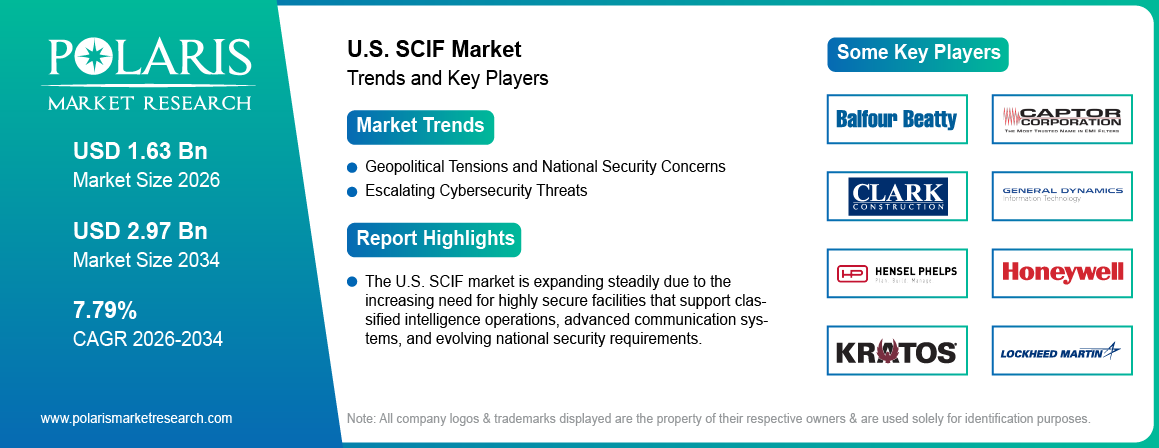
Some of the major players are Balfour Beatty, Inc.; Captor Corporation; Clark Construction Group; General Dynamics Information Technology, Inc.; Hensel Phelps; Honeywell International Inc.; Kratos Defense & Security Solutions, Inc.; Lockheed Martin; Parsons Corporation; SCIF Global Technologies
The SCIF market encompasses the traditional physical construction and the new virtual solution providers. Vendors such as Balfour Beatty, Clark Construction and Hensel Phelps, have deep experience in secure fed centers. Captor Corporation offers first-grade RF-shielding and TEMPEST solutions essential for physical SCIF compliance. General Dynamics IT and Lockheed Martin, for example, build SCIFs as part of larger defense IT and intelligence solutions. Honeywell Security Systems (access control, surveillance). Kratos and Parsons provide engineering, cyber security, and integration for sensitive sites.
SCIF Global Technologies seems to be specializing in SCIF building, but Intertrust's iSCIF is a cloud-based, virtual alternative. The main area of competitive pressure is between physical traditional builders and new virtual/software-defined players. Physical builders can provide an accredited, real security but at a much higher cost and risk of underutilization. Virtual solutions tout flexibility and cost savings, but they still have to break down government trust barriers and deal with handling classified information in the cloud.
Key Players
- Balfour Beatty, Inc.
- Captor Corporation
- Clark Construction Group
- General Dynamics Information Technology, Inc.
- Hensel Phelps
- Honeywell International Inc.
- Kratos Defense & Security Solutions, Inc.
- Lockheed Martin
- Parsons Corporation
- SCIF Global Technologies
Industry Developments
July 2025: Intertrust launched iSCIF, a cloud-based virtual alternative to physical SCIFs. The company claims it exceeds physical security standards while reducing operating costs and eliminating idle equipment, offering greater flexibility than traditional secure facilities.
June 2025: the U.S. Marine Corps Warfighting Laboratory awarded CenCore a USD 19 million contract to develop mobile SCIFs, intended to meet the secure communications requirements for dispersed operations against near-peer rivals such as China.
U.S. SCIF Market Segmentation
By Type Outlook (Revenue, USD Billion, 2021–2034)
- Permanent SCIFs
- Temporary SCIFs
By Construction Type Outlook (Revenue, USD Billion, 2021–2034)
- New Construction
- Retrofit and Upgrades
By Application Outlook (Revenue, USD Billion, 2021–2034)
- Government
- Military & Defense
- Telecommunication
- Cybersecurity Firms
- Others
U.S. SCIF Market Report Scope
| Report Attributes | Details |
| Market Size in 2025 | USD 1.51 Billion |
| Market Size in 2026 | USD 1.63 Billion |
| Revenue Forecast by 2034 | USD 2.97 Billion |
| CAGR | 7.79% from 2026 to 2034 |
| Base Year | 2025 |
| Historical Data | 2021–2024 |
| Forecast Period | 2026–2034 |
| Quantitative Units | Revenue in USD Billion and CAGR from 2026 to 2034 |
| Report Coverage | Revenue Forecast, Competitive Landscape, Growth Factors, and Industry Trends |
| Segments Covered |
|
| Competitive Landscape |
|
| Report Format |
|
| Customization | Report customization as per your requirements with respect to countries, regions, and segmentation. |
Source: Polaris Market Research Analysis
U.S. Sensitive Compartmented Information Facility Market FAQ's
U.S. SCIF market is projected to grow from USD 1.51 billion in 2025 to USD 2.97 billion by 2034.
Key construction type includes new construction, retrofit and upgrades.
Major players include Balfour Beatty, Inc.; Captor Corporation; Clark Construction Group; General Dynamics Information Technology, Inc.; Hensel Phelps; Honeywell International Inc.; Kratos Defense & Security Solutions, Inc.; Lockheed Martin; Parsons Corporation; SCIF Global Technologies.
Geopolitical Tensions and National Security Concerns, Escalating Cybersecurity Threats.
High initial costs due to the specialized construction materials, advanced security systems, and compliance certifications.
Download Sample Report of U.S. Sensitive Compartmented Information Facility Market
Please fill out the form to request a customized copy of the research report.


