
Veterinary Excipients Market Size, Share, Global Report 2026-2034
REPORT DETAILS
Market Statistics
What is the Current Market Size?
Veterinary Excipients Market size was valued at USD 1.15 billion in 2025. The market is anticipated to grow from USD 1.20 billion in 2026 to USD 1.72 billion by 2034, exhibiting a CAGR of 4.60% during the forecast period.
Market Statistics
- 2025 Market Size: USD 1.15 billion
- 2034 Projected Market Size: USD 1.72 billion
- CAGR (2026-2034): 4.60%
- North America: Largest market in 2025
Industry Trends
Veterinary excipients are substances used in the formulation of animal health products, such as medicated feeds, nutritional supplements, and pharmaceuticals, that are not themselves active ingredients but serve other purposes in the product. These substances include fillers, binders, diluents, solvents, and stabilizers. They are added to improve the stability, dissolution, and bioavailability of the active ingredient(s) and enhance the palatability or acceptability of the product for the target species.
The global demand for veterinary excipients is expected to be driven by the increasing demand for animal healthcare products, particularly in the companion animal segment. As pet owners become more aware of the importance of preventative care and seek to provide their pets with better healthcare, the demand for veterinary drugs and nutritional supplements has increased, leading to a corresponding increase in the demand for excipients. In addition, advancements in technology and the development of new drug delivery systems have created opportunities for the use of novel excipients in veterinary medicine.
However, the industry’s strict regulations governing the use of excipients in animal health products are creating hurdles for market growth. Another challenge facing the market is the need for more awareness among veterinarians and animal owners about the importance of excipients in animal health products. Despite these challenges, the market growth remains positive. With ongoing investment in research and development and an increasing focus on improving animal health, the demand for high-quality excipients is likely to continue to grow.
Source: Polaris Market Research Analysis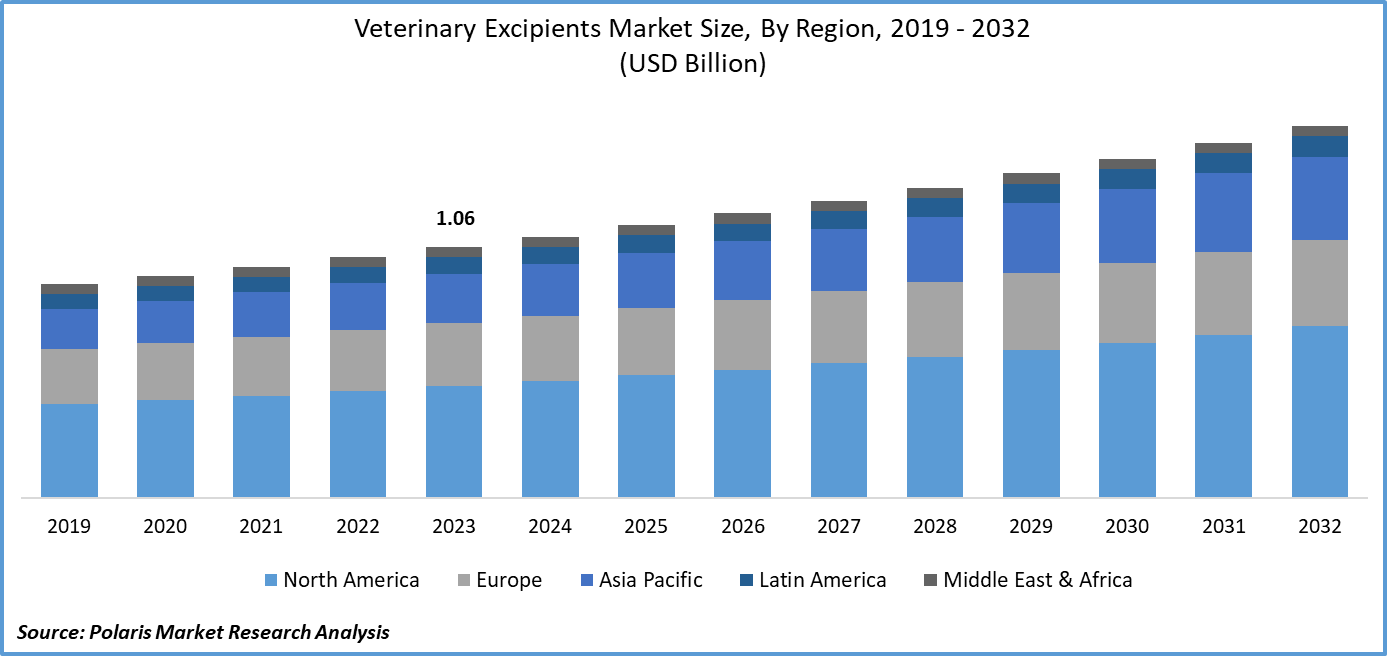
To Understand More About this Research: Download Sample Report
Key Takeaways
- North America dominated the market and contributed over 32% of the market share in 2025
- By chemical group category, the polymers segment accounted for the largest veterinary excipients market share in 2025
- By function category, the solubilizers/solvents segment held the dominating revenue share in 2025
- By animal type category, the companion animals segment is expected to grow with a significant CAGR over the forecast period
- By application category, the pharmaceuticals segment held a significant market share of the total veterinary excipients market size in 2025
What are the market drivers driving the demand for veterinary excipients market?
The increasing demand for animal healthcare products drives market growth.
The increasing demand for animal healthcare products is a significant veterinary excipients market driver for the growth. The increased need for effective and safe treatments to prevent and cure various animal health issues has led to an increased demand for high-quality animal healthcare products, including pharmaceuticals, vaccines, and nutritional supplements, which in turn drives the demand for veterinary excipients.
Veterinary excipients play a crucial role in the development and manufacturing of these animal healthcare products, providing essential functions such as stabilization, solubilization, and taste masking. The growing demand for animal healthcare products is fueled by several factors, including the rising trend of humanizing pets, increased awareness of animal health, and advancements in animal healthcare technology. Also, the growing awareness of animal health issues and the importance of preventive care has resulted in an increased demand for veterinary products that can help prevent and treat various conditions. All these factors are contributing to the growth of the market.
Source: Polaris Market Research Analysis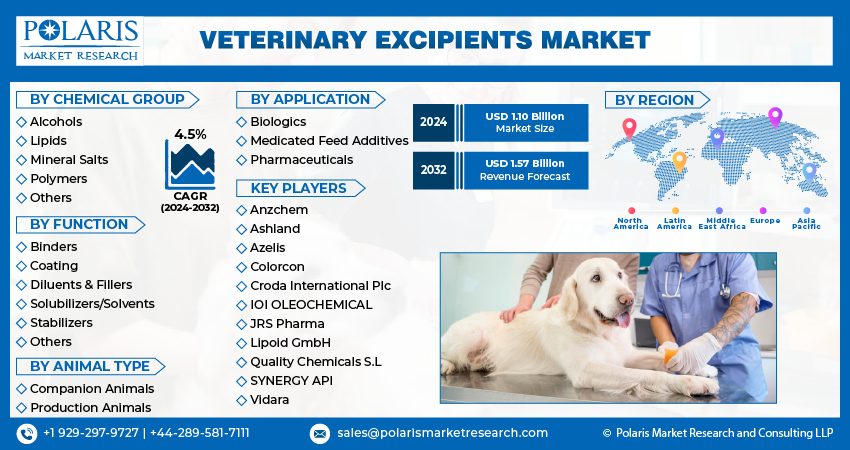
Get Full Segment-Level Forecasts & Insights: Download Sample Report
Which factor is restraining the demand for veterinary excipients?
The cost constraints, as well as the regulatory challenges, limit veterinary excipients market growth.
The market is facing significant challenges in terms of cost and regulation, which are hindering its growth. The high cost of raw materials and production processes, combined with stringent regulations on the use of certain excipients, are making it difficult for manufacturers to produce affordable and compliant products. In addition, the complexity of the regulatory landscape, including varying regional laws and guidelines, is creating uncertainty among manufacturers, further limiting their ability to bring new products to market. As a result, the market is experiencing slower growth than expected despite the increasing demand for animal healthcare products.
Report Segmentation
The market is primarily segmented based on chemical group, function, animal type, application, and region.
| By Chemical Group | By Function | By Animal Type | By Application | By Region |
|
|
|
|
|
Source: Polaris Market Research Analysis
To Understand the Scope of this Report: Request Customization
Category Wise Insights
By Chemical Group Insights
Based on chemical group analysis, the market is segmented into alcohols, lipids, mineral salts, polymers, and others. The polymers segment dominated the veterinary excipients market size in 2025, owing to their versatile properties and wide range of applications in animal health products. Polymers are used as binders, coating agents, disintegrants, and controlled release agents in various veterinary formulations, such as tablets, capsules, and injectables. They enhance the stability, bioavailability, and shelf life of active pharmaceutical ingredients, making them more effective and easier to administer. Also, advancements in polymer technology have led to the development of novel drug delivery systems that target specific sites and cells, improving treatment outcomes.
The lipids segment is expected to witness the fastest CAGR during the forecast period since these lipids offer straightforward and innovative solutions to several challenges faced in the manufacturing of veterinary medicine formulations, including topical, oral, and parenteral formulations.
By Function Insights
Based on function analysis, the market has been segmented on the basis of binders, coating, diluents and fillers, solubilizers/solvents, stabilizers, and others. The solubilizers/solvents segment accounted for the dominant veterinary excipients market share in 2025 due to their crucial role in enhancing the availability and stability of active pharmaceutical ingredients (APIs) in animal health products. Solubilizers such as polyethylene glycol, poloxamer, and sodium lauryl sulfate help dissolve poorly soluble drugs, improving their absorption and efficacy.
Also, solvents like ethanol, isopropyl alcohol, and propylene glycol are used to enhance drug solubility, stabilize the API, and provide appropriate viscosity to the formulation. The growing demand for advanced dosage forms like injectables, oral solutions, and topicals, which rely heavily on solubilizers and solvents, has further contributed to the dominance of this segment.
By Application Insights
Based on application analysis, the market has been segmented on the basis of biologics, medicated feed additives, and pharmaceuticals. The pharmaceuticals segment accounted for the highest veterinary excipients market share in 2025, owing to the increasing demand for animal healthcare products and the growing prevalence of diseases among animals. The use of veterinary excipients in pharmaceuticals enables the development of effective medications that can improve the health and well-being of animals, including companion animals, livestock, and zoo animals.
The dominance of the pharmaceuticals segment is also driven by advancements in technology, which have enabled the development of new drug delivery systems and formulations that can target specific animal populations and disease conditions more effectively. Also, the rising trend of humanizing pets, where pet owners are seeking advanced medical care for their pets, has increased the demand for high-quality veterinary drugs, thereby driving the growth of the market.
Source: Polaris Market Research Analysis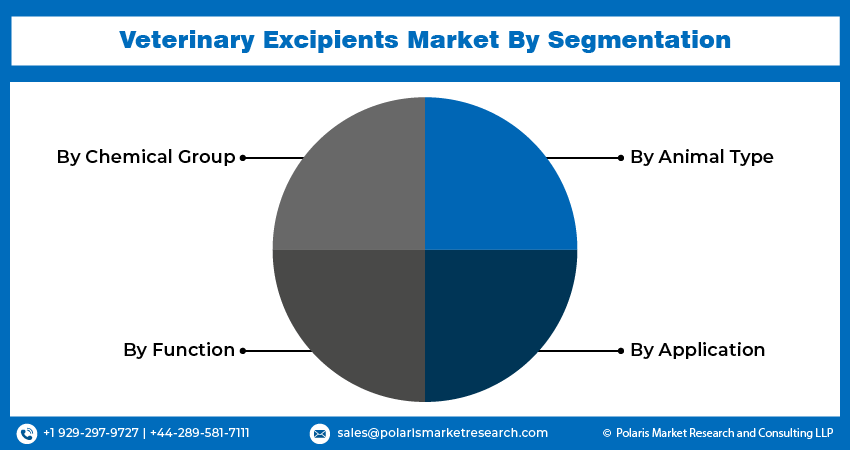
Need Granular Data Across All Market Segments? Request Customization
Regional Insights
North America
The North American region domianted the global market in 2025, accounting for a significant share of the total market revenue. This dominance is attributed to several factors, including the presence of well-established animal veterinary industries, advanced healthcare infrastructure, and growing demand for high-quality animal feed additives in the region. Also, increasing investments in research and market development activities by key players in the region have led to the development of innovative and effective veterinary excipients, further driving the growth of the market.
Asia Pacific
The Asia Pacific region is expected to exhibit a significant growth rate in the veterinary excipients industry over the forecast period, owing to the increasing demand and focus on animal health and products, particularly in countries such as China, India, and Indonesia. As the livestock population in these countries continues to grow, there is a rising need for animal feed additives that promote healthy animal growth and productivity, thereby driving the demand for veterinary excipients. Also, the increasing awareness about animal health and welfare, along with the growing number of companion animals in the region, are contributing to the growth of the market.
Source: Polaris Market Research Analysis
Curious About Regional Market Performance? Request Customization
Competitive Landscape
In the market for veterinary excipients, key market players are in constant competition to offer a wide range of high-quality products. To gain a competitive edge, they are continuously innovating by developing better excipient formulations that meet the evolving needs of the industry. Companies that are following strict quality control protocols and complying with regulatory requirements are better positioned to earn the trust of pharmaceutical manufacturers, ultimately leading to a competitive advantage.
Some of the major players operating in the global market include:
- Anzchem
- Ashland
- Azelis
- Colorcon
- Croda International Plc
- IOI OLEOCHEMICAL
- JRS Pharma
- Lipoid GmbH
- Quality Chemicals S.L
- SYNERGY API
- Vidara
Recent Developments
- October 2024: Clariant launched new pharmaceutical excipients at CPHI 2024. The VitiPure LEX range and Polyglykol 1450 S are tailored to solutions for API delivery, with a particular focus on enhancing bioavailability for poorly soluble compounds and providing a high level of microbial control for sensitive formulations.
- May 2023: Croda International Plc announced that it had signed a license agreement with Amyris, a leading synthetic biology company, for the supply of biotechnology-derived, pharmaceutical-grade squalene used in adjuvants to boost immune responses.
- December 2023: Roquette, a pharma and plant-based ingredient giant, acquired Qualicaps from the Mitsubishi Chemical Group, a manufacturer of hard capsules and pharmaceutical-related equipment.
Report Coverage
The Veterinary Excipients market report emphasizes key regions across the globe to provide a better understanding of the product to the users. Also, the report provides market insights into recent developments and trends and analyzes the technologies that are gaining traction around the globe. Furthermore, the report covers an in-depth qualitative analysis pertaining to various paradigm shifts associated with the transformation of these solutions.
The report provides a detailed analysis of the market while focusing on various key aspects such as competitive analysis, chemical group, function, animal type, application, and their futuristic growth opportunities.
Veterinary Excipients Market Report Scope
| Report Attributes | Details |
| Market size value in 2025 | USD 1.15 billion |
| Market size value in 2026 | USD 1.20 billion |
| Revenue Forecast in 2034 | USD 1.72 billion |
| CAGR | 4.60% from 2026 – 2034 |
| Base year | 2025 |
| Historical data | 2021 – 2024 |
| Forecast period | 2026 – 2034 |
| Quantitative units | Revenue in USD billion and CAGR from 2026 to 2034 |
| Segments Covered | By Chemical Group, By Function, By Animal Type, By Application, By Region |
| Regional scope | North America, Europe, Asia Pacific, Latin America; Middle East & Africa |
| Customization | Report customization as per your requirements with respect to countries, regions, and segmentation. |
Source: Polaris Market Research Analysis
Veterinary Excipients Market FAQ's
key companies in Veterinary Excipients Market are Anzchem, Ashland, Azelis, Colorcon, Croda International Plc, IOI OLEOCHEMICAL
Veterinary Excipients Market exhibiting a CAGR of 4.60% during the forecast period
The Veterinary Excipients Market report covering key segments are chemical group, function, animal type, application, and region.
key driving factors in Veterinary Excipients Market are increasing demand for animal healthcare products
The global veterinary excipients market size is expected to reach USD 1.72 Billion by 2034.
Download Sample Report of Veterinary Excipients Market
Please fill out the form to request a customized copy of the research report.


