
Virtual Private Network Market Size, Share Report, 2024-2032
REPORT DETAILS
Market Statistics
The global virtual private network market was valued at USD 44.01 billion in 2023 and is expected to grow at a CAGR of 17.2% during the forecast period.
The increasing apprehensions regarding the security of data transmitted over public internet connections are anticipated to fuel market growth. Virtual Private Networks (VPNs) offer encrypted connections, enabling users to access the internet securely over public networks. Many organizations depend on these secure connections to restrict remote network access to authorized users. However, the dynamics have shifted due to the pandemic, resulting in a significant surge in demand for VPN services from end-users. Industry experts foresee challenges arising from this increased demand, requiring both VPN providers and enterprises to address and overcome them.
Various end-use industries are incorporating VPNs into their business processes to enhance operational efficiency. The increasing adoption of virtual private networks is not only making end-use organizations more result-oriented but also fostering efficiency. This rising trend in VPN adoption is attracting new entrants to explore the market, offering specialized solutions and services for specific applications. Meanwhile, established players are implementing diverse strategic initiatives to secure a competitive edge.
Source: Polaris Market Research Analysis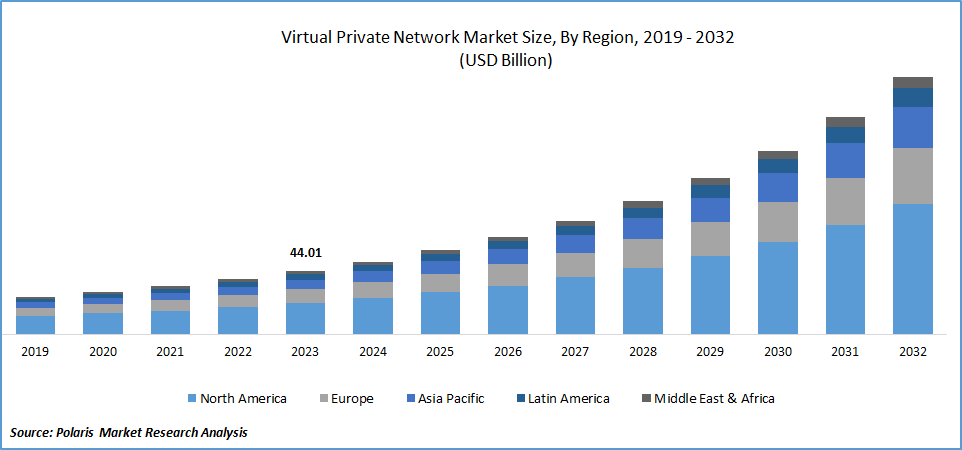
To Understand More About this Research:Download Sample Report
Virtual private networks are becoming increasingly popular for circumventing internet censorship. Despite certain countries like Russia and China currently imposing restrictions on VPN usage, industry growth has remained strong. In fact, such regulations have drawn significant attention to the applications of VPNs. These countries have implemented laws prohibiting VPN usage, leading to considerable resistance from local citizens and garnering extensive media coverage. In countries with mandatory censorship aimed at blocking specific news portals and websites, citizens often resort to using a virtual private network. A VPN ensures the encryption of all data, preventing government censorship and allowing users to access restricted websites and portals.
The European Union established the General Data Protection Regulation (GDPR) to protect and regulate the interests of both governments and civilians. Enforced since May, 2018, GDPR applies to any companies that store, log, or share personal information of users residing in Europe. According to GDPR, every user should have the right to access all the data they have shared online across various websites or platforms. Additionally, users should have the capability to modify, control, and delete their data as desired.
Growth Drivers
A virtual private network (VPN) ensures continuous, high-speed, and secure connectivity. In recent years, persistent high-speed internet connections have become more cost-effective compared to those used for basic email access. As a result, enterprises require greater capacity to handle occasional spikes in usage. Unlike permanent links associated with contract negotiations and monthly fees, a VPN offers flexibility. Additionally, VPN solutions have a notable advantage over frame relays or leased lines as they don't necessitate specialized equipment. In essence, a VPN serves as a cost-effective solution for encryption, tunneling, authentication, and access control services and technologies to transmit traffic over a managed IP network, the internet, or a provider's backbone.
Source: Polaris Market Research Analysis
Get Full Segment-Level Forecasts & Insights: Download Sample Report
Report Segmentation
The market is primarily segmented based on component, connectivity, end use, deployment, type, and region.
| By Component | By Type | By Connectivity | By Region |
|
|
|
|
Source: Polaris Market Research Analysis
To Understand the Scope of this Report:Request Customization
By Component Analysis
-
Software segment held the largest share in 2023
The software segment held the largest share in 2023. This growth is attributed to the widespread adoption and increasing demand for VPN software. The ease of deployment and use of VPN software makes it accessible to a diverse user base across various platforms, including desktop and mobile devices. Moreover, VPN software often comes equipped with advanced features beyond basic encryption, meeting the varied needs of users. The subscription-based business model employed by most VPN providers ensures a steady revenue stream as users continue to pay recurring fees for ongoing access to the service.
The services segment is projected to grow at the fastest rate during the forecast period. Virtual private network solutions have garnered substantial traction, especially among commercial vendors and individual solution providers, in recent years. The dynamic evolution of work practices and shifting commercial demands for virtual private networks are expected to sustain the demand for VPN services.
By Connectivity Analysis
-
Remote access segment registered the largest market share in 2023
The remote access segment accounted for the largest share in 2023. This is primarily due to the rising prevalence of franchised dealers in the virtual private network market. The increasing adoption of mobile VPN devices and the growing demand for remote accessibility have fueled the need for remote virtual private network solutions in recent years. Remote access solutions assist organizations in adhering to security regulations.
Site to-site segment is projected to grow at a substantial growth rate during the forecast period. This growth is attributed to the rising demand for secure connectivity between multiple locations, influenced by factors like the adoption of cloud services, the prevalence of remote work, the interconnection of business networks, adherence to data privacy regulations, and concerns about cybersecurity. The need for seamless and optimized bandwidth and data transfer drives the increasing requirement for both remote access and site-to-site connectivity.
By End Use Analysis
-
Commercial segment held the significant market revenue share in 2023
The commercial segment held the largest share in 2023. This dominance can be attributed to the increasing emphasis on establishing secure networks. Virtual private networks play a crucial role in mitigating risks throughout the entire data lifecycle. Additionally, VPN solutions contribute to building trust between commercial users and their customers. The appeal of features such as cost-effectiveness, fault tolerance, and redundant resource availability is expected to drive further the adoption of virtual private network solutions in commercial settings.
Individual segment is expected to grow at the fastest rate. With organizations permitting the use of remote devices in the workplace, employees are increasingly connecting to corporate networks and accessing various business applications from diverse locations using devices like laptops, computers, netbooks, and tablets. This trend is a key driver for the demand for VPN solutions at an individual level. Moreover, virtual private networks are employed to create hybrid network applications, combining MPLS and Internet VPN solutions. Additionally, VPNs are utilized to extend company data centers into the cloud.
Source: Polaris Market Research Analysis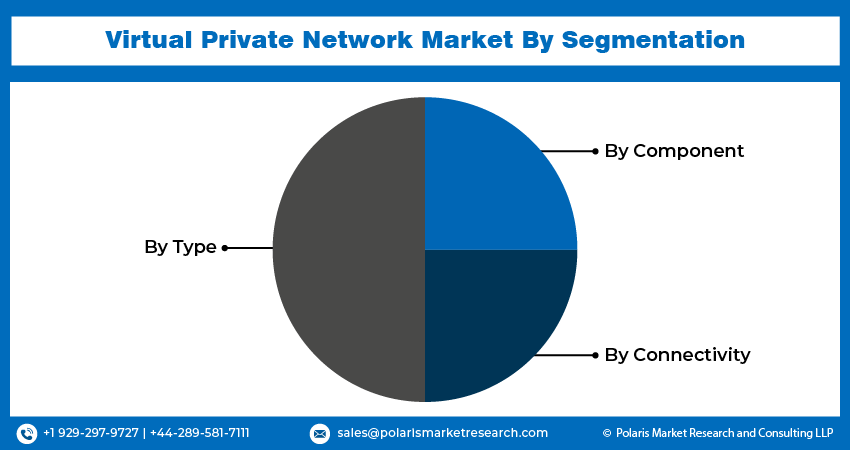
Need Granular Data Across All Market Segments? Request Customization
Regional Insights
-
North America region held the largest share of the global market in 2023
The North America region dominated the market in 2023. This dominance is attributed to the swift surge in demand from sectors such as telecommunications and BFSI within the United States. Moreover, the escalating concerns related to personal data privacy, data security, and the rising instances of cybercrimes are pivotal factors propelling market growth in the region.
The Asia Pacific region projected to grow at the rapid pace during forecast period. In China, there is notable growth, marked by the emergence of organized players offering mobile VPN services. The region presents various opportunities for entrepreneurs, especially in response to government policies and regulations governing popular websites and the provision of virtual private network solutions.
Source: Polaris Market Research Analysis
Curious About Regional Market Performance? Request Customization
Key Market Players & Competitive Insights
Various strategic initiatives, including strategic partnerships, collaborations, acquisitions, and mergers, has been a key focus for companies. For instance, in January 2023, Cloudflare extended its collaboration with the Microsoft, with a specific emphasis on streamlining the deployment, automation, and improvement of Zero Trust security measures for their customers.
Some of the major players operating in the global market include:
- Avast Software s.r.o.
- BlackBerry Limited.
- Cisco Systems, Inc.
- Citrix Systems, Inc.
- CyberGhost S.R.L.
- Google LLC
- IBM Corporation
- Absolute Software Corporation.
- Opera Holdings
- WatchGuard Technologies, Inc.
Recent Developments
- In November 2025, NordVPN (LV) partnered with a top cybersecurity firm to improve its encryption protocols. This move strengthens its position as a secure VPN choice for privacy-focused users. By adding advanced security features, NordVPN aims to stand out in a market where data privacy is critical.
- In October 2025, ExpressVPN (VG) introduced a feature that lets users bypass geo-restrictions more easily. This improves user experience and positions ExpressVPN as a leader in providing access to global content, attracting users who want to stream content unavailable in their regions.
- In September 2025, Surfshark (NL) expanded into emerging markets, including Southeast Asia. This strategy targets new customer segments where internet use is growing. By adapting marketing and services for local needs, Surfshark aims to boost its presence and growth in these areas.
- In January 2023, Etisalat joined forces with Huawei Technologies to deploy and assess the capabilities of a 5G portable private network multi-access edge computing (MEC). Within Etisalat UAE's initiative to independently commercialize this technology, the objective was to offer a 5G solution as an alternative to traditional VPN services.
Virtual Private Network Market Report Scope
| Report Attributes | Details |
| Market size value in 2024 | USD 50.71 billion |
| Revenue forecast in 2032 | USD 180.17 billion |
| CAGR | 17.2% from 2024 – 2032 |
| Base year | 2023 |
| Historical data | 2019 – 2022 |
| Forecast period | 2024 – 2032 |
| Quantitative units | Revenue in USD billion and CAGR from 2023 to 2032 |
| Segments covered | By Component, By type, Connectivity, By Deployment, By End Use, By Region |
| Regional scope | North America, Europe, Asia Pacific, Latin America, Middle East & Africa |
| Customization | Report customization as per your requirements with respect to countries, region, and segmentation. |
Source: Polaris Market Research Analysis
Virtual Private Network Market FAQ's
Virtual Private Network Market Size Worth $ 180.17 Billion By 2032
The top market players in Virtual Private Network Market Avast Software, BlackBerry, Cisco Systems, Citrix Systems, CyberGhost, Google
North America contribute notably towards the Virtual Private Network Market.
The global virtual private network market is expected to grow at a CAGR of 17.2% during the forecast period.
Virtual Private Network Market report covering key segments are component, connectivity, end use, deployment, type, and region.
Download Sample Report of Virtual Private Network Market
Please fill out the form to request a customized copy of the research report.


