

What is the Current Market Size?
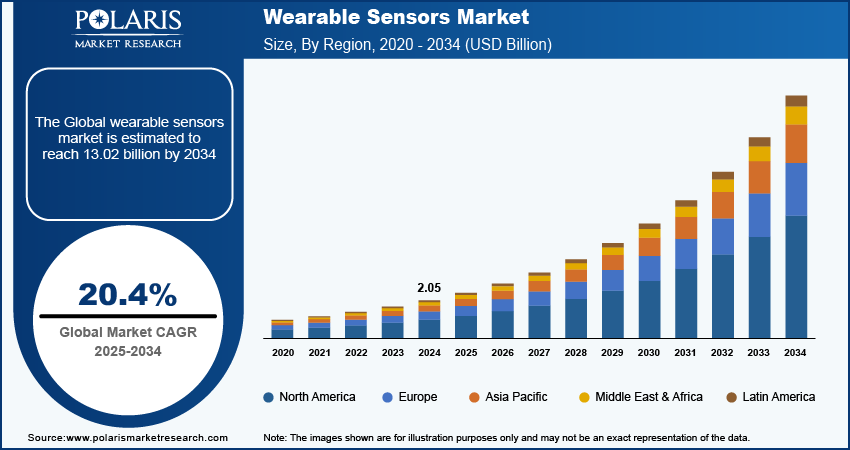
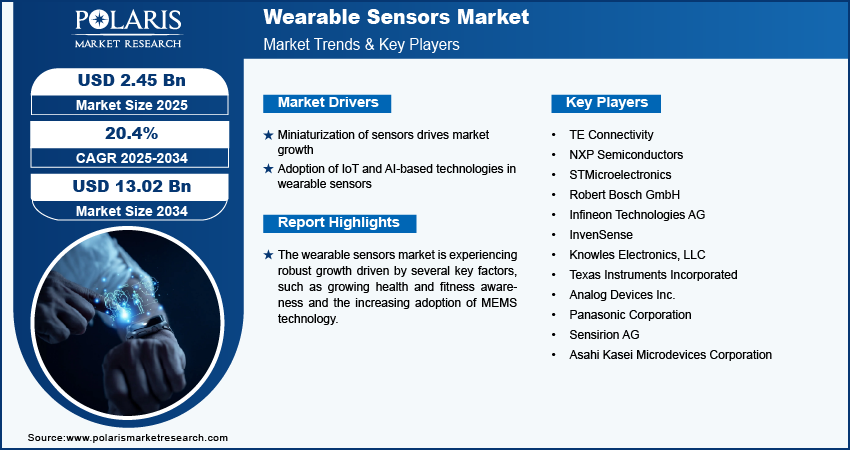
The wearable sensors market size was valued at USD 2.45 billion in 2025 and is projected exhibit a CAGR of 20.40% from 2026 to 2034. The wearable sensors demand is driven by several key factors, such as growing health and fitness awareness and the increasing adoption of MEMS technology. People are focusing on their well-being and actively seeking ways to monitor their health metrics.
Market Statistics
- 2025 Market Size: USD 2.45 billion
- 2034 Projected Market Size: USD 13.02 billion
- CAGR (2026-2034): 20.40%
- North America: Largest market in 2025
Wearable sensors are advanced devices designed to monitor and collect data about an individual's physiological and biochemical parameters in real-time, often in a non-invasive manner. These sensors are integrated into various wearable technologies, such as smartwatches, fitness trackers, smart clothing, and even tattoo-like devices. They serve multiple purposes, including health monitoring, fitness tracking, and providing insights into personal well-being.
MEMS technology allows for the miniaturization of sensors, making them smaller, lighter, and more energy-efficient. This miniaturization enables seamless integration of these sensors into various wearable devices, enhancing their functionality and user comfort. The ongoing advancements in MEMS technology are expected to lead to the development of even more sophisticated and versatile sensors, further driving growth.
To Understand More About this Research: Request a Free Sample Report
Rising disposable incomes, especially in developing economies, are a major factor driving the industry. Wearable sensors that monitor physical activity, heart rate, and sleep patterns align well with this trend. People are now able to invest in advanced health and fitness trackers due to their improved financial situations. This growing willingness to spend on advanced wearable technology is leading to a significant increase in revenue.
Market Dynamics
Miniaturization of Sensors
The miniaturization of sensors is transforming the wearable devices by allowing sophisticated monitoring capabilities to be incorporated into smaller designs. This advancement makes wearable technology more appealing as devices can now perform complex functions. The ability to include powerful sensors in smaller packages caters to consumers looking for efficient and user-friendly health and fitness monitoring solutions. Miniaturization allows for the development of compact, comfortable, and functional wearable devices like the OHSU-ADI smartwatch, a device developed in December 2022 by Oregon Health and Science University (OHSU) in collaboration with Analog Devices, Inc (ADI). This smartwatch serves as an early detector of suicidality or depression among teenagers, offering precise, continuous health data unobtrusively, making it suitable for everyday use by individuals of all ages, thereby driving growth.
Adoption of IoT and AI-Based Technologies in Wearable Sensors
The adoption of IoT (Internet of Things) technologies and AI (artificial intelligence) technologies in wearable sensors significantly boosts their demand by enhancing functionality, improving user experience, and expanding applications in healthcare and personal wellness. AI algorithms improve the accuracy of data collected by wearable sensors, enabling better detection of health issues. For instance, AI corrects inaccuracies in heart rate measurements, ensuring reliable data for users and healthcare providers. This reliability increases trust in wearable devices, encouraging more consumers to adopt them.
Emerging Technological Advancements in Wearable Sensors
|
Company / Product |
Technological advancement |
What’s new vs. earlier wearables |
Key use cases / benefits |
|
Philips – next‑generation wearable biosensor & Healthdot / smartQare viQtor platform |
Disposable, wireless chest‑worn biosensors tightly integrated with hospital monitoring platforms, providing continuous monitoring of heart and respiratory rate plus posture and activity. |
Moves from wired Holter‑style monitoring to medical‑grade patches that require no cleaning or charging, stream data into clinical workflows, and support early deterioration detection. |
Continuous inpatient and step‑down ward monitoring, earlier detection of patient deterioration, reduced staff workload, and support for hospital‑without‑walls models. |
|
Medtronic – BioButton and Corsano multi‑parameter wearable with Vital Sync platform |
Multi‑parameter, medical‑grade wearables (patch and wrist) capturing numerous vital signs continuously and connecting to cloud‑based Vital Sync remote patient‑monitoring software. |
Extends conventional bedside monitoring to lightweight wearables that trend multiple vitals over time, enabling early detection of decline and remote surveillance across the hospital. |
Hospital and home‑based remote patient monitoring, post‑discharge surveillance, and workflow optimization through centralized dashboards and alerts. |
|
Philips – ePatch ECG sensor |
Miniaturized, waterproof ECG patch that records continuous heart rhythm for several days, with AI‑assisted analysis of captured data. |
Replaces bulky Holter monitors and wired electrodes with a small, discreet sensor usable during sleep, showering, and exercise, and couples it to AI algorithms for rapid arrhythmia analysis. |
Long‑term ambulatory ECG monitoring, large‑scale atrial fibrillation detection studies, and improved patient comfort and adherence. |
|
Bosch Sensortec – Smart Connected Sensors platform & ultra‑small MEMS accelerometers (BMA530/BMA580) for wearables |
A full‑body motion‑tracking platform combining multiple wireless sensor nodes with embedded AI features, plus what Bosch calls the world’s smallest MEMS accelerometers optimized for wearables and hearables. |
Shifts from single‑device motion sensing to multi‑node body tracking with onboard pattern recognition and qualitative movement feedback, while shrinking accelerometers for space‑constrained devices. |
AI‑assisted rehab and fitness coaching, immersive gaming, and highly compact activity/voice‑detection sensing in smartwatches, fitness bands, and hearables. |
|
WHOOP 4.0 platform (WHOOP) |
Always‑on health‑performance wearable focusing on continuous strain, recovery, sleep, HRV and blood‑pressure insights, delivered through a subscription analytics model. |
Moves consumer wearables beyond step counting to continuous physiological load and recovery analysis, with personalized coaching based on multi‑parameter sensor data and advanced analytics. |
Athlete and lifestyle optimization, chronic stress and recovery tracking, and long‑term healthspan management using continuous sensor data and tailored recommendations. |
Segment Analysis
By Sensor Type
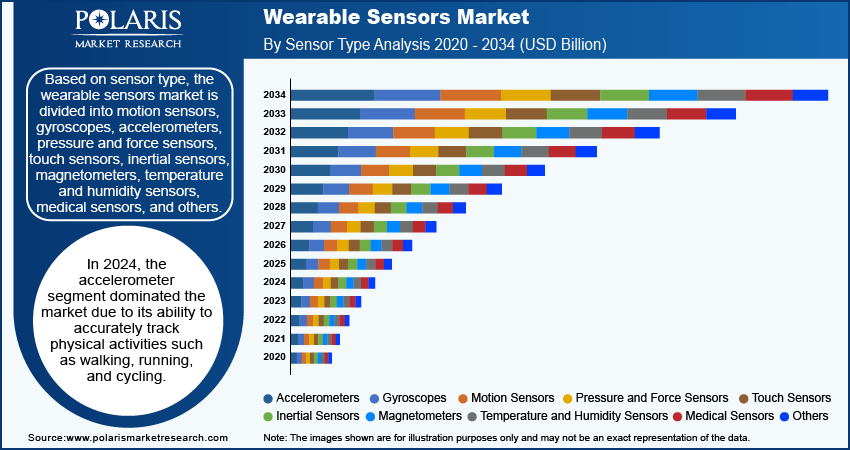
Based on sensor type, the market is segmented into motion sensors, gyroscopes, accelerometers, pressure and force sensors, touch sensors, inertial sensors, magnetometers, temperature and humidity sensors, health sensors, and others. The accelerometers segment dominated in 2025 due to its ability to accurately track physical activities such as walking, running, and cycling. They provide precise measurements of movement and orientation, enabling wearable devices to differentiate between various types of physical activity. This capability is essential for fitness enthusiasts who seek detailed insights into their performance and activity levels. Moreover, the rise of smartwatches, which generally incorporate accelerometers, has significantly contributed to the demand for these sensors.
By Device
Based on device, the market is segmented into smartwatches, fitness bands, smart glasses, smart footwear, smart socks and others. The fitness band segment is expected to experience significant growth. This growth is driven by increasing demand from young consumers for affordable fitness trackers and continuous technological advancements. In March 2023, Infineon Technologies introduced SECORA Connect X, a low-power NFC chip designed for fitness bands, rings, and smartwatches. This integrated solution enables secure contactless payments and wireless charging, ultimately enhancing user experience due to its compact size and efficiency, which boosts battery life. Such developments are expected to drive the segment growth.
Regional Insights
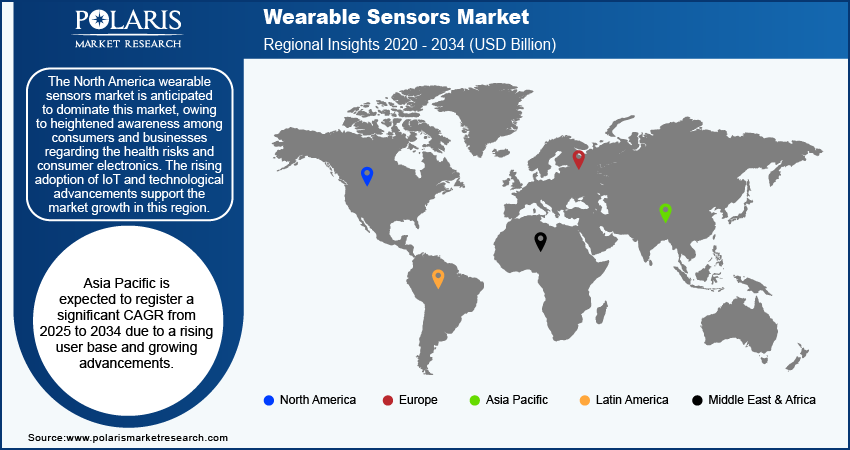
By region, the study provides insights into North America, Europe, Asia Pacific, Latin America, and the Middle East & Africa. The North America dominated the share, owing to heightened awareness among consumers and businesses regarding health risks and consumer electronics. The rising adoption of IoT and technological advancements also support the growth in this region.
The key players are merging, acquiring, and collaborating to strengthen their presence and serve better offerings in North America, further driving the market during the forecast period. The United States wearable sensors market has garnered the largest share in the region due to the rising consumer health awareness and growing healthcare sector.
The Asia Pacific wearable sensors market, is expected to register the fastest CAGR from 2026 to 2034 due to the growing user base and increasing disposable incomes. Moreover, growing urbanization, expanding e-commerce industry, and advancement in technology are propelling the growth of the region. China is expected to witness significant growth in the region during the forecast period, owing to the presence of major technology companies.
Key Players & Competitive Analysis Report
Major players are investing heavily in research and development in order to expand their product lines, which will help the market grow even more. Participants are also undertaking a variety of strategic activities to expand their global footprint, with important developments including new product launches, contractual agreements, mergers and acquisitions, higher investments, and collaboration with other organizations. To expand and survive in a more competitive environment, the wearable sensors industry must offer cost-effective items.
Manufacturing locally to minimize operational costs is one of the key business tactics used by manufacturers to benefit clients and increase the sector. In recent years, the market has witnessed some technological advancements. Major players in the include Infineon Technologies AG; Texas Instruments Inc.; Broadcom Limited; Asahi Kasei Microdevices Corporation; NXP Semiconductors N.V.; Robert Bosch GmbH; Invensense, Inc.; TE Connectivity Ltd.; Knowles Electronics, LLC; and Panasonic Corporation.
Infineon Technologies AG, headquartered in Neubiberg, Germany, is a leading global semiconductor company with around 58,000 employees. Founded as a spin-off from Siemens in 1999, Infineon specializes in semiconductor solutions across four main segments. The Automotive segment provides chips for electric vehicles, automated driving, and safety systems. The Green Industrial Power segment focuses on power semiconductors for energy generation, industrial drives, and renewable energy applications. The Power & Sensor Systems segment offers power management components, sensors, and connectivity solutions for consumer electronics and IoT devices. Lastly, the Connected Secure Systems segment delivers embedded security controllers for payment systems, government IDs, and secure connectivity. Infineon operates globally with more than 150 locations, serving regions in Europe, Asia Pacific, Greater China, Japan, and the Americas. Its innovative technologies drive advancements in electromobility, energy efficiency, and digital security, making it a key player in the semiconductor industry worldwide.
STMicroelectronics (ST) is a semiconductor company headquartered in Geneva, Switzerland, established in 1987. It designs and manufactures a variety of semiconductor products used in automotive, industrial, personal electronics, and communication applications. The company’s product range includes microcontrollers, analog and power devices, MEMS sensors, application-specific integrated circuits (ASICs), and smartcards. ST’s main business segments cover automotive systems, such as electric vehicle components and driver-assistance technologies; industrial uses, including factory automation and energy management; personal electronics, like mobile devices and wearables; and communication products, such as networking and wireless connectivity chips. The company operates manufacturing sites in Italy, Singapore, France, Morocco, the Philippines, Malta, Malaysia, and China. Its sales and marketing offices are located in more than 35 countries. The Asia Pacific region accounts for about 59% of its revenue, with the Americas and Europe making up the remainder. It recently introduced advanced wearable sensors for improved health and fitness tracking, ideal for consumer and medical applications.
List of Key Companies
- Infineon Technologies AG
- Texas Instruments Inc.
- Broadcom Limited
- Asahi Kasei Microdevices Corporation
- NXP Semiconductors N.V.
- Robert Bosch GmbH
- Invensense, Inc. (TDK Corporation)
- TE Connectivity Ltd.
- Knowles Electronics, LLC
- Panasonic Corporation
- Analog Devices Inc.
Wearable Sensors Industry Developments
- January 2025: A wearable stress-detecting system, inspired by human pain perception and developed using a silver wire network, was launched by JNCASR to enable adaptive, intelligent sensing for healthcare and robotics applications.
- May 2024: Asahi Kasei announced a new facility in Port Colborne, Ontario, Canada. This facility will be dedicated to manufacturing lithium-ion battery separators. This move demonstrates Asahi Kasei's commitment to supporting the market by improving battery technologies essential for portable and wearable devices.
- May 2024, Sensirion launched the SLD3x series, a compact liquid flow sensor platform designed for subcutaneous drug delivery. Sensirion’s customizable solutions support precise closing performance, thereby improving patient safety in therapies that require subcutaneous administration.
- May 2024: Bosch Ventures made strategic investments in cleantech, including battery recycling technologies. According to Bosch, these investments are crucial for the development and maintenance of high-performance batteries used in wearable sensors, contributing to the overall sustainability and efficiency of wearable technology.
- January 2023: Asahi Kasei Corporation unveiled the AK09940A, a 3-axis magnetic sensor designed for superior motion tracking in AR/VR and wearables. Its exceptional low noise and power consumption enhance accuracy in these applications. The sensor excels at pinpointing subtle magnetic field changes, enabling precise fault and position detection. Notably, its energy efficiency makes it ideal for battery-powered wearables and IoT devices.
- October 2023: Infineon Technologies AG introduced the XENSIV radar sensors for sleep tracking, which are integrated into wearables. They offer detailed sleep data on stages and respiration, improving user health awareness and boosting the market.
Wearable Sensors Market Segmentation
By Sensor Type Outlook
- Motion Sensors
- Gyroscopes
- Accelerometers
- Pressure and Force Sensors
- Touch Sensors
- Inertial Sensors
- Magnetometers
- Temperature and Humidity Sensors
- Medical Sensors
- Others
By Technology Outlook
- MEMS
- CMOS
- Others
By Device Outlook
- Smartwatch
- Smart Socks
- Fitness Bands
- Smart Glasses
- Smart Fabric
- Others
By End Users Outlook
- Consumer
- Healthcare
- Industrial
- Defense
- Others
By Regional Outlook
- North America
- US
- Canada
- Europe
- Germany
- France
- UK
- Italy
- Spain
- Netherlands
- Russia
- Rest of Europe
- Asia Pacific
- China
- Japan
- India
- Malaysia
- South Korea
- Indonesia
- Australia
- Vietnam
- Rest of Asia Pacific
- Middle East & Africa
- Saudi Arabia
- UAE
- Israel
- South Africa
- Rest of Middle East & Africa
- Latin America
- Mexico
- Brazil
- Argentina
- Rest of Latin America
Wearable Sensors Report Scope
|
Report Attributes |
Details |
|
Market Size Value in 2025 |
USD 2.45 billion |
|
Market Size Value in 2026 |
USD 2.94 billion |
|
Revenue Forecast in 2034 |
USD 13.02 billion |
|
CAGR |
20.49% from 2026 to 2034 |
|
Base Year |
2025 |
|
Historical Data |
2021–2024 |
|
Forecast Period |
2026–2034 |
|
Quantitative Units |
Revenue in USD billion and CAGR from 2026 to 2034 |
|
Report Coverage |
Revenue Forecast, Market Competitive Landscape, Growth Factors, and Trends |
|
Segments Covered |
|
|
Regional Scope |
|
|
Competitive Landscape |
|
|
Report Format |
|
|
Customization |
Report customization as per your requirements with respect to countries, regions, and segmentation. |
FAQ's
The wearable sensors market size was valued at USD 2.45 billion in 2025 and is projected to grow to USD 13.02 billion by 2034
The market is projected to register a CAGR of 20.40% from 2026 to 2034.
North America is anticipated to dominate the market.
The key players in the market are Infineon Technologies AG; Texas Instruments Inc.; Broadcom Limited; Asahi Kasei Microdevices Corporation; NXP Semiconductors N.V.; Robert Bosch GmbH; Invensense, Inc.; TE Connectivity Ltd.; Knowles Electronics; LLC; and Panasonic Corporation.
The accelerometer segment dominated the market in 2025.
The fitness band segment is anticipated to experience significant growth in the market.
Wearable sensors are advanced devices that monitor and collect real-time physiological and biochemical data in a non-invasive manner, integrated into smartwatches, fitness trackers, and smart clothing for health monitoring.
Key trends include sensor miniaturization through MEMS technology enabling compact, energy-efficient wearables, and growing integration of IoT and AI technologies that enhance data accuracy and expand healthcare applications.
Page last updated on:
Feb-2023
Research Methodology
A robust system of research, verification, and forecasting designed to ensure reliable and actionable market insights.
Polaris Market Research uses a clear and structured approach to deliver insights that clients can rely on. The process combines detailed primary and secondary research, including direct communication with industry experts. The detailed information helps build a complete picture of market trends and developments. Secondary data is gathered from credible sources such as industry reports, company filings, government source links, and trusted organization databases. It is then cross-checked through discussions with key stakeholders across the value chain. Market size and forecasts are developed using both bottom-up and top-down methods to ensure accuracy and consistency in the final results.
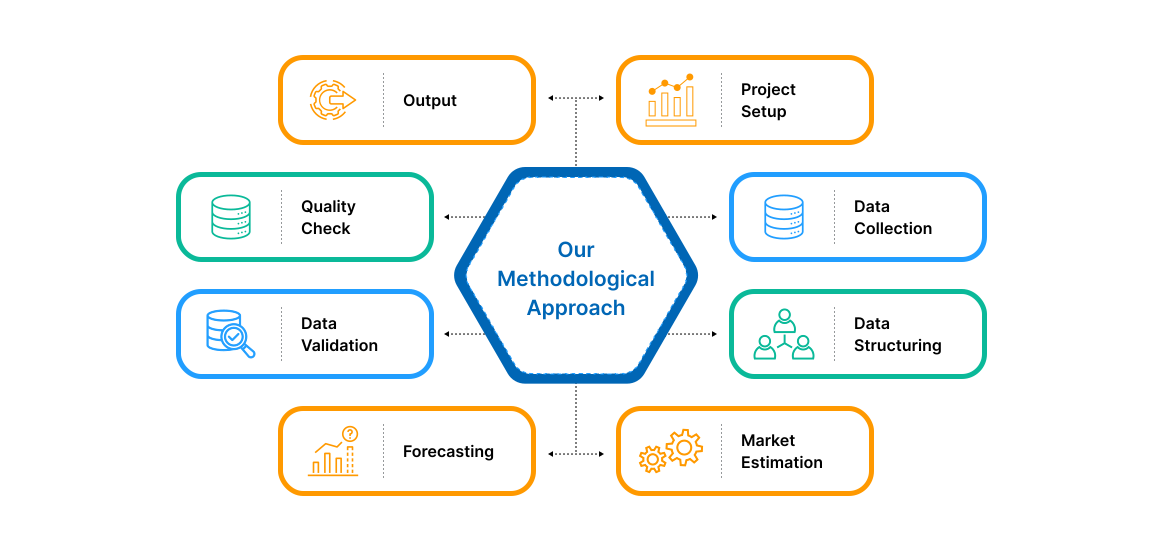
Project Setup
Step 1 & 2:
- We start every project by clearly understanding the client’s objective or goal, then defining the market scope, and aligning regions, segments, and timelines.
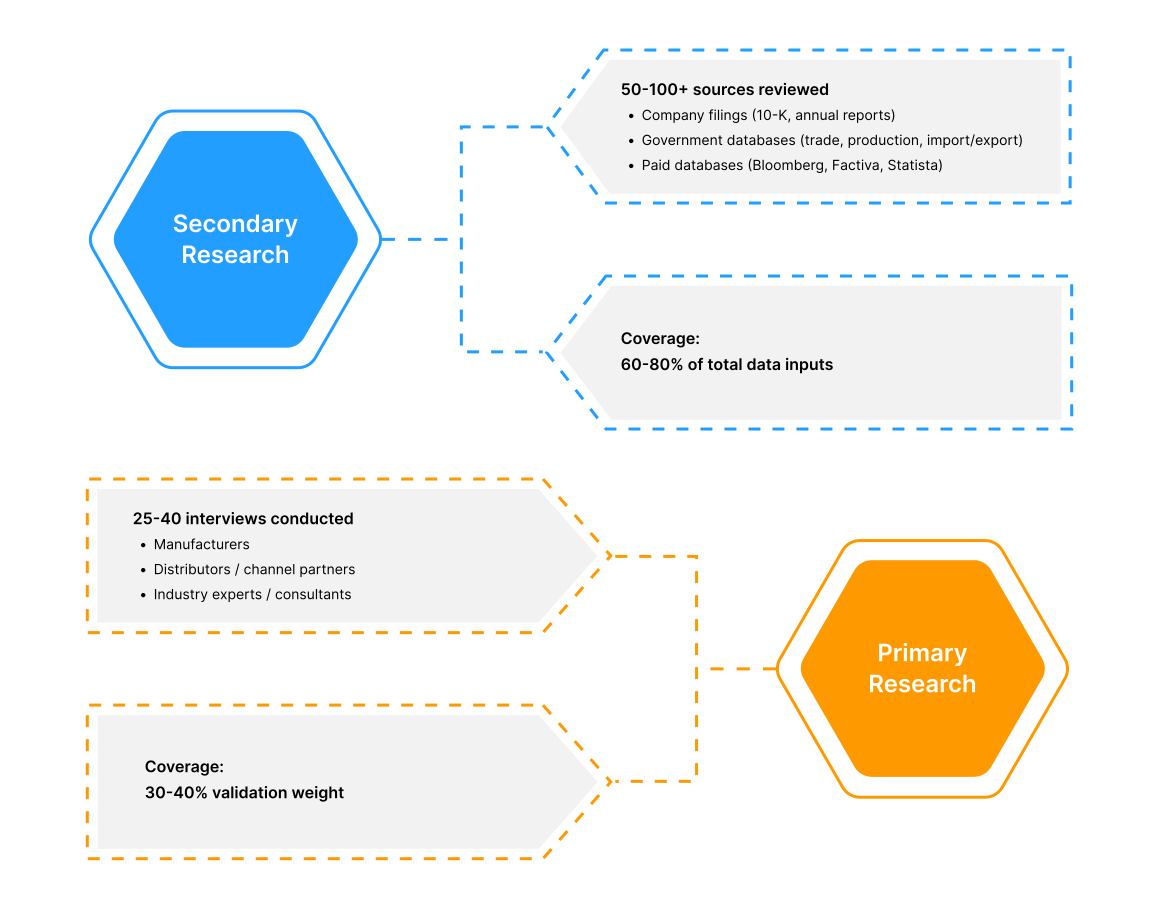
- Once the foundation is set, we collect data from all-around of sources, including company reports, government databases, and paid industry platforms.
- Our research is based on secondary data, which helps us build a strong understanding of the market across regions and industries. Then we validate this information through primary research by speaking directly with industry experts, companies, and stakeholders.
- By combining secondary and primary research, we ensure that our market insights are accurate, practical, and closely aligned with real market conditions.
Data Collection
We gather information from both public and verified sources:
Data Structuring
Step 3:
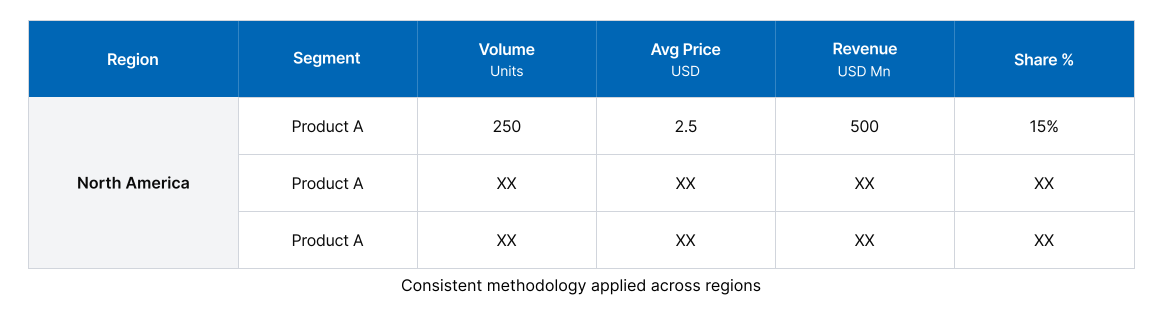
- All collected data is organized into a consistent format to ensure accurate analysis. Since inputs come from multiple sources, they are standardized and aligned before use.
- The data is segmented by product, application, and region, and mapped across a defined historical period (2020–2024). All values are converted into common units (USD Mn/Bn), and volume and pricing are aligned where required to estimate revenue.
- Any overlaps or inconsistencies are reviewed and adjusted to maintain accuracy (<5% variance threshold).
- The result is a structured dataset that allows for clear comparison across regions and supports reliable analysis and forecasting.
Structured Market Dataset, USD Mn/Bn
4. Data Structuring
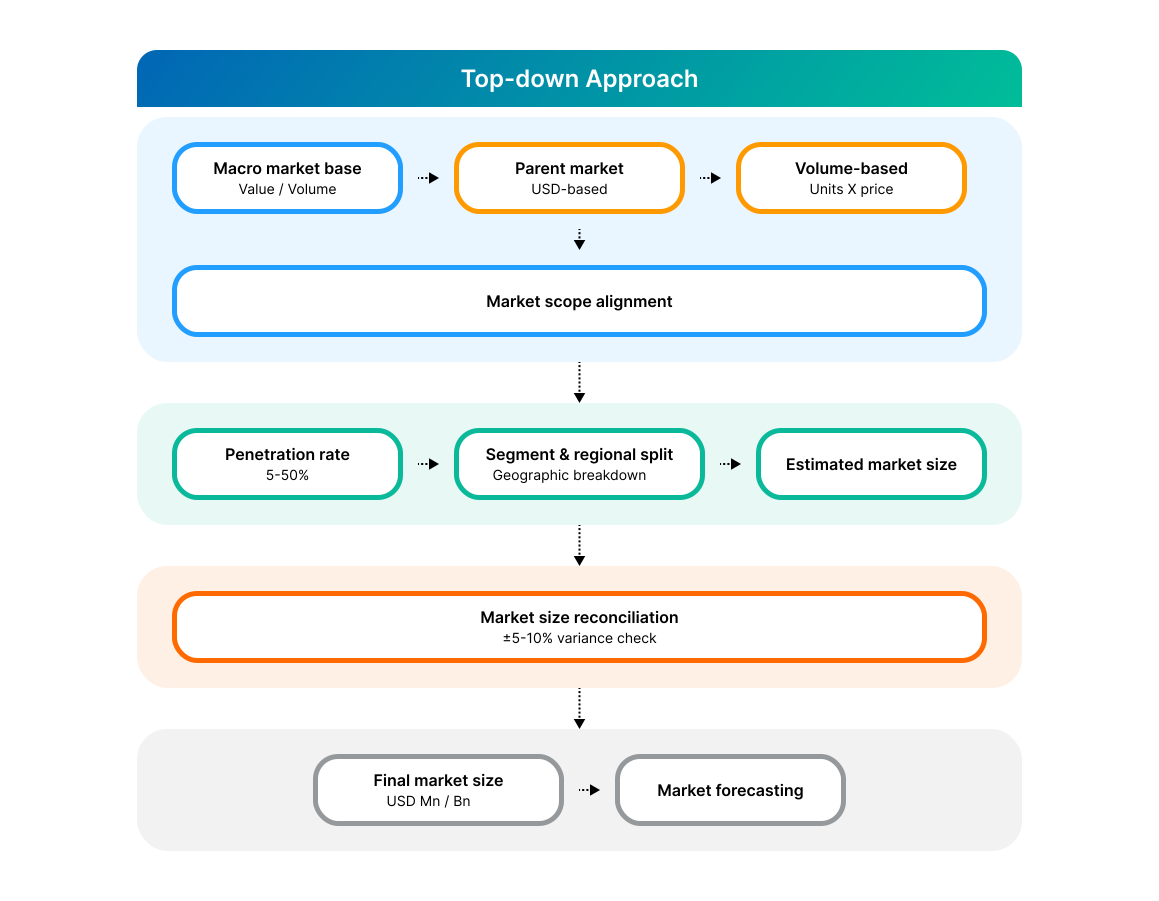
Step 4: TOP-DOWN APPROACH
- We start with the overall market size at a global or macro level.
- The market is then narrowed down based on scope and industry relevance.
- We apply penetration rates and split the data by region and segment.
- This helps us estimate the market size for specific segments.
- The numbers are validated through cross-checks to ensure accuracy.
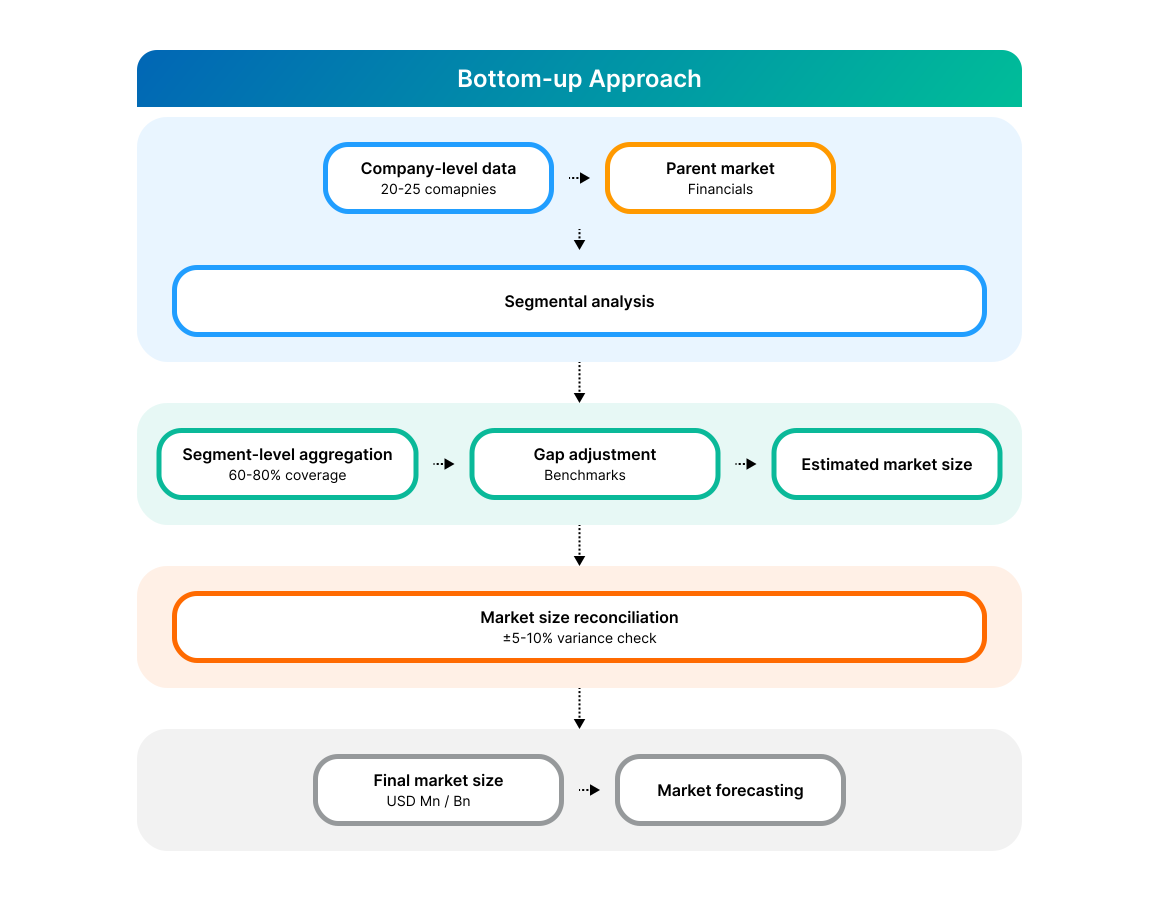
Step 5: BOTTOM-UP APPROACH
- We begin by analyzing data from leading companies in the market.
- Revenue data is collected and mapped across different segments.
- The data is then aggregated to estimate the total market size.
- To fill in any gaps, adjustments are made based on industry standards.
- Validation checks make sure that the results are correct.
5. Data Structuring
Step 6:
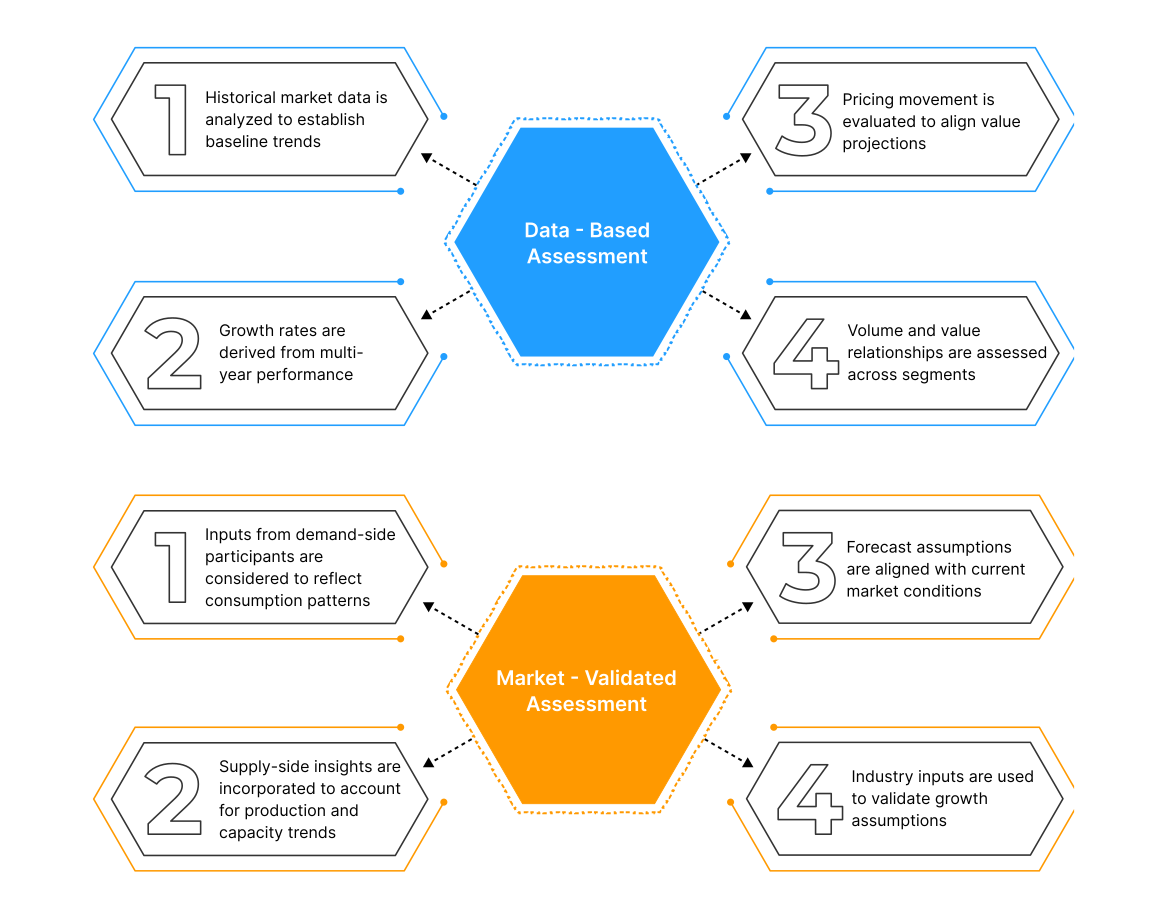
At Polaris Market Research, we employ a methodical forecasting strategy. This approach blends the analysis of historical data with real-time market validation. To forecast future trends with precision, we examine past patterns, pricing fluctuations, and the interplay of supply and demand. To ensure our conclusions reflect the present market landscape, we actively seek input from industry experts and key stakeholders.
To refine our predictions, we carefully consider critical elements such as market drivers and restraints, fluctuations in raw material costs, emerging technologies, and the production capabilities of various regions. Furthermore, we assess regulatory frameworks and potential policy shifts to gauge their potential impact on market expansion.
All this information is synthesized to generate precise forecasts for each segment and region. These forecasts illuminate the current state of the market and highlight forthcoming opportunities.
6. Data Structuring
Step 7:
In the final stage, we validate all our estimates using a triangulation method, where data is cross-checked from multiple reliable sources, like company data, primary interviews, and secondary research. This helps us make sure that our numbers are correct and fit with the rest of the market.
This process involves verifying data consistency across various segments and geographic areas. It also requires comparing historical trends with the assumptions support the forecast. Any discrepancies involve adjustments to ensure everything remains aligned and dependable.
Once the data is finalized, we prepare the final outputs, including market size estimates, segment-wise breakdowns, and growth metrics. These are delivered in structured formats such as tables, charts, and data files for easy analysis and use.
We collaborate closely with clients, ensuring the final products align with their requirements. This includes offering tailored adjustments, supplementary data analyses, and continuous assistance. Furthermore, we monitor market trends post-delivery, providing updates and refinements to maintain the insights' relevance as time passes.
Post-delivery, we continue to monitor market shifts, offering updates and adjustments to ensure the insights remain relevant over time.
Validation
Triangulation Framework
- Company-level data
- Primary inputs from industry participants
- Secondary benchmarks and published data
- Variance maintained within ±5-10%
- Adjustments applied to align estimates
- Segment values validated against overall market structure
Quality Check
Data Consistency & Integrity
- Segment totals validated to 100%
- Regional estimates aligned with global market size
- Historical trends compared against forecast outputs
- Assumptions reviewed for cross-segment and regional alignment
Output & Delivery
Final Outputs
- Market size estimates (USD Mn/Bn)
- Segment-wise distribution (%)
- Growth metrics (CAGR %)
- Structured tables and charts
- Segment-level datasets
- Excel-based data files for further analysis
Client Alignment & Support
- Deliverables are aligned with defined client requirements and scope
- Custom data cuts and segment splits are incorporated as required
- Post-delivery queries are addressed through analyst interactions
- Additional clarifications and data support are provided upon request
Client Continuity & Updates
- Market developments are tracked post-delivery to capture changes in key trends
- Updated data and revisions are provided based on new market inputs
- Additional refinements and data cuts are shared as required
- Continued analyst engagement supports evolving client requirements


