
Mosquito Repellent Market Trends, Industry Report, 2026 - 2034
REPORT DETAILS
Market Statistics
Mosquito Repellent Market Overview
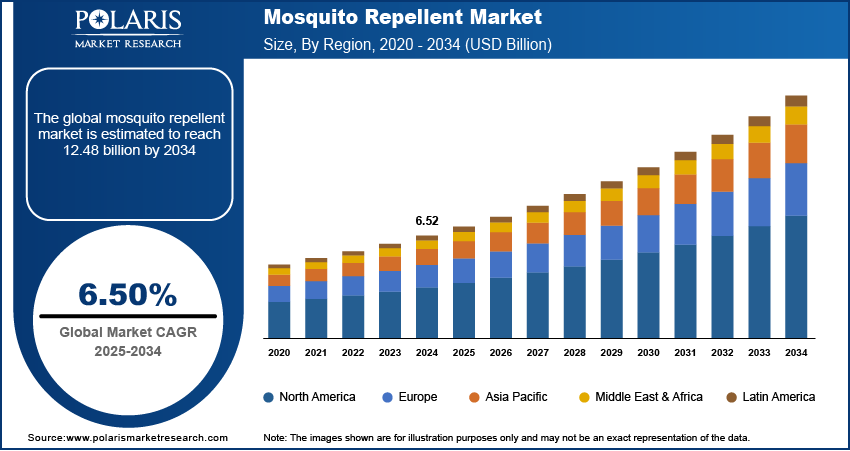
The global Mosquito Repellent Market was valued at USD 6.9 billion in 2025 and is projected to grow at a CAGR of 6.5% from 2026 to 2034. Rising awareness of mosquito-borne diseases and outdoor activities are propelling demand.
Key Takeaways
- Asia Pacific dominated the global market with a 40.48% share. The rapid evolution is basic change the landscape of global commerce.
- Within Asia Pacific, China dominated the market, with 33.21% of market. This was due to country's massive population, the widespread presence of mosquitoes, along with its robust manufacturing sector.
- Europe is projected to grow at the fastest rate of 7.6%. This surge is driven by a substantial consumer population, a high level of awareness regarding mosquito repellents, and increasing disposable incomes
Source: Polaris Market Research Analysis
Spray formats led the market in 2025, capturing 46.25% of the revenue share. This was largely because of their ease of use, rapid effectiveness, and the general consumer inclination towards convenience.- The e-commerce segment is expected to grow steadily at a CAGR of 7.4%, due to its rapid expansion to reshape global business dynamics.
Note: Figures and projections outlined in this report are the result of Polaris Market Research’s proprietary analytical processes, grounded in the latest available datasets and market observations.
Industry Dynamics
- Increased investment in R&D, along with the growing demand for herbal or chemical-free mosquito repellents, is expected to drive product demand over the next few years.
- Increasing health awareness of mosquito-borne diseases, driven by media reports and growing health concerns, is fueling the global demand for mosquito repellents.
Market Statistics
- 2025 Market Size: USD 6.9 Billion
- 2034 Projected Market Size: USD 12.2 Billion
- CAGR (2026–2034): 6.5%
- Asia Pacific: Largest Market Share in 2025
Source: Polaris Market Research Analysis
To Understand More About this Research:Download Sample Report
Mosquito Repellent Definition
Mosquito repellents are substances or products that can be applied to the skin or clothes and surroundings so as to act as a deterrent to mosquitoes and prevent them from biting. These products are common because they are helpful in preventing mosquito-transmitted illnesses like dengue, malaria, and chikungunya. Mosquito repellents are used in both residential and outdoor environments.
The growing incidence of infectious diseases such as dengue, Zika, and yellow fever that are caused by the mosquito, increasing housing waste, as well as improper waste management are the primary factors that are augmenting the industry demand.
This is a material that is designed to prevent mosquitoes from biting humans and feeding on their blood. In addition, changing environmental conditions like heavy rainfall, unstable temperature, etc., are also leading to the chances of breeding, which further acts as catalyzing factor for the industry expansion across the globe. Moreover, increasing investment in R&D activities and adoption of herbal products or chemical-free products in the mosquito repellent market is also creating product demand over the forecasting years.
Various vacant premises without pest control and undisturbed conditions were leading to a higher demand for mosquito breeding, cockroach infestation, and rodent activities. Moreover, growing health awareness and increasing spending on healthcare products are offering various growth prospects for the industry growth during this period. The growing incidence of mosquito-borne diseases is one of the chief driving factors for the industry growth. As per the World Health Organization (WHO), mosquito bites witness more than one million people to die each year. Most of the deaths among them are caused by malaria. Also, WHO projected that every year between 300 and 500 million cases of malaria occurs. In addition, the prevalence of dengue also increases and affects nearly 400 million people in a year, and some of them need to be cured under doctors' observation.
What are the Market Drivers Driving the Demand for Market?
Increasing Awareness about Mosquito-Borne Diseases
In recent years, there has been a significant surge in awareness about mosquito-borne diseases, driven by growing public health concerns, increasing incidence rates, and heightened media coverage. This heightened awareness has emerged as a crucial driver for the mosquito repellent market globally. Mosquito-borne diseases pose substantial health risks to populations worldwide, and the rising consciousness about these illnesses has propelled the demand for effective mosquito repellents and control measures. The increasing prevalence of mosquito-borne diseases, such as malaria, dengue fever, Zika virus, chikungunya, and West Nile virus, has raised public health concerns globally. These diseases cause severe illness, long-term health complications, and even death in some cases. As a result, individuals and communities are increasingly seeking preventive measures to protect themselves from mosquito bites, thus driving the demand for mosquito repellents.
Media channels, including television, radio, social media, and online platforms, play a significant role in disseminating information about mosquito-borne diseases. News reports, health advisories, and educational campaigns raise awareness about the risks associated with mosquito bites and emphasize the importance of using effective repellents. As a result, consumers are more informed about the need for mosquito protection products, driving market growth.
Governments and public health organizations worldwide are implementing initiatives and campaigns to combat mosquito-borne diseases. These efforts often include distribution programs for mosquito nets, repellents, and educational materials to vulnerable populations. By promoting awareness and preventive measures, governments contribute to the increased adoption of mosquito repellents, thereby stimulating market demand. With globalization and increased travel activity, individuals are more exposed to mosquito-borne diseases in regions where they may not have previously been prevalent. Travelers seek protection against mosquito bites to prevent contracting diseases while visiting areas with endemic mosquito populations. This heightened awareness of travel-related risks drives the demand for portable and effective mosquito repellents among travelers.
Source: Polaris Market Research Analysis
Get Full Segment-Level Forecasts & Insights: Download Sample Report
Which Factor is Restraining the Demand for the Market?
Emergence of Resistant Mosquito Strains and Competition from Alternative Solutions Hinder the Mosquito Repellent Market Growth
Continuous exposure to chemical insecticides and repellents contribute to the development of resistance in mosquito populations, rendering certain products less effective over time. Mosquito species such as Aedes aegypti and Anopheles gambiae, which transmit diseases like dengue fever and malaria, have demonstrated resilience to conventional control methods, posing challenges for mosquito management programs and necessitating the development of alternative strategies.
The mosquito repellent market faces competition from alternative mosquito control methods and products, including mosquito nets, traps, citronella candles, electronic repellent devices, and natural remedies. Consumers explore diverse options based on factors such as effectiveness, convenience, affordability, and personal preferences, thereby diluting market share for traditional repellent products and intensifying competition among industry players.
Report Segmentation
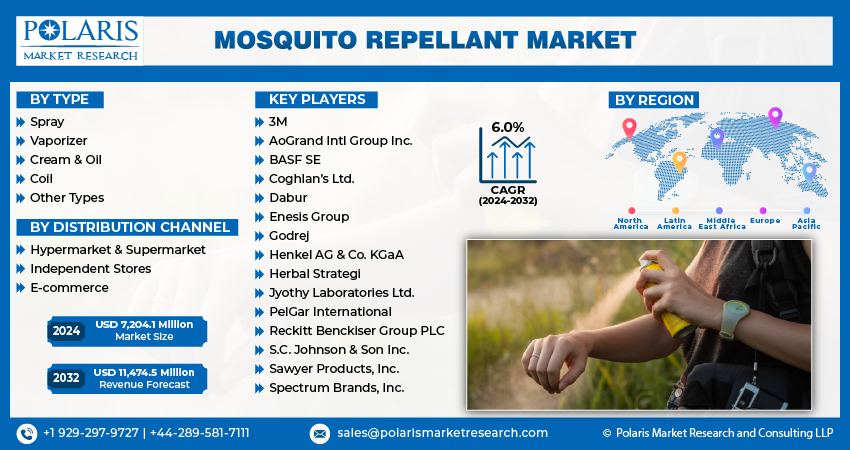
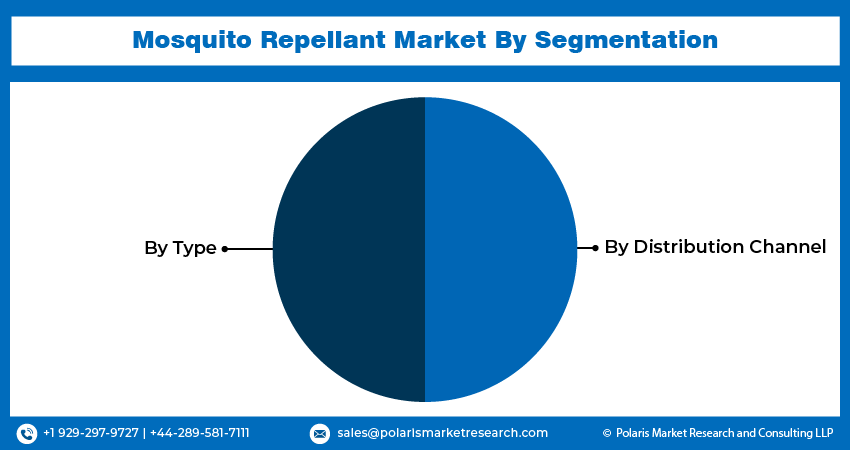
The market is primarily segmented based on type, distribution channel, and region.
| By Type | By Distribution Channel | By Region |
|
|
|
Source: Polaris Market Research Analysis
To Understand the Scope of this Report:Request Customization
Category Wise Insights
By Type Insights
Based on type category analysis, the market has been segmented on the basis of spray, vaporizer, cream & oil, coil, and other types. In 2025, the cream & oil segment has emerged as the dominant segment in the global market because consumers are increasingly seeking convenient and user-friendly mosquito repellent solutions that offer long-lasting protection against mosquito bites. Creams and oils provide a hassle-free application method, allowing individuals to easily apply the repellent to exposed areas of skin, thereby creating a protective barrier against mosquitoes.
Also, the formulation of creams and oils often includes natural ingredients such as essential oils like citronella, eucalyptus, or lavender, which are perceived as safer alternatives to synthetic chemicals by health-conscious consumers. The growing awareness about mosquito-borne diseases such as malaria, dengue, and Zika virus is driving demand for effective repellents, with creams and oils being perceived as reliable options for personal protection, especially in regions where mosquito-borne diseases are prevalent. The convenience, efficacy, and perceived safety of cream and oil-based mosquito repellents have thus propelled this segment to dominance in the global market.
| Product Form | Definition | Benefit | Applications |
| Spray | Mosquito repellent liquid that can be sprayed on the body or surroundings. | Convenient and easy to apply. | Outdoor use, travel, domestic |
| Vaporizer | Electronic equipment that disperses mosquito repellent vapor inside a closed space. | Ongoing protection of enclosed environments. | Bedroom, drawing room, office |
| Cream & Oil | Mosquito repellent cream and oil that can be applied to the body. | Safe and long-lasting protection. | Everyday use, travel, outdoors |
| Coil | Spiral-shaped mosquito repellent that is burnt slowly to produce mosquito repellent smoke. | Inexpensive and protects open or partially covered areas. | Balcony, garden, patio |
| Others | Patches, roll-ons, wrist bands, gels, and natural mosquito repellents. | Convenient and easy to carry mosquito repellents. | Children, travel, self-care |
Source: Polaris Market Research Analysis
By Distribution Channel Insights
Based on distribution channel category analysis, the market has been segmented on the basis of hypermarket & supermarket, independent stores, and e-commerce. The e-commerce segment is projected to witness a progressive growth rate of CAGR 7.4% in the forecasting years. The adoption of e-commerce trading has changed the way business is global. It is a huge platform that is rapidly growing at an ever-increasing rate.
Also, various online supplier of mosquito repellent sells their products via a digital website that facilitates consumers to find specific brands, models, or items, which boost the sales of mosquito repellent worldwide. Consequentially, increasing demand for smartphones and the rising proliferation of the internet is further fuelling the segment demand in the approaching period.
| Distribution Channel | Description | Advantage | Illustrations |
| Hypermarket/Supermarket | Large retail outlets which offer mosquito repellent along with other household items. | Accessibility and availability of multiple options of brands. | Retail chains, groceries |
| Independent Retailers | Local stores which stock repellents alongside daily use items. | Close-by availability of the product. | Local stores, Medical shops |
| E-commerce | On-line portal wherein consumers place orders for mosquito repellents using their phones. | Delivery at home and comparison shopping of prices. | Amazon, Flipkart |
Source: Polaris Market Research Analysis
Source: Polaris Market Research Analysis
Need Granular Data Across All Market Segments? Request Customization
Regional Insights
Asia Pacific
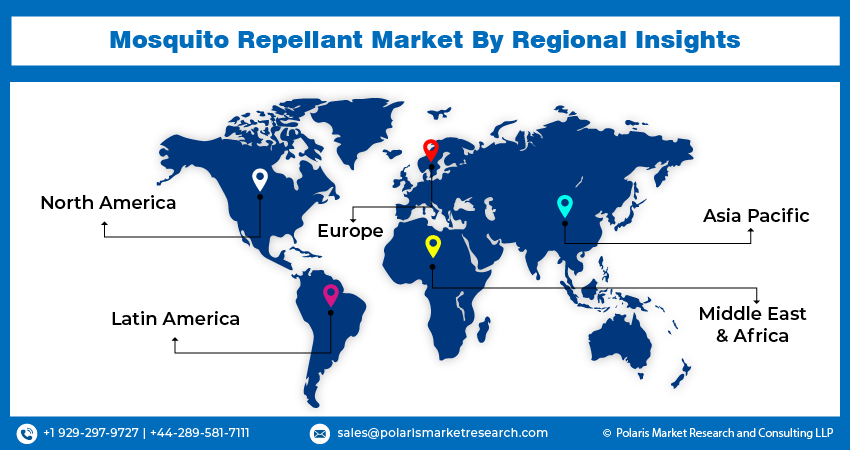
Asia Pacific accounted for the largest revenue share of 40.48% in the global market. The imposition of stringent regulatory policy for population health & hygiene and increasing healthcare spending is creating a lucrative demand for the mosquito repellent market. In addition, enhanced living standards, increasing population, and reasonable pricing of repellents have also propelled the market penetration in household goods. The surging adoption of insect repellents in usable varieties like powders, chalks, sprays, vaporizers, and others in both commercial and residential sectors are further creating productive demand for market growth across the Asia Pacific region.
Europe
The European market is anticipated to exhibit the highest CAGR of 7.6% over the forecasting years. The presence of a huge consumer base, growing awareness about the availability of mosquito repellent, as well as the rising disposable income is contributing to the market growth. Additionally, increasing incidences of mosquito-based diseases, like a virus, zika, malaria, dengue, West Nile Virus (WNV), and chikungunya, along with the growing presence of leading repellent manufacturers are also offering various growth prospects in the near future.
Source: Polaris Market Research Analysis
Curious About Regional Market Performance? Request Customization
Competitive Landscape
The market features a competitive landscape characterized by the presence of several key players striving to gain a competitive edge through product innovation, strategic partnerships, and extensive distribution networks. Established companies such as Godrej, Reckitt Benckiser Group plc, and Spectrum Brands, Inc. dominate the market with their wide range of mosquito repellent products, including sprays, creams, oils, and electronic devices. These players focus on continuous research and development to introduce advanced formulations with improved efficacy and longer protection durations, catering to evolving consumer preferences.
Some of the major players operating in the global market include:
- 3M
- AoGrand Intl Group Inc.
- BASF SE
- Coghlan’s Ltd.
- Dabur
- Enesis Group
- Godrej
- Henkel AG & Co. KGaA
- Herbal Strategi
- Jyothy Laboratories Ltd.
- PelGar International
- Reckitt Benckiser Group PLC
- S.C. Johnson & Son Inc.
- Sawyer Products, Inc.
- Spectrum Brands, Inc.
Future of Mosquito Repellent Market
The mosquito repellent industry is expected to witness consistent growth as awareness regarding mosquito-transmitted illnesses increases. Products that use natural ingredients or are skin-friendly are expected to witness continuous demand. Mosquito repellents that can be carried easily and have long-lasting effects are likely to be more popular among tourists and homeowners. Growth of cities and increased e-commerce will help drive this market.
Recent Developments
Source: Polaris Market Research Analysis
February 2026: OFF! became Major League Fishing's official mosquito and tick repellent brand. They introduced the new Deep Woods MAX aerosol, which has picaridin-based, long-lasting protection that is meant for long-term outdoor use and to get people more interested in the brand. (Source: businesswire.com)- April 2026: Grand Tongo added a 3 oz. nano-mist travel spray and a 1 oz. pocket sprayer to its line of DEET-free insect repellents. These new products are portable, lightweight, and gentle on the skin, and they meet the growing demand for high-quality, easy-to-use products that can be taken anywhere. (Source: prnewswire.com)
- June 2025: Mimikai launched its first DEET-free insect and tick repellent line, using plant-based ingredients for strong bite protection. The innovation stems from research by Michael Roe, who developed a natural active compound inspired by the wild tomato plant’s insect-repelling abilities. (Source: research.ncsu.edu)
Report Coverage
The mosquito repellent market report emphasizes on key regions across the globe to provide better understanding of the product to the users. Also, the report provides market insights into recent developments, trends and analyzes the technologies that are gaining traction around the globe. Furthermore, the report covers in-depth qualitative analysis pertaining to various paradigm shifts associated with the transformation of these solutions.
The report provides detailed analysis of the market while focusing on various key aspects such as competitive analysis, type, distribution channel, and their futuristic growth opportunities.
Mosquito Repellent Market Report Scope
| Report Attributes | Details |
| Market size value in 2025 | USD 6.9 billion |
| Market size value in 2026 | USD 7.3 billion |
| Revenue forecast in 2034 | USD 12.2 billion |
| CAGR | 6.5% from 2026 – 2034 |
| Base year | 2025 |
| Historical data | 2021 – 2024 |
| Forecast period | 2026 – 2034 |
| Quantitative units | Revenue in USD billion and CAGR from 2026 to 2034 |
| Segments covered | By Type, By Distribution Channel, By Region |
| Regional scope | North America, Europe, Asia Pacific, Latin America, Middle East & Africa |
| Customization | Report customization as per your requirements with respect to countries, region, and segmentation. |
Source: Polaris Market Research Analysis
Mosquito Repellent Market FAQ's
The global mosquito repellent market size is expected to reach USD 12.19 Billion by 2034, according to a new study by Polaris Market Research.
Key players in the market are 3M, AoGrand Intl Group Inc., BASF SE, Coghlan’s Ltd., Dabur, Enesis Group, Godrej, Henkel AG & Co. KGaA
Europe contribute notably towards the global Mosquito Repellent Market with CAGR 7.6%
Mosquito Repellent Market exhibiting the CAGR of 6.50% during the forecast period
The Mosquito Repellent Market report covering key segments are type, distribution channel, and region.
Mosquito repellent is a product used to keep mosquitoes away and prevent bites.
Common types include sprays, creams, coils, vaporizers, patches, and oils.
Mosquito repellents emit substances or smells that mosquitoes dislike. This helps in driving them away.
Yes, many plant-based repellents can be effective. But duration may differ from one to another.
Download Sample Report of Mosquito Repellent Market
Please fill out the form to request a customized copy of the research report.


