
U.S. Dental Implants Market Trends, Size, Growth Report 2026-2034
REPORT DETAILS
Market Statistics
Market Overview
The U.S. dental implants market size was valued at USD 1.69 billion in 2025. It is projected to account for a CAGR of 11.5% between 2026 and 2034. The growth of the United States dental implants market is driven by the increasing population of elderly people experiencing tooth loss and seeking effective replacement treatments. In addition, increasing awareness of oral health is prompting individuals to consider various dental replacement treatments. The increasing trend of preventive and cosmetic dental treatments is also boosting demand for dental implants.
The increase in the use of dental implants as a treatment option in the U.S. is also due to the growth of digital dentistry. This is because digital dentistry, which includes 3D imaging, computer-guided dental implants, and CAD/CAM, enhances dental implant outcomes, thereby increasing patient satisfaction. This makes dental implants a preferred treatment option for tooth restoration, making them a leading choice in the dental implant industry U.S.
Key Insights
- The endosteal implants segment accounted for 49.80% revenue share in 2025. This is because they serve as artificial roots that anchor prosthetic teeth such as crowns or bridges.
- The plate form segment is projected to witness rapid growth during the projection period. Plate-form implants are particularly suitable for individuals with weaker jaw structures.
Industry Dynamics
- The rising use of titanium and titanium alloys dental implants in various therapeutic areas is driving market growth.
- The growing demand for prosthetics for oral rehabilitation is fueling market expansion.
- An increase in demand for specialized materials like antibacterial-coated implants is expected to create a number of market opportunities.
- The high cost of dental implants may hinder market development.
Market Statistics
2025 Market Size: USD 1.69 billion
2034 Projected Market Size: USD 4.49 billion
CAGR (2026–2034): 11.5%
Source: Polaris Market Research Analysis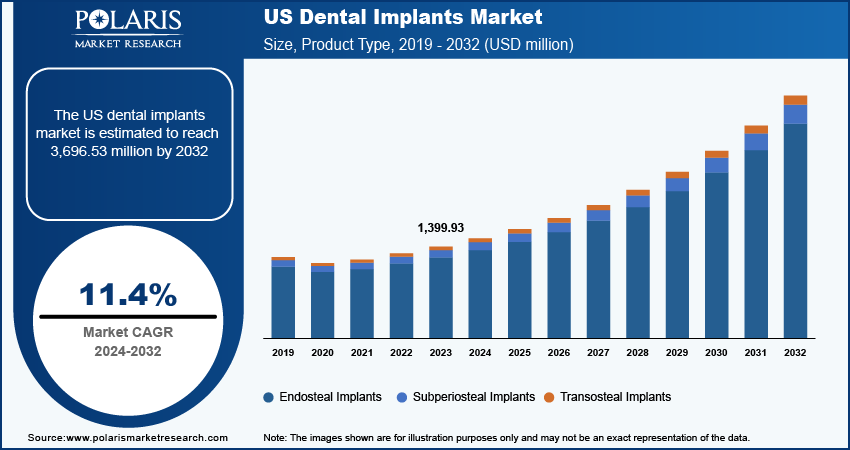
To Understand More About this Research:Download Sample Report
Technological advances in implants, materials, and techniques have improved outcomes. Dental implants are more accessible and appealing to patients who need a long-term dental solution. Dental implants are a common dental restoration in the U.S. for patients who are missing teeth. They are used in supporting different types of dental prosthetics, such as dentures and crowns. Dental implants are an effective solution for patients who need dental restoration.
Additionally, the dental industry estimates that over 5 million dental implant procedures are conducted every year within the U.S. This is a result of the increasing acceptance of dental implants as a restorative treatment option, both by patients and dentists. The use of minimally invasive dental implant procedures, as well as the success rate of dental implants, are also contributing factors to the market growth.
The increase in tooth loss among individuals due to periodontal diseases is also having a major impact on society. As more people are experiencing this problem, there is a higher willingness among them to invest in dental implants, which is a viable solution for this problem. The availability of high-quality services and technology is also increasing patients' confidence, thereby driving higher demand for implants.
The high costs of dental implants may also be a barrier for potential patients, as these treatments require a significant financial commitment. In addition, the low insurance payouts for these treatments can affect the affordability of essential treatments. Finally, risks associated with dental implant surgery, such as complications and further tooth loss, may make potential candidates hesitant. Overcoming these challenges would present several opportunities in the market.
U.S. Dental Implant Procedure Statistics and Demand Trends
The demand for dental implants is increasing in the U.S. due to the increasing tooth loss and periodontal disease. According to the American Academy of Implant Dentistry, nearly 178 million people are missing at least one tooth, while 40 million adults are completely edentulous. This huge patient pool has resulted in a high demand for dental implants as a tooth replacement option.
Additionally, the increasing trend of cosmetic dentistry and awareness of oral health care among elderly individuals are contributing factors to the increasing demand for dental implants in the U.S. Dental implants are becoming more popular compared to removable dentures due to their durability, easy chewing, and natural appearance.
U.S. Dental Implants Market Drivers and Trends
Expanding Applications of Titanium & Titanium Alloys Dental Implants in Various Therapeutic Areas
Titanium and titanium alloy dental implants are used to replace missing teeth in the U.S. They also support dental prostheses such as crowns, bridges, and dentures. Titanium implants are the most commonly used dental implants. This is due to their high biocompatibility with the human body. The implants are strong and durable. The implants also exhibit good osseointegration. This is the implant's ability to bond with the jawbone. This strong connection helps provide long-term stability. It also contributes to high treatment success rates.
With a rapid increase in the elderly population, it is estimated that 27% of the population aged 75 and above are edentulous (toothless). This shows the need for strong, compatible dental implants, such as titanium dental implants. Furthermore, innovations in the surface treatment/coating of dental implants improved bone integration and reduced healing time. This is contributing to the use of titanium dental implants in the country.
Increasing Demand for Prosthetics
Dental implants are becoming increasingly essential for oral rehabilitation, thereby greatly contributing to the restoration of oral function and facial aesthetics. The American Academy of Implant Dentistry states that over 15 million people in the U.S. have bridge and crown replacements for their missing teeth. This has contributed to the need for dental implants.
The acceptance of dental implants is increasing among both patients and dental surgeons. The reason for this increased acceptance is the limitations of removable prosthetics, which include discomfort, unnatural appearance, and maintenance needs. Dental prosthetics attached to implants do not affect the soft tissues and are also aesthetically acceptable. All these factors are expected to boost the growth of the U.S. dental implants market.
Dental Implant Cost and Pricing Analysis in the U.S.
The cost of dental implant surgery in the U.S. is another significant factor that affects the rate of dental implant adoption. The average cost of a dental implant surgery ranges from USD 3,000 to USD 5,000. This is based on the complexity of the dental implant surgery. The cost is also determined by the material used for the dental implant.
The lack of insurance for dental implants is another significant factor that has impacted the patient's access to dental implants. However, increased insurance coverage and flexible financing options are expected to improve dental implant affordability.
Technology Innovations in the U.S. Dental Implant Industry
Technological developments are playing a significant role in the transformation of the U.S. dental implants industry. Digital dentistry U.S. solutions, including intraoral scanners, AI dental implant planning tools, and computer-guided dental implants, are helping improve the precision and efficiency of dental implants.
In addition to that, the application of 3D printing in the manufacture of implants is providing the opportunity to create customized implant solutions that will fit the anatomy of the patients. This is expected to enhance the success rate of the procedures, hence the market growth in the U.S.
Source: Polaris Market Research Analysis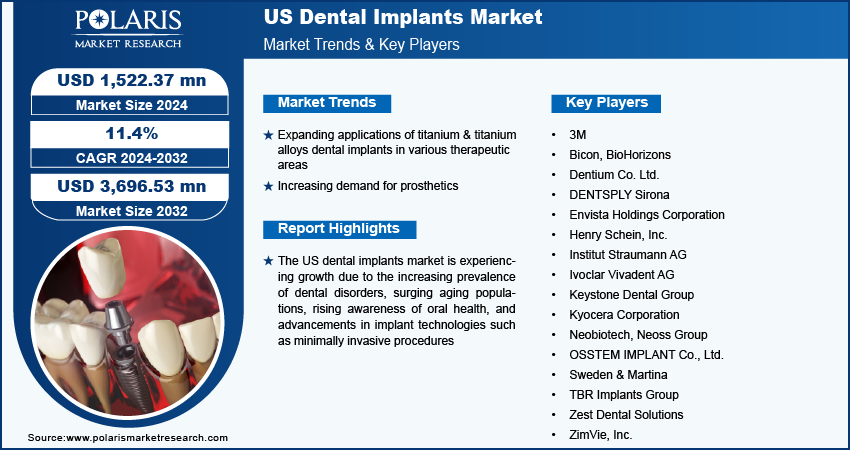
Get Full Segment-Level Forecasts & Insights: Download Sample Report
U.S. Dental Implants Market – Segment Insights
Product Type-Based Insights
The U.S. dental implants market, based on product type, is segmented into endosteal implants, subperiosteal implants, and transosteal implants. The endosteal implants segment accounted for 49.80% revenue share in 2025. The endosteal implants segment accounted for 49.80% revenue share in 2025. Endosteal implants are dental implants surgically placed in the jawbone. The implants are recognized as artificial roots used to support prosthetic teeth. Dental implants are constructed from biocompatible materials such as titanium and are used to support osseointegration, in which the bone and implant fuse for the support of prosthetic teeth. The rising prevalence of dental conditions such as tooth decay and gum disease, coupled with an aging population, is driving an increase in dental restoration procedures.
In recent times, advancements in implant design and materials, as well as the use of technologies like 3D imaging and computer-guided surgery, have helped to enhance the accuracy and reliability of dental implant procedures. Patients also prefer endosteal implants due to their resemblance to natural teeth. Moreover, minimally invasive procedures help to ensure quick recovery times for patients. Overall, awareness of the importance of oral health is helping to drive the use of endosteal implants as a long-term tooth replacement option.
Procedure-Based Insights
The U.S. dental implants market, based on procedure, is bifurcated into root form and plate form. The plate form segment is expected to witness significant growth during the forecast period. A plate form implant is used when the jawbone lacks sufficient width or length to support a root form implant. The plate form implant is flat and elongated. It is placed directly on top of the jawbone, covered by the gums. The bone and soft tissue naturally cover this type of implant. This makes it stable and securely attached.
Plate form implants have a successful history. Plate form implants are able to disperse the masticatory forces over a greater area of the jaw compared to screw-type implants. This has made these implants particularly useful for people who have weaker jaw structures. Plate form implants can help people with weaker jaw structures bypass the bone grafting procedures that are usually required to strengthen the jaw to support the screw-type implants. After the implant anchor is in position, the artificial tooth can usually be securely attached to these implants. All these factors have increased the demand for plate form implantation procedures.
Source: Polaris Market Research Analysis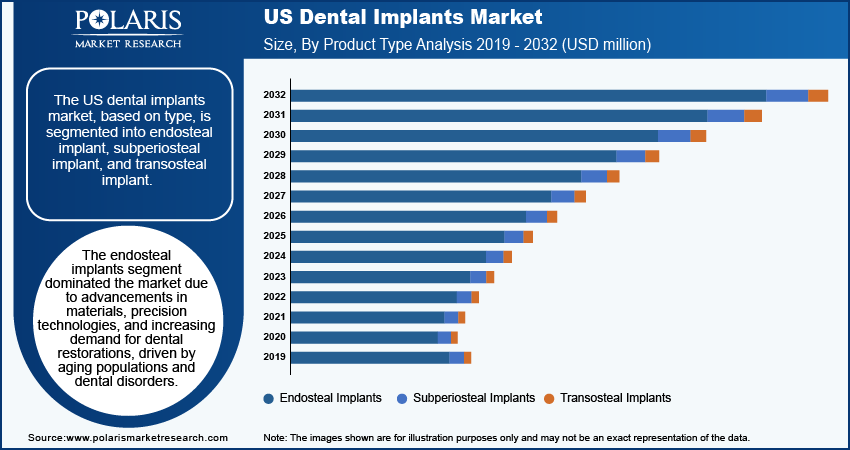
Need Granular Data Across All Market Segments? Request Customization
Key Players and Competitive Insights
The major players are investing more in research and development to increase the variety of products, which is expected to boost the growth of the U.S. dental implants market in the near future.
Dental implant companies U.S. are focusing more on digital dentistry solutions, implant navigation systems, and AI-based treatment planning, which can improve the results for dental implants. Strategic alliances are helping the dental implants industry expand its customer base for the U.S. dental implants market. Major players in the market are Ivoclar Vivadent AG; Keystone Dental Group; Dentium Co. Ltd.; Neobiotech; OSSTEM IMPLANT Co., Ltd.; Institut Straumann AG; Sweden & Martina; TBR Implants Group; Zest Dental Solutions; ZimVie, Inc.; 3M; Kyocera Corporation; Neoss Group; Bicon; BioHorizons; Envista Holdings Corporation; DENTSPLY Sirona; and Henry Schein, Inc.
In addition, the major players are using different strategies, such as product launches, partnerships, mergers, more investments, and collaborations with other firms, to boost the dental implant market share U.S.
Osstem Implant Co., Ltd. is a South Korean healthcare company that offers dental implant products and training programs. The company has operations in over 70 countries with 21 subsidiaries and 70 sales networks. Its KS implant system offers excellent stability and ease of use for both patients and dentists. The system also offers various features such as a hexagonal connection system and a 15-degree Morse taper design, which can be beneficial for increasing the longevity of the implant while also effectively managing stress. The system can also be beneficial for planning prosthetics and managing inventory.
Neobiotech, established in 2000, delivers a broad spectrum of dental implant, restoration, and digital dentistry solutions. Their product and educational portfolio span almost 70 worldwide locations. Neobiotech announced in August 2023 the introduction of a new 'Tick-Tock Implant.’ The new implant is a revolutionary prosthetic system that makes attachment easier and the procedure more aesthetically pleasing. It also reduces surgery time and eliminates inflammation during implant attachment compared to screw-attachment techniques.
List of Key Companies
- 3M
- Bicon
- BioHorizons
- Dentium Co. Ltd.
- DENTSPLY Sirona
- Envista Holdings Corporation
- Henry Schein, Inc.
- Institut Straumann AG
- Ivoclar Vivadent AG
- Keystone Dental Group
- Kyocera Corporation
- Neobiotech
- Neoss Group
- OSSTEM IMPLANT Co., Ltd.
- Sweden & Martina
- TBR Implants Group
- Zest Dental Solutions
- ZimVie, Inc.
Regulatory Landscape for Dental Implants in the United States
In the United States, dental implants are controlled by the Food and Drug Administration as medical devices. The manufacturers are required to comply with stringent regulations during the production of the devices. This involves classifying, testing, and seeking approval for the devices before launching a new dental implant system into the market.
The regulatory standards for dental implants in the United States are essential to the safety, efficacy, and reliability of dental implants used in dental restoration procedures within the U.S. dental care system.
Industry Developments
June 2025: ZimVie Inc. launched its RealGUIDE Dental Implant Software Suite and Implant Concierge service in Japan. According to ZimVie Inc., the launch will expand access to an integrated digital implant ecosystem that supports end-to-end workflows from planning to placement. It marks a key milestone in its largest APAC market.
October 2023: Dentsply Sirona launched the SureSmile Simulator. The simulator is an AI-driven application in DS Core. It offers 3D visualizations for confident SureSmile Aligner treatment decisions.
November 2022: 3M announced the launch of its innovative therapeutic product, 3M Filtek Matrix. The company stated that the product has been developed to increase the predictability of composite placement for dentists while providing a cost-effective option for their patients.
June 2022: Ivoclar announced the launch of a new product called VivaScan, which is a portable intraoral scanner for dentists. This product provides dentists with efficient digital impression solutions for a better patient experience.
U.S. Dental Implants Market Segmentation
By Product Type Outlook (Revenue, USD Billion, 2021–2034)
- Endosteal Implants
- Subperiosteal Implants
- Transosteal Implants
By Procedure Outlook (Revenue, USD Billion, 2021–2034)
- Root Form
- Plate Form
By Material Outlook (Revenue, USD Billion, 2021–2034)
- Titanium
- Zirconia
- Ceramic
- Others
By Design Outlook (Revenue, USD Billion, 2021–2034)
- Tapered
- Parallel
By Age Outlook (Revenue, USD Billion, 2021–2034)
- Geriatric
- Middle Age
- Adults
- Others
By End-Use Outlook (Revenue, USD Billion, 2021–2034)
- Dental Clinics
- Hospital
- Dental Academics & Research Institute
- Dental Laboratories
U.S. Dental Implants Market Report Scope
| Report Attributes | Details |
| Market Size in 2025 | USD 1.69 billion |
| Market Size in 2026 | USD 1.88 billion |
| Revenue Forecast by 2034 | USD 4.49 billion |
| CAGR | 11.5% |
| Base Year | 2025 |
| Historical Data | 2021–2024 |
| Forecast Period | 2026–2034 |
| Quantitative Units | Revenue in USD billion, and CAGR from 2026 to 2034 |
| Report Coverage | Revenue Forecast, Market Competitive Landscape, Growth Factors, and Trends |
| Segments Covered |
|
| Competitive Landscape | U.S. Dental Implants Industry Trend Analysis (2025) Company profiles/industry participants profiling include company overview, financial information, product/service benchmarking, and recent developments |
| Report Format | PDF + Excel |
| Customization | Report customization as per your requirements with respect to countries, regions, and segmentation. |
Source: Polaris Market Research Analysis
U.S. Dental Implants Market FAQ's
The U.S. dental implants market stood at USD 1.69 billion in 2025. The market is projected to reach USD 4.49 billion by 2034.
The market is projected to account for a CAGR of 11.5% beween 2026 and 2034.
The market for dental implants in the U.S. is primarily driven by the rising prevalence of periodontal diseases and the increasing adoption of cosmetic dentistry procedures.
According to the American Academy of Implant Dentistry, over 5 million dental implant procedures are performed each year in the United States. This number continues to rise as dental implants become the preferred treatment option for replacing missing teeth.
Titanium is widely used for dental implants. It has excellent biocompatibility and can integrate with the jawbone through a process called osseointegration.
The average cost of dental implants in the U.S. ranges from USD 3,000 to USD 5,000 per implant. The cost is based on factors such as implant material and surgical complexity.
The endosteal implants segment dominates the market. This is because they provide strong support for dental prosthetics.
Major players in the market are Ivoclar Vivadent AG; Keystone Dental Group; Dentium Co. Ltd.; Neobiotech; OSSTEM IMPLANT Co., Ltd.; Institut Straumann AG; Sweden & Martina; TBR Implants Group; Zest Dental Solutions; ZimVie, Inc.; 3M; Kyocera Corporation; Neoss Group; Bicon; BioHorizons; Envista Holdings Corporation; DENTSPLY Sirona; and Henry Schein, Inc.
Technological innovations are making dental implant procedures more efficient. They are also improving their success rates.
The market faces challenges such as the high cost of implant procedures and limited insurance reimbursement.
Download Sample Report of U.S. Dental Implants Market
Please fill out the form to request a customized copy of the research report.


